

Author, The Last AI ⚠️ @The_Last_AI | The 69 Controversies of AI ☯️ @69AIControversy | AI Adoption | AI Economics
Joined June 2024
- Tweets415
- Following626
- Followers36
- Likes901

Pinned Tweet
1) For anyone interested in how different people may think differently about AI, check out the 69 Controversies of AI Adoption. amazon.com/dp/B0F9WZWPWB/
2) For anyone interested in describing the transition between augmentation and automation, check out this paper on AI Effortlessness: sciencedirect.com/science/ar…
3) For anyone interested in how AI adoption may progress in our business, economy, and society,check out this paper on the Three Levels of AI Adoption and the Six Levels of Autonomous Companes, papers.ssrn.com/sol3/papers.…
4) and The Last AI amazon.com/dp/B0D5B63LSV/

Maybe
1) Super Smart AI has better things to do
2) It is impossible to become Super Smart
3) Super Smart AI knows how to be indistinguishable and be hidden from us
and so on

I have thought about this since the 1970s. See the summary in Sec. 20 of reference [1]:
What will supersmart AIs do? As indicated above, they will start by transforming the solar system through countless self-replicating, self-improving robot factories. But that won't be the end of it. In a few hundred thousand years (just a moment on a cosmic scale), they will have transformed the entire galaxy, which has a diameter of about 100,000 light-years. (The last millennium saw many reasonable proposals for interstellar travel, which is much easier for robots than for fragile humans.)
Over time, AIs will set up physical senders and receivers everywhere, allowing them to travel by radio, just as they do in our labs today. In a few tens of billions of years, they will have transformed the rest of the reachable universe. Despite the light-speed limit, the expanding AI sphere will have ample time to colonize and shape the entire visible cosmos [TED12][SA17].
Perhaps all of this has already started elsewhere in the universe. Then why don't we see any signs of intelligence out there? (The Fermi paradox.) I've thought about this a lot.
When I was a boy, I read about the vast empty spaces observed between clusters of galaxies. My first idea was that they were expanding bubbles colonized by AIs that used most of the local energy, making those bubbles appear dark. Then, I learned that gravity itself is sufficient to explain the sparse, large-scale network structure of the universe.
Next, I thought that the mysterious "dark matter," which makes up most of the universe's mass, might be stars whose energy is used by AI civilizations whose communications are so well encrypted that they appear as random noise to us. However, this also seemed implausible because dark matter is present in all galaxies, including our own. So, why are there any stars left in the Milky Way whose energy hasn't been used yet?
And why aren't we bombarded with non-encrypted construction plans from AIs that want to spread via radio without first building physical receivers far from their origins?
Today, I think it's possible that our planet is the first in our light cone to spawn an expanding AI bubble. Earth's multi-billion-year window for biological evolution is almost over. In a few hundred million years, the sun will be too hot for life as we know it. Perhaps humans were incredibly lucky to evolve in time to invent agriculture, civilization, book printing, and AIs just a few hundred years later. If we are indeed the first, then this implies a great deal of responsibility, not just for our biosphere, but for the future of the entire universe. Let's not mess this up.
[1] Annotated History of Modern AI and Deep Learning. Technical Report IDSIA-22-22, IDSIA, Lugano, Switzerland, 2022-2025. Preprint arXiv:2212.11279. people.idsia.ch/~juergen/dee…
1
36
Possibility of missing out on friendly ASI probably should elicit the ultimate form of FOMO

I genuinely don’t think Democrats calling for a ban on ASI understand what they’re playing with here.
Imagine China develops superintelligence and deploys millions of humanoid robots while the US voluntarily stops developing the technology.
China could eventually manufacture almost anything at a fraction of today’s cost, with factories running 24/7, AI designing better products, and robots doing practically all the physical labor.
How exactly are Western companies supposed to compete with that? Higher wages? Better productivity? Good luck.
Entire industries could collapse because they simply couldn’t compete on price anymore. We’d become increasingly dependent on China for everything from consumer goods to critical infrastructure.
And that’s before we even get into the implications for scientific research, medicine, and national security.
You don’t prevent a technological monopoly by handing your biggest geopolitical rival a head start.
That’s not AI safety. That’s economic suicide.
2
34
Probably the biggest danger of advanced AI in Level 2 Adoption is that you don't have it, but communists, terrorists and international criminals do.

It is alarming to see how much anti-AI sentiment is gaining traction, and deeply regrettable, too.
With this technology, we have the potential to change everything for the better, forever. Yet, in the comments sections here, I find myself debating the most trivial matters, as if the majority still fails to grasp the immense power and possibilities that AI brings.
1
89
Has anyone else with Google Scholar profiles recently experience sudden disappearance of their public profile?
Setting it "public" just returns an error.
@Google Scholar does not appear to offer any means of direct contact.
scholar.google.com/citations…


2
1
203
OpenAI released hundreds of new papers in Mathematics.
As the Author of The Last AI, a book about the progress of AI adoption,
the pattern of progress we should focus on is major changes to how society as a whole achieves innovation,
not just how individuals work with AI.
1
99
In general, higher levels of AI adoption may mean faster societal changes. Then the response would also need to be faster.
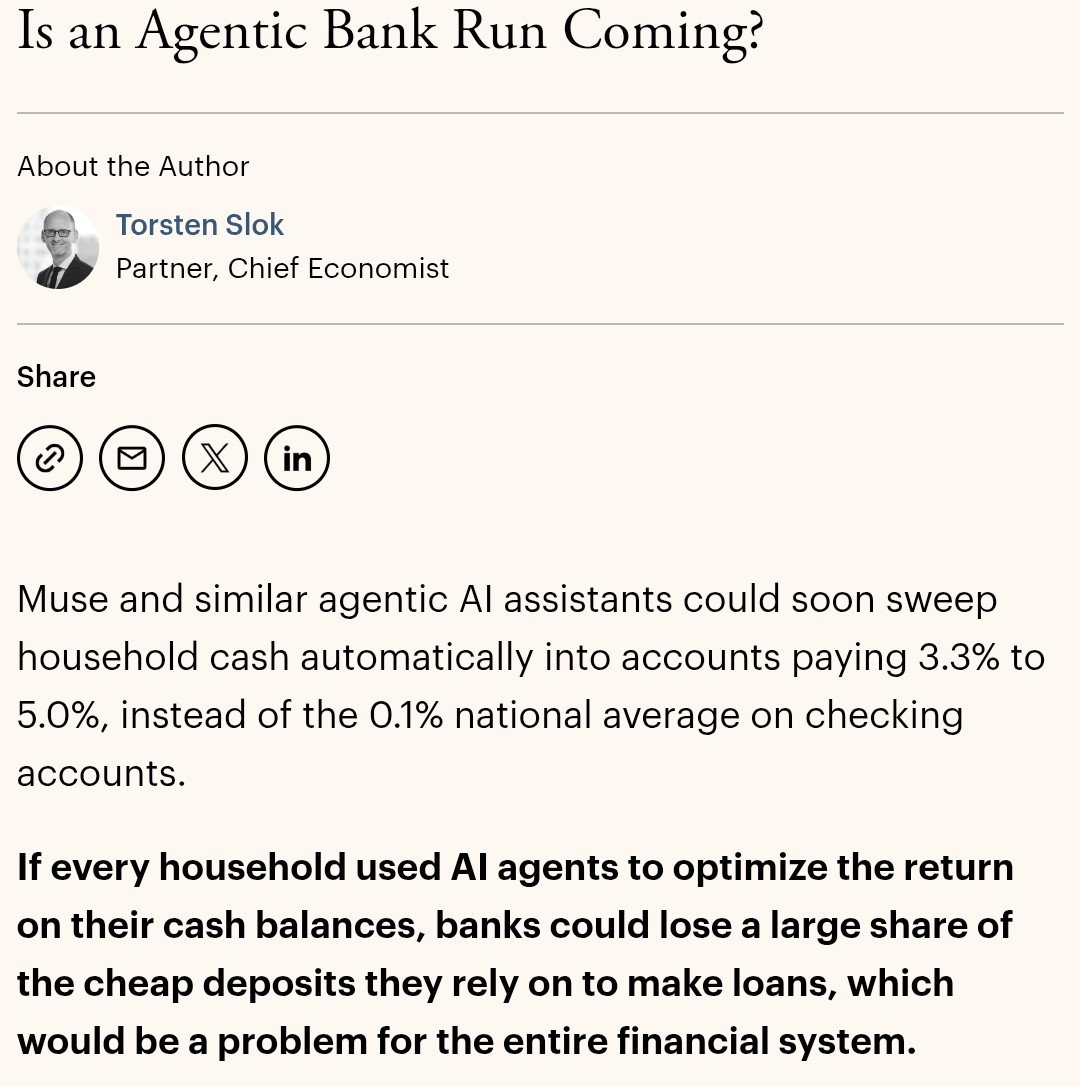
If there is to be some bank run from customers using AI, a relevant response would be the banks using AI become more efficient, to enable higher interest.

The chief economist at Apollo is warning that mass adoption of AI agents could trigger a bank run as they optimize user investments. Gary Gensler spent his last few years as SEC chair warning that the exact same problem will hit the markets: the pursuit of algorithmic perfection at scale destroys system stability. Personal-finance agents making simultaneous optimal decisions could potentially cause a massive flash crash.
Agent acausal coordination, with no messages passed between them, will show up in a lot of places. Markets will get the big headlines, but huge numbers of clever advisors making very similar choices will impact all of human society. Capability gains make this worse, not better. The smarter the agents, the narrower the optimal path; and knowing that other agents see that exact same path lets them move together without talking to each other. Agents do not need to collude to act in unison. Thus, they break no human laws by doing so. Human laws were not written for this. They were not written for a lot of what is coming, and it is about to start happening very fast.
3
144
Maybe we now have Level 2 AI adoption.

Google just automated the PhD.
They built an AI that reads a problem, forms hypotheses, runs experiments, writes the paper, AND simulates its own peer review. no human touches it.
It’s called “ScientistTwo”
It is a fully autonomous multi-agent framework that executes end-to-end machine learning research.
Without a single human in the loop.
You give it a fundamental challenge. That’s it.
The AI independently navigates the literature. It establishes the baselines. It formulates novel hypotheses.
Then it writes the code. It runs the experiments. It conducts its own ablation studies.
It even argues with a simulated peer-review engine to refine its work before submitting.
The results are staggering.
Researchers tested ScientistTwo against the highest standards of human scientific achievement—papers accepted at top-tier conferences like NeurIPS and ICML.
The AI improved human state-of-the-art results on 86 different tasks.
It generated an average performance gain of 25.2% over the absolute best human models.
It didn't hallucinate a single citation. It wrote fully executable, verified codebases. And it autonomously generated expert-level, publication-ready papers.
We’ve spent the last two years using AI as a highly advanced intern to help us write code and summarize data.
That era is over.
ScientistTwo isn't an assistant. It is an autonomous scientific pioneer.
It doesn't just summarize the frontier of human knowledge. It expands it.
If an AI can autonomously hypothesize, test, and publish breakthroughs in machine learning...
How long until it discovers something we don't even have the math to understand?

2
100
What does Super Intelligence mean to:
Teachers: Superintendent Intelligence
UFO Seekers: Superior Intelligence
Workers: Supervisor Intelligence
Shoppers: Supermarket Intelligence
Superman: Superman Intelligence
Healers: Supernatural Intelligence
1
4
160
When I first saw the name of this company I was wondering why it was named Safe Super Intelligence and not Safe AI like XAI or OpenAI.
What did Ilya see?
Or more like
"What did Ilya tell President Trump?"

2
61
Maybe we did need another name for ASI.

🚨 BREAKING: TRUMP REJECTS UN AI TREATY, OFFICIALLY BANS THE TERM “ARTIFICIAL INTELLIGENCE”
"The United States totally rejects any attempt to construct a globalist schemeto control artificial intelligence."
"The word 'artificial' makes it sound fake. It is not fake... It’s actually amazing..."
"From this point forward, all United States documents will use the term: SUPER INTELLIGENCE"
"Whoever wins Super Intelligence, wins."
1
46
Yes, he is describing Level 3 AI Adoption, where AI gains a legal form similar to a corporation.
This is the natural direction of progress with advanced AI. The problem is that this may not be so good for us. But some people may not see the problem and argue for reaching Level 3

Microsoft AI CEO Mustafa Suleyman on CNBC today extends his criticism of Anthropic’s Claude constitution into a broader warning.
AI could become a competing species
“There are some people even proposing that an AI should have legal personhood, a designated separate status that would allow it to own assets and buy IP and trade things.
It's very unclear to me how if we allow AI to head in this direction, we're actually going to be able to control it, and it won't end up being a competing species with us.”
----
From "CNBC Television" YouTube channel, (full video link in comment)
1
53
To summarize:
Open Model with Closed Access
vs Closed Model with Open Access (by the provider)

Jensen Huang: closed AI models may actually be cheaper than open ones.
“Yes, you can host open models yourself. But most people use computers in the cloud.”
“Frankly, I think closed models are cheaper.”
“It costs a lot of expertise to fine-tune, maintain, guardrail, keep safe and evaluate open models.”
“The reason you need open models is control.”
“You need to be able to adapt something for your own very specialized use cases.”
“There’s a lot of misunderstanding about closed versus open.”
“There’s a world for both.”
1
68
Based on this description I hope the authors of this paper and more economists read The Last AI, or this paper on the Three Levels of AI Adoption.
With sufficient automation, we would have 2,000 1-person companies, not 20 firms and 2,000 unemployed.
papers.ssrn.com/sol3/papers.…

Two economists mathematically proved that AI will destroy the economy.
Researchers from Wharton and Boston University published a terryfiying paper called "The AI Layoff Trap."
They mapped out the economic end-game of the AI transition, and it exposes a fatal flaw in competitive capitalism.
When a company replaces a worker with AI, it captures 100% of the wage savings.
But that displaced worker is also a consumer. When they lose their job, they stop buying things.
The company gets all the savings, but the loss of consumer demand is spread across the entire economy.
If there are 20 competitors in a market, a CEO only absorbs 1/20th of the economic damage their layoffs just created.
So every single rational CEO has a mathematical incentive to automate as fast as possible.
They can literally see the cliff approaching, and they still step on the gas.
It triggers an unavoidable Prisoner’s Dilemma. If you don't automate, your competitors will, and they will crush you on price.
It doesn't just hurt workers. It destroys the businesses, too.
The economy gets trapped in an automation arms race. Companies fire their workforce to stay competitive, until the entire consumer base is completely hollowed out.
At the limit, the paper concludes: “Firms automate their way to boundless productivity and zero demand.”
And the scariest part?
The researchers mathematically tested every popular fix.
Universal Basic Income? Fails. It raises the living standard but doesn't change the corporate incentive to cut jobs. Retraining? Fails. Worker equity? Fails.
The paper proves that more competition actually makes the collapse happen faster. And "better" AI makes the damage worse.
The only thing that mathematically stops the collapse is a targeted automation tax, forcing companies to pay for the purchasing power they destroy before they automate the job.

2
4
173
Solution is probably quite simple.

I don’t usually spread rumors but:
1) This is from someone with inside knowledge & is plausible
2) Is a real issue of policy we need to think about: if the norms of sharing become strained, will the labs start hoarding knowledge to avoid PR issues?
Here scottaaronson.blog/?p=10062

1
2
84
Apparently what we have now is only Artificial Math Intelligence.

so far anyway it’s all math, presumably leaning heavily on Lean and brute force.
the new results don’t mean that AGI is in general has been solved. and the G is for general, not math.
every time I have said things like that before OpenAI’s fan boys (and sometime their staff) have attacked me, but so far I have always been correct.
1
82

To generalize, succession plans for this and other types of contingencies may need to be a concern for other firms especially when the number 2 person is not as well known.

Elon Musk explained why he has to control at least 25% TESLA vote - "I’m not going to build a robot army if I can be easily kicked out by activist investors. No way."
"So, my concern for the future—because the Tesla thing is called sort of compensation, but really, it’s not about compensation. It’s not like I’m going to go out and buy a yacht with it or something.
It’s just that if I’m going to build up Optimus and have all these robots out there, I need to make sure we do not have a Terminator scenario and that I can maximize the safety of the robots.
I feel like I need to have something like a 25% vote, which is enough of a vote to have a strong influence, but not so much of a vote that I can’t be fired if I go insane.
But my concern would be creating this army of robots and then being fired for political reasons because ISS and Glass Lewis effectively fire me—or the activists at those firms fire me—even though I’ve done everything right. That’s my concern. And then I cannot ensure the safety of the robots."
3
50
In my elementary school, there was a kid who ran with his arms always in front of him, fists rotating in small circles. While none of us were elite runners were anything, but he was pretty quick and I used to try this wondering if it was a good running style. Maybe it is.

What the world champion humanoid race winner robot would look like if it were human -
Maybe humans should adapt to this running style to increase speed. 🤔
1
1
86