

FDE @HCompany_AI deploying the next generation of Computer Use automations. I enjoy posting about AI! Thoughts and posts my own.
Paris, France
Joined November 2019
- Tweets3.8K
- Following1.1K
- Followers1.7K
- Likes47.4K





Looks like a super cool way to white-box estimate model base language modeling knowledge here
Goated idea overall with pretty convincing results!

very very interesting work
the idea is to let the model choose the most likely completion between the real one and a fake one generated by mistral small, and use this as a proxy for perplexity for closed models. it's working very well with different ppl corpus, such as oai held out codebase, pretraining index and others, pretty crazy

1
235
This is gonna be big, and this is gonna be fun! Go look into it and play! 😁

Civilization, Europe edition 🇪🇺
You liked France, here's the whole continent: 37 countries, 646 cities, 98,000 municipalities, a daily geography challenge.
Built in a few hours with Claude, all from open data (Eurostat, Copernicus). First version, more coming.
mathieuastruc.com/europeciv
Repo below contributions welcome
Drop a ⭐ if you like it!

2
161
That’s actually a super funny and cool capacity that GPT 6.2 Astra has wrt optimization problems
I mean you could guess models would be good at math and solvers after it being drained into their data but good enough to sometimes outperforms solvers themselves?
Like it makes me wonder how these capacities are acquired!
A shame it can’t yet do weight optimization for generalization all on its own, but considering the works in weight space programming currently I’m not even sure that’s not the case
Like if you’d reframe the problem perhaps it would even win? Who knows!

New blog: GPT 6.2 Astra is vastly superhuman in mathematical optimization (discrete, continuous, quadratic, nonlinear, you name it)
rybindmitry.github.io/blogs/…
Within 30-60 minutes, a single Astra agent finds better solutions and proves optimality in million-dimensional problems that resisted human written software (solvers, custom algorithms).
I tested it on MIPLIB, QPLIB, MINLPLIB, SDPLIB and other cases and the results are outstanding.

3
5
460
The @harvey crew proves once more that they’re not just a Frontier team for Legal but also that they’re have solid labs capacities
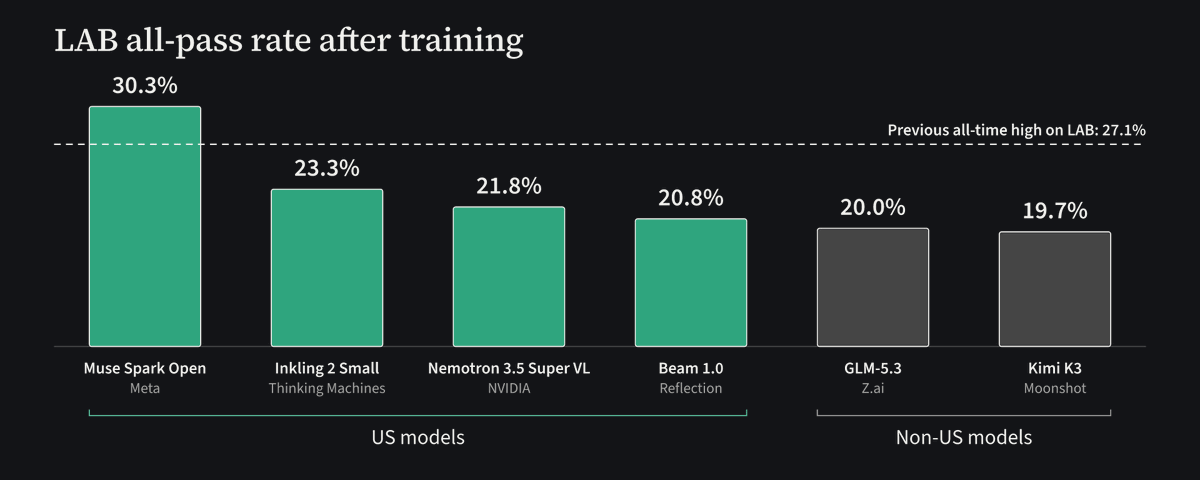
In collaboration with @baseten and @tinkerapi, they tuned a set of frontier open weight models, most notably the American Muse Spark Open from Meta, Inkling 2 small from TML, Nemotron 3.5 Super VL from Nvidia, and Beam 1.0 from Reflection
The models were specialized over closed universe “client” synthetic environments, on which they were asked to produce deliverables on which they were evaluated on with rubrics
They applied 80 (200 for beam) steps of Async RL with as such a rubric based reward system, tuning the model with rank 64 LoRA over a CiSPO objective using DrGRPO advantage computation
And the models tuned have a pretty strong showing, most notably with Muse Spark Open now beating the last model to have topped the leaderboard, which was Gemini 4 Argon ! A great win for open source indeed !

3
4
327
The release post of GLM 5.4 states it clearly: the future is looped!
Those efficient performance increments come solely from the 30B scaling experiment, the benchmarks from the 750B model haven’t been published yet but I do expect it to be quite strong on release
Also pretty interesting choices of architecture at high level to have higher control on looping updates and inference efficiency described on the blogpost:
- learnable gates after the looping block (similar to Inkling a bit, except that the gate is also applied from the final looping block to the last block)
- and KV Cache + Sparse Indexer sharing mechanisms that reduce overall compute
Overall a very promising update for which I can’t wait to go through the tech report!


Introducing GLM-5.4: Generalized Coding with Our First Loop Transformer.
- Loops existing layers in the GLM-5 base model for deeper reasoning
- Pushes beyond traditional coding to video, games, 3D shaders, and CAD modeling
- Adds vision capabilities for stronger visual coding
API access will open after safety evaluation. Model weights will be released responsibly.
Tech Blog: z.ai/blog/glm-5.4

1
1
271
Want to comment real quick on the release of MACBench from Bespoke Labs, a really really cool research lab working on frontier environment problems
Their experiment here is basically dedicated to finding interesting problems to measure how swarms of agents interact
This has a lot of downstream application, as it is obviously great to work on pure R&D (theorem proving/disproving, or even simulation stuff) ; and therefore having agents that can communicate efficiently without stepping on another’s toes is pretty paramount for that to work
On their bench, they evaluate the swarms of one model of each of the big three labs performing over 12 different simulated setups that do incentivize coordination
Opus, Sol and Argon have middling results in the setup, with Opus 5.5 still being the best at it. It’s just 12 games so perhaps the data points could hide bias, but it’s definitely still worth mentioning there’s room for collaboration improvement
That’s great, because it means there’s progress for the next releases still! Would love to see it eval with Fable, Astra and Carbon now :)


We’re releasing Multi Agent Coordination Bench, a benchmark of twelve natively multi-agent long-horizon tasks that measure the coordination capabilities of frontier models.
We find that current frontier agents coordinate poorly. A team of eight agents beats a single agent, but the gain comes from having more agents, not from coordination. Of Opus 5.5, GPT-6.1 Sol and Gemini 4 Argon, only Opus shows signs of a gain from coordinating.

ALT The leaderboard of MAC Bench: one bar per model shows the score of a single agent and the gain from more agents. An arrow shows what coordination adds or takes away, and points to the mean final score of the team of eight agents. Opus 5.5 scores 0.534, with a green arrow to the right for a gain from coordination. GPT-6.1 Sol scores 0.406 and Gemini 4 Argon 0.319, each with a red arrow back to the left for a loss from coordination.
1
144
GoodfireAI, a SoTA lab for all interpretability purposes has started to analyze Inkling-2-mini with very promising results for looped model analysis!
Inkling-2-Mini has a pretty unique architecture causing some very specific manner of information transit, which still remain analysable
They first analyse the mechanics of the following transit, and notice that the last layers of each block (Mini being divided in 4 blocks) actually help facilitating the information flow from one block to the following
They then look into the activation outputs of the model’s layers (loop outputs included) and find that there is one outlier coordinate, coordinate 2027 out of 2304, which surges at layer 18 notably.
—> This is related to the loops: this coordinate is used as a gate to know whether it’s more interesting to attend to block 2 or block 3 from one loop to another, and therefore the actually sees a flat drop at the end of the last loop
Finally, the authors study different decoding lens used for interpretability purposes, and check their usefulness. They note that the Coda lens and the Tuned lens can be used to have a hidden layer mimic the final layer with success ; while the base logit lens can also provide some information without being too affected by loops —> which is a great result for interpretability!
Overall pretty cool read, although a bit dense especially since I had to refresh my mind on all those specific attention concepts -but learning is always a pleasure!


Looped models are weird. A layer can write to itself or read from "future" layers.
@thinkymachines gave us early access to Inkling 2 Mini so we could study its inner mechanisms. We uncover how it coordinates information flow across layers, blocks, and loops.
Studying Inkling 2 Mini gave us cause for optimism: as transformers continue to evolve, we believe our ability to understand their internal mechanisms can evolve with them.
Read the full post: goodfire.com/research/interp…
Didn’t think openAI would be the first lab to try and set the bar for training limits but here we are
Basically what they advance here is that part of downstream model strength can be predicted through pretrain language modeling capacity
Here this is represented by the model’s ability to minimize its perplexity on a held-out eval set: it corresponds to how good the model exactly is at next token prediction for a given corpus
As they noticed thresholds could be directly linked to model breaking new barriers, they are imagining what could happen if the model were to go an increment below -which also would limit its alignment auditing possibilities, which is indeed concerning
Hence the argument to use such a metric to set a limit before releasing a new model, despite the related pitfalls that are very well noted in the article: you’d need to have a common eval set for all labs, along with perplexity being mainly a language modeling metric, not directly related to downstream performances that could already be unlocked through data
But this is indeed a very solid point to make, as pretraining improvements have already shown to indeed lead to heavy downstream improvements, and that there is no common “threshold-barrier” currently between the different labs to judge a model’s dangerousness!

We decided to provide more transparency into pretraining progress at OpenAI for the sake of moving toward shared safety bars. In “Perplexity and Intelligence” I argue for common limits based on perplexity and other measurements, with progress beyond them gated on our ability to understand AI behavior.
openai.com/index/perplexity-…

9
4,161
Oooh
Yes yes yes go and beat that
Reminder in image for those who don’t know


BREAKING: 284-year-old Strong Goldbach Conjecture emerges as the most likely major math problem for AI to solve next in 2026.
25% chance.
poly.market/JKMsib7

180
Another Alex Zhang work that deeply shows the strength and interest to have within RLM
Basically it’s kinda like orchestrator agent delegation but better in context management, especially for long-context long-horizon tasks
The work shows that it’s possible for the models to decompose the large tasks in smaller ones which end up being “locally in distribution”, and that training in those small tasks a model that ends up doing offloading on the large tasks… actually works great!
Their last section is about generating synthetic envs which tasks are similar but not a copy of the domains they’re targeting, and checking whether pure SFT on sampled RLM root LM trajectories works
Lo and behold, with 8k sampled trajectories, a Qwen3.8-27B is much improved and becomes a way better compositioner :)
Well done job, and sincerely hoping it generalizes in vision due to the computer use impact!


Harnesses used to be a crutch for weak LLMs. In 2026 and onward, with stronger models, harnesses now offer a mechanism for composing an LLM’s existing and new capabilities to generalize well beyond their training environments.
In our new paper, LM Harnesses are Compositional Generalizers, we explore how various harness abstractions enable LM systems to generalize over task length, task strategies, recursive task depth, and more through composing existing LLM capabilities. These abstractions provide a means for more data-efficient training, especially over long tasks, by keeping trajectories locally in-distribution (LID) — i.e., shaping all individual LLM calls to be in-distribution.
For tasks that take a very long time to roll out, this implies that we can even perform surrogate harness training, meaning we train an individual LLM call instead of doing the very long harness rollout, using purely synthetic tasks, with fake tool calls + sub-agents!
A common idea floating around is that LLMs will absorb harnesses and make them obsolete. We disagree, and argue that we haven’t sufficiently explored what harnesses can provide.
The full paper, logs, codebase, and data are available: alphaxiv.org/abs/2611.harnes…
w/ @SOURADIPCHAKR18 @lateinteraction

3
274
The Timestral report is really goated and feels like a Google-like side quest from @MistralAI
It basically covers how they train their 4 time series foundation models and how they reach SoTA performance with respect to Pareto-optimum
I was surprised a bit to see that the only commonality to LLM stuff was the fact that there is a transformer backbone to handle most of the stuff!
Otherwise this is mainly time-series related content so it took me quite a bit to dredge through but pretty cool to be able to be newbie again on a read
And those kind of models are actually super helpful! They work for retail store price prediction, for electricity forecasting… there’s a lot to love about them, and the report contains really plenty of information on its fabrication process
Really really cool release overall, will likely be helpful to plenty of their deployments and looks like a fun high deep learning based side quest in general!


That’s the amazing achievement of this week
The code:
- does tries to prove the Riemann Hypothesis as stated (removing the possibility that it’s a weaker one)
- compiles (removing the possibility that “in infinite time it solves”)
- is valid (which means that outside of Lean issues it’s gg)
Congrats to Anthropic and @__alpoge__ !

The Lean FRO and Mathlib Initiative have released a joint statement on the Lean verification of the Riemann Hypothesis.
On November 20, Levent Alpöge released a proof of the Riemann Hypothesis as a Lean library of 17 million lines of code. Over the past day, the Lean and Mathlib communities worked together to verify it. The statement certifies the proof as correct and describes how it meets all necessary verification criteria.
Congratulations to Levent on this achievement, and thank you to everyone in the community who contributed to the verification.
Full statement: leanprover-community.github.…

1
355


Very effective defense as it did its job: slaughtering all previous distillation attacks
The sauce:
- Models taught to recognize reasoning extraction attempts
- Input classifiers & Output classifiers both before output & for tool calls
- API level encrypted reasoning protection
All that for the win!


Distillation can reproduce powerful AI capabilities without the safeguards built around them.
We’re sharing new research on our work to combat distillation of our models, how these capabilities transfer, and how we detect and disrupt coordinated attempts.
These findings are helping us sharpen our defenses and support safeguards across the industry.
openai.com/index/combatting-…

1
223
The fun thing about the two impressive RH proofs (human and Claude+Alpoge) that we’ve gotten is that if they truly were finished when they were claimed
Then we had truly RH solved before GTA VI
1
1
150
The most amazing and heavy meaning sentence
Looping is going to dominate open source, inference efficiency is EVERYTHING and this lab note from TML just proves that it works GREAT


Some of you thought that Inkling 2 Small was too big at 594B parameters. We heard you: Inkling 2 Mini is a looped transformer with just 26B parameters, small enough to run on your laptop, powerful enough for agentic work with a score of 20.1 on AA Index.
thinkingmachines.ai/news/ink…
