

Structured finance for the AI data economy. Founder of Matrix Point Capital.
Joined October 2026
- Tweets56
- Following115
- Followers288
- Likes65


Pinned Tweet
I’m fascinated by the data industry emerging around AI.
Data brokers, synthetic data providers, RL environment builders, and a growing range of other specialized providers are at the forefront of a giant new industry that few people outside of AI even know exists.
They’re solving interesting problems surrounding AI, albeit not without problems of their own. Some of these challenges are new and novel, while others are familiar across other industries, but the supporting infrastructure hasn't quite caught up.
Brandon Fryer retweeted

The only thing the enterprise actually wants to buy is spiritual salvation through artificial intelligence.
So you either build intelligence or you diffuse it.

Brandon Fryer retweeted

Bullish on data markets. I think we aren't far from companies buying data and fine tuning their own models
Hilariously, it won't even be the companies themselves. In the future, I think agents will autonomously be buying data and fine tuning models

I’ve been spending a lot of time thinking about the value of data used to train AI models. One of the closest comparisons I can think of is music royalties.
When a new song is released, it’s hard to know how much it will ultimately be worth. Some songs have a brief period of popularity, while others become classics that generate royalties for decades.
I think data could follow a similar pattern. A dataset that’s never been sold is difficult to value, and its usefulness to AI developers could change over time. Some datasets might see a surge in demand before becoming outdated, while others could be licensed repeatedly and generate revenue for years.
It’ll be interesting to see if the data market eventually develops something similar to music royalties, where buyers can look up historical sales of similar data to help determine what a dataset is worth. Right now, there’s very little transparency in the market
Was expecting this progression eventually but not this soon
An interesting 2nd order impact could be a major expansion of the AI data market from mostly the major labs to any company that wants to refine their own corporate AI

Brandon Fryer retweeted

What is a data company actually worth in the long run?
I've been asking lab researchers, data founders and some of the largest data buyers this for a few months. Here's where I've landed for now.
1/ Frontier labs don't need more data. They need a small amount of really good data, then they synthesize and run RL on top of it. Volume gets cheap fast.
2/ Expert networks feel this first. Writing and grading answers is exactly what models are getting good at, and in some domains I'm told synthetic data already beats the experts. The margins say the same thing: public numbers for human-data vendors sit around 30–45%, because most of the revenue goes straight to contractors.
3/ RL environments have a few good years while verifiers are still hard. Over time I'd expect the value to move to QA, catching reward hacking and keeping sandboxes safe.
4/ Real-world data looks like the actual moat to me. Archives, long-tail industries, live workflows, the physical world, wet-lab results: things the model can't reach on its own. Licensing that data many times over is a great business. Collecting it in the field is closer to running a supply chain.
5/ The piece nobody has built yet is a Moody's for data. Today, checking a dataset can cost almost as much as making it, so buyers and sellers end up grading their own homework.
And most data revenue is still one-off projects. The companies that turn it into something recurring, like licenses, environments or verifiers, will be the real ones.
Curious where people disagree. If you run a data company or buy data at a lab, what would you still pay for after your next model ships? And is anyone actually close to building the Moody's?

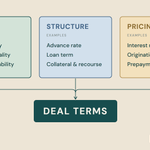
When structuring a loan, there are 3 main considerations: risk, structure, and pricing. These factors often influence one another, so there's usually some give and take when negotiating loan terms.
For example, offering more collateral or accepting a lower advance rate may help you get better pricing. On the other hand, asking a lender to take on more risk will generally come at a higher cost.
While there are typical terms and pricing ranges for some types of loans, the specifics depend on how these 3 pieces fit together. It's rarely as simple as quoting an interest rate

Brandon Fryer retweeted

been saying this over and over
most of the public web has been scraped. the real alpha for frontier model training is shifting toward private, proprietary, and long-tail data, much of which targets specific model weaknesses since the baseline is already the entire public web
we're seeing this firsthand with buyers coming in with increasingly specific requests as they hillclimb performance on niche problems
think OpenAI pushing mathematical reasoning, but across medicine, law, finance, robotics, and other specialized domains
volume is no longer the differentiator. it’s about finding the exact data that closes a capability gap, especially data nobody else has access to
expect massive capex going into novel data acquisition in 2027 as labs compete to solve increasingly narrow problems

Catching up with labs and data vendors lately, the same thing keeps coming up: labs now pay most for data on what their models get wrong.
Volume got cheap. Models generate their own code, sim scenes and tasks now. The deals go to data aimed at a weak spot, or data nobody else has.
1. Meta, Nvidia and AWS are buying sim data from Physicl, a Paris startup that just raised a $10M seed. It's built only around scenes their robot models get wrong, like odd lighting or objects they've never seen.
2. 4 of the top 5 US closed labs pay Halluminate, a 9-person team, for finance RL environments like PE due diligence. On its test the best of 7 frontier models averaged 51%.
3. Google paid $10M for a bankrupt airline's 100M emails and 500M Teams messages, and outbid Mercor to get it. Heard exclusive deals like that run 4-5x non-exclusive ones.
The data vendors I'd watch find failures before the lab does, or own something nobody else can sell.
If you sell data to labs: are you getting paid for volume or for failures?

Another example of the AI data economy

My friend runs one of the biggest woodworking businesses in the northeast. He was telling me the other day Anthropic offered him $1M just watch his team create cabinets. $1M! No other strings attached. Three months of watching employees virtually so they can model, learn and integrate it into Claude.
The rep said they were doing this with multiple firms across every industry.
All knowledge work will have every scenario and use case backed by experts 10k hours, in Claude within the next year or two.
Not a doomer but the "AI isn't going to drive job losses" is going to be so wrong it hurts.
154
Great piece on the current state of the AI data market and where it might be headed. Highly recommend reading


2
367
I love meeting different players across the AI data supply chain. There’s so much more to this industry than just data brokers and the labs.
It spans everything from the original data owners to aggregators, marketplaces, RL environments, synthetic data, quality assurance providers, inference data, robotics data collection, and so much more.
The industry is so much bigger than most people realize, and I don’t see it going away anytime soon
2
7
1,460
Brandon Fryer retweeted

Interesting to see a big jump in data vendor spend this past quarter for Anthropic.
Much more in my Anthropic S-1 breakdown which goes out shortly.

Great to see some insight on where demand for data is right now, especially with how quickly things seem to be changing

Manufacturing is super hot. Industrial is very hot. Medical is fifty fifty. Schools, no demand.
Quick read on where demand is sitting right now for the owners asking.
If your in manufacturing or industrial, now is the time to have the conversation. Buyers are asking for it.
Medical is split because of the patient data. Clinics have the records, but patient data makes it harder, so some buyers want it and some won't touch it.
Schools, that kind of data has no demand right now.
One thing to keep in mind. Two weeks ago it was different demand. Right now its something else. Two weeks from now its gonna be different again.
So don't sit on it. DM's open.
In honor of Halloween, here are some of the “scary” things that can happen to borrowers when a loan goes bad, in roughly increasing order of severity.
This can happen when you miss a payment, breach a financial covenant (like falling below a required cash balance), or otherwise violate your loan agreement. Depending on the terms of your loan, here’s what your lender may be able to do:
1. Default interest: Your lender may increase your interest rate, sometimes by several percentage points, making the loan more costly until the default is resolved.
2. Increased reporting and oversight: Instead of monthly financial reports, your lender may require weekly updates, more frequent collateral inspections, or detailed cash flow forecasts.
3. Restrictions on business decisions: Your lender may impose additional restrictions on borrowing, asset sales, distributions, or acquisitions. Some of these restrictions may already apply before a default.
4. Reduced access to capital: If you have a revolving credit facility, your lender may stop allowing new draws or tighten the requirements for which assets qualify as collateral.
5. Mandatory repayments: Your lender may reduce your advance rate (the percentage of eligible collateral value you can borrow against). If that leaves you with more debt outstanding than your collateral supports, you may have to repay the difference, even if you’ve never missed a payment.
6. Cash controls: Your lender may start directing customer payments into a controlled account and using that money to pay down the loan, leaving you with less cash to operate your business.
7. Accelerated repayment: Rather than waiting until the original maturity date, your lender may demand repayment of the entire outstanding loan balance immediately.
8. Foreclosure or bankruptcy: In the worst cases, your lender may enforce its rights against the collateral, potentially seizing and selling business assets. If the company can’t resolve its financial problems, it could end up in a restructuring or bankruptcy.
Of course, some lenders are much more flexible than others. Many loans also provide cure periods, giving borrowers time to fix certain issues, and lenders can agree to waivers or amended terms rather than immediately exercising their rights.
Just another reason to consider more than the interest rate when choosing a lender.
Happy Halloween!
2
163
A lot of people are talking about Anthropic's S-1 that just came out, but seeing very few mention the big debt deal they also just closed.
Yesterday, Anthropic announced a $63bn transaction to acquire more AI computing power using Broadcom chips and networking equipment. The first deliveries are expected in 2027.
The deal includes $43.5bn of financing from senior lenders including Bank of America, Citi, and Morgan Stanley, and ~$19.5bn of junior debt from Blackstone. To structure the transaction, they created a new Special Purpose Vehicle ("SPV") to borrow the money, purchase the equipment, and own the assets. So rather than Anthropic borrowing directly to buy the chips, they will lease the computing equipment from the SPV. Those lease payments will then provide the cash flow used to repay the debt.
Pricing for the new deal hasn't been disclosed, but there is a useful comparison. In June 2026, Apollo and Blackstone completed a similar ~$35bn financing supporting Anthropic's computing capacity. That transaction included $6bn of A1 senior notes priced at 1% above U.S. Treasuries, $24bn of A2 senior notes paying 5.75%, and $4.5bn of junior notes paying 8.5%.
Broadcom is also providing something called residual-value support to protect against a decline in the value of the collateral (the chips). While the full terms haven't been disclosed, the idea is that if something goes wrong (early lease termination, default, etc.) and the chips can't be sold or re-leased to someone else for enough to cover the outstanding senior debt, Broadcom would help cover the shortfall.
In short, the SPV will use debt to purchase Broadcom equipment, lease it to Anthropic, and use those lease payments to service the debt. The equipment serves as collateral, with additional protection provided by Broadcom.

2
203
The market is clearly showing demand for data right now. The big question is whether the volume of general data dilutes its value over time, resulting in labs only paying real money for specialized data. When, or if, that happens is hard to say. Such an event could pose a problem for any financing built on the assumed value of the data, potentially translating to issues with repayment of that financing.
One way to mitigate this, however, is to borrow against the (preferably contracted) cash inflows tied to the monetization of that data, rather than the underlying data itself


Why can a VC close a deal in 5 days, while a lender might take several weeks?
Much of it comes down to the potential returns and how often each investor needs to be right.
VCs invest in companies with the potential to return 10x, 20x, or more. Of course, they're not expecting every investment to fail, but the upside on a successful deal can be enormous. For example, a VC could make 20 equal-sized investments, lose everything on 19 of them, and still break even if the last one returns 20x.
Debt works differently. A great loan might earn 2x, but a more typical loan might return closer to 1.2x over its life. At that level, a lender needs 5 successful investments just to offset 1 that goes to zero.
The difference in timelines between equity and debt financing has come up in a number of conversations I've had with founders. Hopefully this helps explain why the lending process can sometimes take a little longer
2
175
I get a lot of questions asking what terms would look like on a potential financing deal. The truth is... it depends.
Every deal is different. It's a mix of risk, structure, and pricing (fees and interest). The main driver, however, is risk. The level of risk in a deal generally dictates the rest of the terms.
Want to factor a single invoice from a reputable customer that's due in 30 days, with full recourse if it isn't paid (meaning you're still on the hook)? That's a much different risk profile than a pre-revenue company asking for a multimillion-dollar working capital facility with minimal collateral to support it.
Even if two companies are looking for the same type of financing, the terms can look very different depending on the underlying risks.
Ultimately, every deal is different. It's about finding the right balance of risk, structure, and pricing that works for both the lender and the borrower
1
164
I'm considering starting a new series looking at how companies are monetizing their data for AI. Here is the first one:
Case Study #1: Wiley (NYSE: $WLY )
Wiley is an academic and research publisher that's been around for over 200 years. It publishes approximately 2,500 journals spanning fields such as medicine, chemistry, engineering, and finance. Its traditional business includes providing universities, researchers, and businesses with access to this content through subscriptions, publishing fees, and licensing agreements.
More recently, Wiley has expanded into licensing its research content, including journals, books, and specialized scientific reference materials, to AI companies. Some customers license large collections of this research to train AI models, while others subscribe to regularly updated information for use in their AI applications.
Why is this valuable? Companies developing AI tools for fields like healthcare, drug discovery, or engineering need specialized information that isn't always readily available through general internet data. Wiley provides access to decades of scientific research and technical knowledge across these fields.
Wiley generated $49.1mm in AI licensing revenue during its fiscal year ended April 2026, up from $40mm in FY2025 and $23mm in FY2024. Of that $49.1mm, approximately $8mm was recurring revenue, up from just $1mm the prior year.
But Wiley isn't just monetizing its own content. It also helps other publishers sell access to their research to AI companies. Rather than each publisher having to find AI customers, negotiate licensing agreements, and manage the delivery of their data independently, Wiley can handle those functions on their behalf and share the proceeds. In FY2026, approximately $19.4mm of Wiley's $49.1mm in AI licensing revenue was attributable to content from these third-party publishers, representing nearly 40% of the total.
As of July 2026, Wiley had built a network of 71 publishing partners whose content it could license to AI companies. On the customer side, it reported six AI model-training customers and 23 corporate customers subscribing to regularly updated research for their AI applications.
Wiley is also exploring additional ways to monetize the data it has accumulated through its publishing business. Beyond the research itself, this includes information about how studies are conducted, how scientific findings relate to one another, and insights gathered through the peer-review process. This could give AI developers greater insight into how scientific research is conducted and evaluated, potentially helping their models better understand and reason through complex problems.
Wiley illustrates a broader opportunity in the AI data market. Companies may be sitting on valuable information accumulated over years of operating their businesses, much of which was never intended for AI. As demand for specialized data grows, both the companies that own this information and the intermediaries that help bring it to market stand to benefit.


3
221