

Sharing the curated research discoveries in plain language, infographics, & videos
Joined August 2022
- Tweets436
- Following2
- Followers1.1K
- Likes8







🧠 Shining Light on Alzheimer’s: Multifunctional Probes
Decades of AD research are shifting from single-target drugs to Multifunctional Theranostics! A new account in AMR (2025) by @IITGuwahati details how fluorescent probes are unveiling the secrets of the AD brain. 🚀
💡 Key Innovations:
All-in-One: A single molecule for imaging Aβ plaques, chelating toxic metal ions, and reducing oxidative stress.
Smart Design: Using PET & FRET mechanisms to visualize early-stage protein aggregation with high precision.
Toxic to Non-toxic: Probes help redirect harmful Aβ clusters into harmless aggregates.
🌍 Impact: Paving the way for precision medicine in neurodegenerative disorders.
Full Article: doi.org/10.1021/accountsmr.4…
#Alzheimers #Neuroscience #Chemistry #Fluorescence #MaterialsScience #Innovation

Turning Methane into Value with MOFs ⚗️
How can methane be activated and converted more efficiently? This Account highlights how metal–organic frameworks offer tunable active sites and confined microenvironments for CH₄ adsorption, activation, and catalytic transformation.
Read the full article: pubs.acs.org/doi/10.1021/acc…
#MOFs #MethaneConversion #Catalysis

🧪 Engineering the vdW Gap: A New Dimension for 2D Materials
Forget just exfoliation! A new account in AMR (2025) highlights van der Waals Gap Engineering as a powerful tool to create "artificial" materials with custom quantum properties. 🚀
💡 Key Breakthroughs:
Confined Chemistry: Inserting guest species into sub-nanometer gaps to trigger new physics (e.g., coexisting superconductivity & ferromagnetism).
High-Yield Production: Electrochemical intercalation achieves >75% yield for high-quality monolayers and quantum dots.
Hybrid Superlattices: Building stable organic-inorganic stacks that combine bulk-like stability with monolayer-like performance.
🌍 Future: Paving the way for next-gen ion sieving, biomedicine, and quantum devices.
Read more: doi.org/10.1021/accountsmr.4…
#2DMaterials #MaterialsScience #Nanotechnology #Chemistry #Superconductors #Innovation

💣 Designing the Next Generation of High-Explosives
Developing new energetic materials (EMs) is slow and dangerous—but data-driven science is changing the game! A new account in AMR (2025) outlines a massive scale combinatorial design strategy. 🚀
💡 Key Highlights:
Million-Molecule Space: Designing over 10^7 potential molecules using a "Scaffold + Functional Group" approach.
Smart Strategies: From screening known drug-like scaffolds to "editing" unknown cage structures for zero oxygen balance.
AI-Powered: Combining Machine Learning with DFT to balance speed and accuracy.
Proven Success: Strategy validated by the successful synthesis of 3 new multi-functional materials!
Full Article: doi.org/10.1021/accountsmr.4…
#EnergeticMaterials #MaterialsScience #MachineLearning #Chemistry #Innovation #HEDM

🧪 MXenes: From Etching to "Chemical Editing"
A new account in AMR (2025) explores the evolution of 2D MXenes! Beyond just etching, we are now entering the era of Atomic-scale Chemical Editing. 🚀
💡 Key Insights:
Topotactic Transformation: Precise A-site etching in MAX phases led to the discovery of 2D MXenes.
Chemical Scissors: Using Lewis acidic molten salts to decouple etching & intercalation for "isomorphous replacement."
The Full Loop: We can now swap A-site atoms, modify surfaces, and even turn 2D MXenes back into 3D MAX phases!
🌍 Impact: Designing custom-made materials for next-gen energy storage and nuclear applications.
Full Article: doi.org/10.1021/accountsmr.4…
#MXene #MaterialsScience #Nanotech #Chemistry #Innovation #2DMaterials

🧪 Solvent Chemistry: The Secret to Perfect Perovskites
How do we create high-quality halide perovskite films for solar cells? A new account in AMR (2025) highlights Solvent Chemistry as the ultimate tool for morphology control! 🚀
💡 The Strategy:
Dispersion Solvents: Govern nucleation & growth kinetics to shape the film.
Binding Solvents: Use solvent-involved intermediates to fine-tune crystallization & phase transitions.
Result: Minimized defects, optimized crystals, and record-breaking efficiency.
🌍 Impact: A roadmap for designing next-gen, high-stability perovskite photovoltaics.
Read more: doi.org/10.1021/accountsmr.4…
#Perovskite #SolarEnergy #MaterialsScience #Chemistry #Innovation #RenewableEnergy

🧵 Fiber Sorbents: Scaling Up CO2 Capture
Traditional carbon capture uses powders that cause high pressure drops and heat loss. Georgia Tech researchers (Lively Group) have developed Fiber Sorbents—embedding porous materials into polymer fibers to solve these industrial bottlenecks.
🚀 Why It Matters:
Energy Efficient: Hollow fibers allow direct heating/cooling, slashing energy use.
High Throughput: Massive gas flow with minimal pressure resistance.
Versatile: Perfectly hosts fragile materials like MOFs and Zeolites.
🌍 The Goal: A scalable, low-cost platform for Direct Air Capture (DAC) and industrial decarbonization.
Full Article: doi.org/10.1021/accountsmr.4…
#CarbonCapture #Sustainability #MOF #GreenTech #Innovation #GeorgiaTech

🔬 Bridging Mechanical & Electrical Analysis in AFM
A new review by Prof. Seungbum Hong’s group (KAIST) in Accounts of Materials Research (2025) showcases how integrating mechanical and electrical probing in Atomic Force Microscopy (AFM) is unlocking the secrets of the nanoscale world.
🚀 Key Breakthroughs:
3D Nanolithography: Uses "asymmetric wear" between polarized domains for chemical-free, mask-less etching.
Charge Gradient Microscopy (CGM): Enables ultra-fast imaging of ferroelectric domains via surface scraping.
Component Mapping: Combines ESM with friction mapping to identify specific active materials vs. electrolytes in battery composites.
💡 Impact: By bridging these two realms, researchers can now design more reliable solid-state batteries and next-gen nanoelectronics with unprecedented precision.
Read the full account: doi.org/10.1021/accountsmr.4…
#AFM #Nanotechnology #MaterialsScience #EnergyStorage #Innovation #KAIST #BatteryTech

Breaking the Speed Limit for Solid-State Batteries! 🔋⚡
Solid-state batteries are the "holy grail" of safe, high-energy storage, but slow ion transport has been a major roadblock. A team from USTC, led by Prof. Hong-Bin Yao, has introduced a new class of UCl₃-type chloride solid electrolytes in Accounts of Materials Research (2025)!
🚀 The Game Changer:Unlike traditional "close-packed" electrolytes that squeeze ions through tiny gaps, the UCl₃-type structure features a "non-close-packed" framework with massive 1D diffusion channels.
💡 Why it Matters:
Super-Fast Ions: It achieves an experimental ionic conductivity of 5.17 mS/cm (and a theoretical 13.8 mS/cm)—comparable to liquid electrolytes!
Ultra-Low Barrier: The ion migration barrier is dropped to below 0.2 eV, enabling faster charging and better performance at room temperature.
Lithium Metal Friendly: Thanks to the low electronegativity of lanthanides (like Lanthanum), these electrolytes are much more stable against lithium metal anodes than conventional versions.
✨ The Impact:By combining high conductivity with better electrode compatibility, UCl₃-type conductors are paving the way for next-gen all-solid-state batteries that are both safe and powerful. 🌍💻
Full Viewpoint:
doi.org/10.1021/accountsmr.4…
#SolidStateBatteries #EnergyStorage #BatteryTech #MaterialsScience #Innovation #LithiumMetal #Chemistry #USTC

Bye-Bye Trial-and-Error! 🧪➡️💻 AI is Revolutionizing Catalyst Discovery!
The search for sustainable energy solutions just got a major speed boost! In their latest Account in AMR (2026), Zhongfang Chen and Aliaksandr Bandarenka dive into how Data-Driven Workflows are transforming electrocatalysis.
🚀 The New Paradigm:Instead of testing thousands of materials in a lab, researchers are using Interpretable Machine Learning (like SISSO and SGD) to predict performance before the first experiment even starts.
💡 Key Highlights:
Physics-Aware AI: It’s not just a "black box." These models use descriptors like the d-band center to tell us why a catalyst works.
Finding Hidden Gems: Using "Subgroup Discovery," AI can find high-performance material pockets that traditional global models might miss.
Versatile Tech: Whether it’s splitting water (HER/OER) or capturing CO2, these workflows apply to everything from Single-Atom Catalysts to MOFs.
✨ The Future:The next step? Moving from vacuum models to simulating the complex "real world" of the electrochemical interface, including pH and electrolyte effects.
Full Article: doi.org/10.1021/accountsmr.5…
#MachineLearning #Electrocatalysis #EnergyTransition #MaterialsScience #AI #Sustainability #GreenEnergy #Innovation

Nano-LEGO: Building "Colloidal Molecules" with Polymer-Grafted Nanoparticles! 🧱✨
What if we could treat inorganic nanoparticles as "artificial atoms" and build molecules out of them? In their latest Account in AMR (2026), Zhihong Nie and Yutao Sang from Fudan University showcase the fascinating world of Colloidal Molecules (CMs) and Colloidal Polymers (CPs)!
🚀 The Big Idea:By grafting polymer chains onto nanoparticles (PGNPs), researchers have created a versatile toolkit to mimic the architecture of real molecules and polymers at the nanoscale.
💡 Why it Matters:
Precision Control: These "hairy" nanoparticles use their polymer shells to interact via hydrogen bonding, electrostatics, or chemical recognition, locking into precise 3D shapes.
Collective Power: When nanoparticles assemble, they develop "superpowers"—like enhanced light manipulation (plasmonic coupling) that individual particles don't have.
Future Tech: From ultrasensitive biosensors to metasurfaces that can bend light in unnatural ways, these assemblies are the building blocks of next-gen materials.
✨ The Challenge:The next frontier? Scaling up production to high-purity levels and creating "polar" asymmetric structures that are as complex as the proteins in our bodies.
Full Article: doi.org/10.1021/accountsmr.5…
#Nanotechnology #Polymers #ColloidalScience #MaterialsScience #FudanUniversity #Innovation #SelfAssembly #Metamaterials

Decoding MXene Catalysis: The Computational Roadmap to CO₂ Conversion! 🌍💻
As we fight climate change, finding efficient ways to capture and recycle CO2 is critical. Enter MXenes—the 2D materials taking the catalysis world by storm! A new Account by Francesc Illas and team in Accounts of Materials Research (2026) outlines how advanced simulations are guiding this green revolution.
🚀 The Breakthrough:MXenes are no longer just "promising"; they are outperforming traditional materials. Computational models predicted—and experiments confirmed—CO2 uptake capacities of up to 12 mol/kg!
💡 Key Insights:
Beyond Surfaces: Researchers are now using "flake models" to understand how edges—not just flat surfaces—drive chemical reactions.
Predicting the Real World: By using Kinetic Phase Diagrams, scientists can pinpoint the exact temperature and pressure needed for CO2 activation.
Tailored Selectivity: From producing CO to synthesizing Formic Acid, the team shows how surface chemistry and Single Atom Catalysts (SACs) can be tuned for specific outcomes.
✨ The Future:This computational workflow isn't just for CO2 It provides a universal toolkit for designing cheaper, more efficient catalysts for energy storage, hydrogen production, and beyond! 🧪🔋
Read the Full Account: doi.org/10.1021/accountsmr.5…
#MXenes #ComputationalChemistry #CO2Capture #Sustainability #MaterialsScience #GreenTech #Catalysis #Innovation

Breaking the 20% Barrier: How to Make Organic Solar Cells "Brighter" & More Efficient! ☀️🔋
Why do Organic Solar Cells (OSCs) lose energy as heat? Researchers from Qingdao University and Donghua University just dropped a definitive guide in Accounts of Materials Research (2026) on how to stop non-radiative energy loss.
🚀 The Secret Sauce:
To get higher voltage, the solar cell needs to be efficient at emitting light (high EQEEL). The team summarizes 4 key moves:
1️⃣ 3D Molecular Design: Adding bulky 3D units to acceptors to stop "Aggregation-Caused Quenching" (ACQ).
2️⃣ Planarity is Power: Locking molecule structures to stop energy-wasting vibrations.
3️⃣ Ternary Blends: Adding a third ingredient to perfect the molecular "puzzle" in the active layer.
4️⃣ Side-chain Magic: Fine-tuning the chemistry to reduce the energy gap at the donor-acceptor interface.
With these tweaks, OSCs have officially crossed the 20% Efficiency milestone, bringing flexible, lightweight, and printable solar panels closer to your roof than ever before! 🌍✨
Full read: doi.org/10.1021/accountsmr.5…
#SolarEnergy #OrganicPhotovoltaics #Sustainability #CleanTech #MaterialScience #20PercentEfficiency #GreenEnergy

Shining Brighter in the Dark: The Rise of Silver Chalcogenide Quantum Dots! 💎✨
Invisible to the naked eye but revolutionary for science! The research group led by Prof. Qiangbin Wang from SINANO, CAS just published their comprehensive Account in Accounts of Materials Research (2026) on NIR-II emitting Ag₂X quantum dots.
🚀 The Breakthrough:Since their first report in 2010, the team has transformed these "low-toxicity" nanocrystals from lab curiosities into high-performance imaging probes and optoelectronic components.
🔍 Why it matters:
✅ Deep Tissue Vision: NIR-II light (900-1700 nm) cuts through skin and bone like butter, providing high-contrast images of internal organs and tumors.
✅ Tougher & Safer: Unlike cadmium-based dots, silver chalcogenides are eco-friendly and extremely stable under light exposure.
✅ Beyond Bio: These dots are now powering the next generation of night-vision sensors for autonomous driving and NIR LEDs.
By mastering "Cation Exchange" and "Surface Engineering," the team has unlocked unprecedented brightness and efficiency in the infrared spectrum! 🔬🌍
Dive deeper: doi.org/10.1021/accountsmr.5…
#NanoTech #NIRII #Bioimaging #QuantumDots #SINANO #MaterialScience #MedicalInnovation #Optoelectronics

Taming the Chaos of Complex Alloys with AI! 🤖🔬
Designing high-performance materials like High-Entropy Alloys (HEAs) and Metallic Glasses (MGs) is a nightmare for traditional modeling because of their chaotic, disordered structures. But a new study in Accounts of Materials Research (2026) shows how Machine Learning is changing the game!
🌟 The Breakthrough:Instead of replacing physics, researchers are using ML as a bridge to capture the "hidden order" within disorder.
🛠️ Key Innovations:
✅ Quantum-Speed Potentials: ML-trained potentials (ML-IAPs) allow for large-scale simulations with the accuracy of quantum mechanics—revealing how atomic-level "messiness" actually boosts strength.
✅ Physics-Informed GNNs: These neural networks respect crystal symmetries to predict chemical ordering faster than ever.
✅ MG Flow Defects: AI algorithms can now pinpoint "Shear Transformation Zones" in liquid-like metals, helping prevent catastrophic failure.
The result? A predictive blueprint for designing the next generation of alloys that are stronger, tougher, and built for extreme environments. 🚀🌍
Original Article: doi.org/10.1021/accountsmr.5…
#MaterialsScience #MachineLearning #AIinScience #HighEntropyAlloys #MetallicGlass #ComputationalPhysics #Innovation #NextGenMaterials

Can We Go Lead-Free in Solar Energy? ☀️🔋
Perovskite solar cells are the future, but the lead (Pb) content remains a hurdle. A new study in Accounts of Materials Research (2026) dives deep into Tin-Halide Perovskites (THPs)—the most promising eco-friendly alternative!
🧠 The Science:THPs have a near-perfect bandgap for solar harvesting. However, they struggle with "self-doping" and oxidation (Sn(II) to Sn(IV)), which kills efficiency.
🛠️ The "Fix" Strategy:
✅ Halide Alloying: Swapping some Iodine for Bromine to stabilize the electronic structure.
✅ Surface Passivation: Using 2D layers and n-dopant molecules to create a protective shield.
✅ Additive Magic: UsingSnF2 to "vacuum" out harmful oxidized tin species by forming a sacrificia Sn3F8 phase.
By combining theoretical modeling with experimental design, researchers are turning THPs from a fragile curiosity into a robust, high-performance photovoltaic material. The path to 20%+ efficiency for lead-free cells is becoming clearer! 🚀🌍
Original Article: pubs.acs.org/doi/10.1021/acc…
#SolarEnergy #RenewableEnergy #Perovskite #LeadFree #MaterialsScience #Sustainability #Innovation #CleanTech

Is the Battery "SEI" Actually Dead? Meet the REI! 🔋⚡
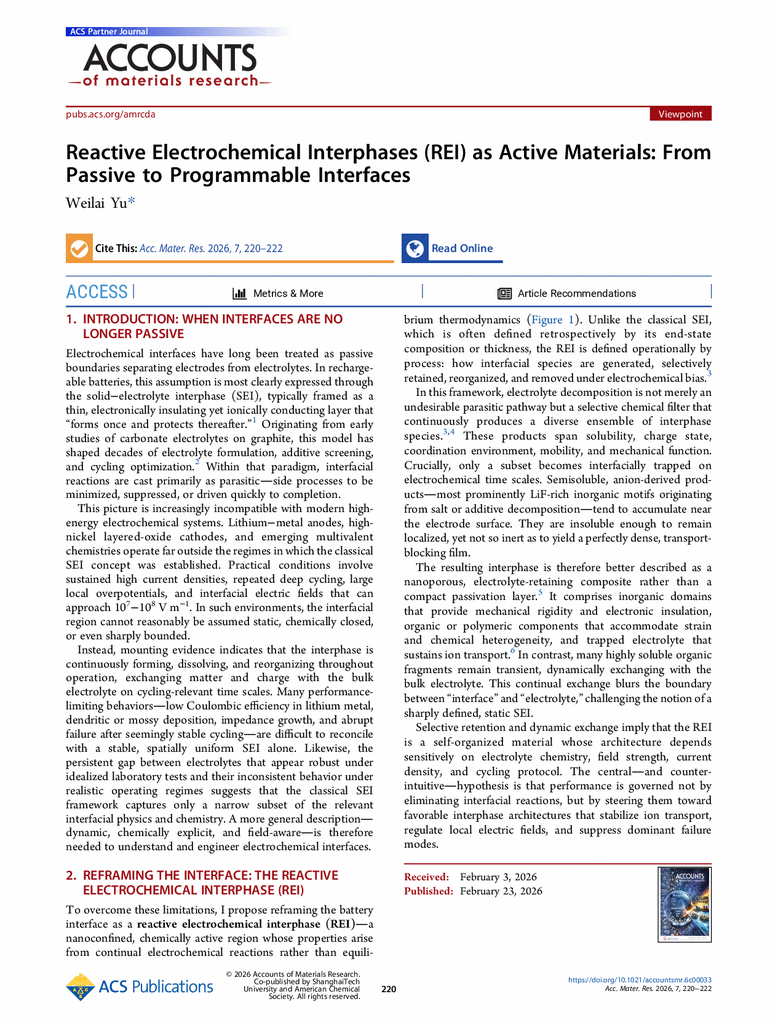
For decades, we’ve treated the battery interface (SEI) as a passive, "one-and-done" protective layer. But a new study suggests it's time for a paradigm shift! Researchers have introduced the Reactive Electrochemical Interphase (REI).
🧠 The Big Idea:Modern high-energy batteries don't have static interfaces. They have REIs—nanoconfined, chemically active zones that constantly breathe, dissolve, and reform under extreme electric fields.
🌟 Why REI Matters:✅ Dynamic Self-Repair: Instead of seeking total stability, the best interfaces use "intermediate solubility" to fix themselves during cycling. ✅ Ion Navigation: Ions don't just pass through a film; they navigate a complex "nanoporous composite" influenced by local fields. ✅ Programmable Design: We can use electrolytes as "molecular tools" to actively program these interfaces, rather than just preventing "parasitic" reactions.
This shift moves us from merely describing what grows on an electrode to actively engineering a living material that makes batteries last longer and charge faster. 🚀🛡️
Original Article: pubs.acs.org/doi/10.1021/acc…
#BatteryTech #EnergyStorage #MaterialsScience #Electrochemistry #REI #Innovation #GreenEnergy
Beyond Performance: A "Transformation-First" Roadmap for Safe Materials! 🌍🔬
The 2025 Nobel Prize for MOFs proved we are masters of creating complex architectures. But are we masters of their safety? Prof. Swaroop Chakraborty argues in Accounts of Materials Research (2026) that it's time to treat materials as trajectories, not just objects.
🚀 The Shift to SSbD (Safe and Sustainable by Design):Advanced materials like MOFs and nanohybrids shouldn't just work—they must be "Safe by Design" from day one. Retrofitting safety at the end is no longer enough for regulators or the market.
💡 Key Takeaways for Researchers:
✅ The "As-Deployed" Identity: Don't just characterize your material in a pristine bottle. What does it look like after it hits water or biological fluids?
✅ The Release Budget: Quantify exactly what leaches out and when. Is it an ion? A ligand? The trajectory matters more than the starting point.
✅ Retrieval is Key: If you can't contain, recover, or recycle it (ideally >3 cycles), its sustainability ceiling is low.
Chakraborty’s team proposes a Minimum SSbD Information (MSI) checklist to help labs pivot without needing a full regulatory unit. It’s about building a future where high-performance chemistry and environmental safety are two sides of the same coin. 🛡️🌱
Full Roadmap: doi.org/10.1021/accountsmr.5…
#MaterialsScience #SSbD #Sustainability #Nanotech #MOFs #GreenChemistry #ACS #Innovation

Bridging the Gap: The Future of Practical Lithium-Sulfur Batteries! ⚡🚀
With 5x the theoretical energy density of standard Li-ion, Lithium-Sulfur (Li–S) batteries are the "holy grail" for EVs and Urban Air Mobility (UAM). But how do we make them last?
Prof. Yang-Kook Sun's team at Hanyang University lays out the roadmap in their latest Accounts of Materials Research:
🔹 Solving the "Shuttle Effect": Using advanced carbon hosts and catalysts to trap and accelerate the conversion of polysulfides.
🔹 Taming Insulators: Innovative pelletizing and conductive additive designs to handle the non-conductive nature of S and Li₂S.
🔹 All-Weather Power: New strategies enabling stable performance even at -10°C for aerospace applications.
🔹 Going Solid: Transitioning to All-Solid-State Li–S batteries to maximize safety and eliminate leaks.
The journey from coin cells to high-loading pouch cells is complex, but these advanced cathode architectures are paving the way for a sustainable, high-energy future. 🌍🔋
Full Article: doi.org/10.1021/accountsmr.4…
#BatteryTech #EnergyStorage #LithiumSulfur #CleanEnergy #MaterialsScience #FutureMobility #Sustainability
