

ASIA PACIFIC JOURNAL OF PUBLIC ADMINISTRATION is dedicated to research that enhances public governance and administration, emphasizing the Asia Pacific region.
Hong Kong, China
Joined March 2020
- Tweets1.3K
- Following846
- Followers1.7K
- Likes389





Pinned Tweet
We now have a LinkedIn page: buff.ly/47dQRd8 curated by Prof Kim Moloney @Global_Academic
Please subscribe and follow us for more updates and insights on the research published in our journal!

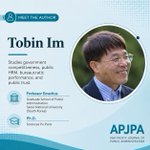
👤 Meet the Author: Tobin Im
Tobin Im is Professor Emeritus at Seoul National University. His research spans government competitiveness, public HRM, bureaucratic performance & public trust.
Read his latest APJPA editorial:
📖 buff.ly/WywTQxc

3
361
⚖️ How should a professional civil service balance responsiveness with independence?
In this editorial, Andrew Podger traces #Australia’s experience and highlights the roles of merit, tenure and institutional safeguards.
📖 buff.ly/oXmaMEK

🎥 Article at a Glance
Watch a quick summary of “Meritocracy in the era of politicisation: the role of the #Korean Civil Service Commission” by Tobin Im.
▶️ Watch: buff.ly/uTP2uYG
📖 Read the full article: buff.ly/oCrOTmB

🏛️ How does institutional reform reshape Party–state governance in #China?
Tian, Christensen & Ma examine China’s 2023 reform, showing how Party leadership was further institutionalised through administrative restructuring and networked governance.
📖 buff.ly/1bmntFc

🆕 Just out in APJPA!
In this latest editorial, Rahman draws on #Bangladesh to argue that civil service politicization persists because political and economic incentives sustain it—creating a cycle that is hard to reform.
📖 buff.ly/HgLavWU

💬 Can a text message improve municipal payment compliance?
In a field experiment in #SouthAfrica, Willemse et al. find no average SMS effect—but social-norm messages slowed arrears growth, while deterrence messages did not.
📖 buff.ly/FSO4qua

📊 What makes #performance information credible?
Lee & Walker find that hard performance information from external sources is seen as most credible—while internal, soft information can sometimes be less convincing than providing none at all.
📖 buff.ly/PNRjzpj

📚 One of APJPA’s most-cited articles
Riskawati et al. examine how Muhammadiyah values are internalised by local leaders in Indonesia and translated into inclusive policies, participatory governance, anti-corruption reform & sustainable development.
📖 buff.ly/abLXlD0

⏰ One month to go!
APJPA’s Special Issue on Governing #AI in the Public Sector welcomes comparative and theory-driven proposals across the #AsiaPacific and beyond.
🗓 Due: 1 Dec 2026
📄 800–1,200 words
🔗 buff.ly/oI4lTNh

🔓 Open Access in APJPA!
Beasley & Fernandez find that occupational diversity is linked to better cooperation, information sharing, job satisfaction & work-unit performance, while social-attribute diversity shows more mixed effects.
📖 buff.ly/0LXy6Or

🌍 Can public administration knowledge be global if context is secondary?
One of our most-cited articles argues for systematic context analysis across Global Souths and Norths.
📖 buff.ly/hUysOFE

🔓 Open Access in APJPA!
Hameduddin, Alfes & Ritz review what drives employee engagement across sectors and propose a public-sector model centred on public values, professionalism & political insulation.
📖 buff.ly/EqjMyI1
📚 buff.ly/pM0InLm

4
234
📚 How do public management reforms become hybrid?
Qin & Christensen show how #China institutionalised traditional PA, #NPM & post-NPM almost simultaneously—a “compressed reform trajectory” contrasting with more sequential reform layering elsewhere.
📖 buff.ly/f2ljp5E

📚 One of APJPA’s most-read articles
Tran, Cheema & @JLPerrySPEA draw on cognitive science to show why #PublicServiceMotivation may remain resilient in austere and chaotic times—and how compassion-based training could strengthen it.
📖 buff.ly/njlhwVa

🎥 Article at a Glance
Watch a quick summary of “Vertical and horizontal accountability: determinants of government transparency in China” by Han Qiu & Jekyung Lee.
📖 buff.ly/9lI0XTA
▶️ buff.ly/SCKQsbY

🆕 Just out in APJPA!
Nguyen Thi Quynh Trang shows how ethical #leadership can work through competing pathways: stronger leader identification may increase unethical pro-organisational behaviour, while #PublicServiceMotivation may reduce it.
📖 buff.ly/izcrOs3

3
177
🆕 Just out in APJPA!
Brillantes Jr., Ruiz, Dulpina & Rivera examine how the #Philippines’ Civil Service Commission and capacity-building institutions work to protect meritocracy amid persistent political pressures.
📖 buff.ly/MQaSDrR

⚖️ Uncertainty can widen bureaucratic discretion—and lead to very different responses.
Drawing on evidence from #Indonesia, Bake, Alam & Wahbi show how expanded discretion can support integrity-based adaptation or enable opportunism.
📖 buff.ly/9L3lURy

📣 Anti-corruption information can backfire.
Cui, Yuan & Tang show that citizens’ corruption experiences shape how they respond to different information formats—and, in turn, their willingness to fight corruption.
📖 buff.ly/wLTmpDm
📚 buff.ly/xddf7Js

🤖 Trust in algorithmic governance can be emotional.
Drawing on a survey of 586 citizens, Levitats, Vigoda-Gadot & Styrin examine how emotions towards algorithmic decision-making shape trust in governance institutions.
📖 buff.ly/hc62uiG
