

Dream researcher | https://teapaw.org/t.co/UDkcp2Er84
- Tweets12.3K
- Following4.3K
- Followers3K
- Likes134K






ALT Sparklers are shared between a prince and a princess at night. They're wearing golden yellow garments with delicately detail and refined faces and limbs. The sky is cloudy at night with the radiance of a moon shining a silvered-gold aura. A masterful and elegant depiction.

ALT This image is a Pahari painting from my ancestral region Kangra, 1800 (British Museum). It depicts two lovers in traditional Indian attire celebrating Diwali, the festival of lights, with fireworks against a night sky filled with stars. The woman, dressed in a delicate white dress with subtle embroidery, extends her arm to ignite fireworks that arc elegantly towards the dark sky, embodying the spirit of illumination. Her male companion, wearing a green robe with a turban adorned by a feather, stands closely behind her, holding additional fireworks in his hand, symbolizing shared joy and celebration. The scene is set within the walls of a palace, with faint architectural elements like windows and a low parapet adding depth to the setting. The dark, starlit sky provides a stark contrast to the golden sparks, capturing the essence of light piercing through darkness, mirroring the symbolic meaning of Diwali as a time to celebrate the inner light, resilience, and hope amidst life’s shadows.


ALT Celebrating Deepawali by Navneet Parikh


ALT Suzanne Lagneau, a page from Indian Mythology, The Birth of Lakshmi, Daughter of the Milky Sea, 1924. An absolutely stunning painting by a French Art Deco artist Suzanne Lagneau. It's full of operatic watercolour of the gods and asuras churning the milky ocean of consciousness to reveal Lakshmi herself born brilliantly in the centre. An absolute jewell of a painting. Dreamlike and figurative, refined effulgence.

ALT Painted in Bikaner, Rajasthan, circa 1725, this folio depicts Mahadevi, the Great Goddess, as the supreme reality of the cosmos. Suspended against a deep indigo ground within an arched frame, the goddess appears in profile, crowned and sheltered beneath an imperial domed parasol. She wears a pleated, floral-patterned court robe and transparent veil adorned with pearls, reflecting the refined Bikaner atelier aesthetic. Rather than treading upon a slain demon, she balances gracefully in a rhythmic tribhanga posture atop a fully open pink lotus blossom emerging from swirling leaves. Radiating from her torso are twenty arms holding the celestial weapons and emblems ceded to her by the major male gods—including Shiva's trident, Vishnu's discus, Indra's thunderbolt, and sacred ritual vessels. This iconography synthesizes the protective power of Durga with the auspicious sovereignty of Mahalakshmi, functioning as both an object of contemplation and the protector of the Bikaner throne.


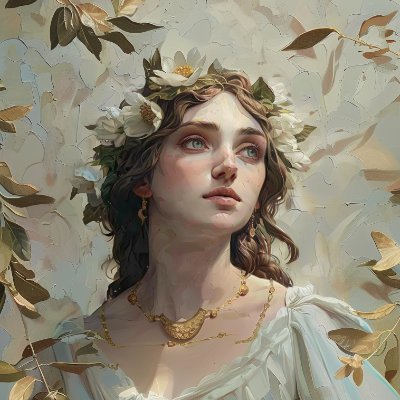

ALT Mysticism keeps men sane. As long as you have mystery you have health; when you destroy mystery you create morbidity. The ordinary man has always been sane because the ordinary man has always been a mystic. He has permitted the twilight. He has always had one foot in earth and the other in fairyland. He has always left himself free to doubt his gods; but (unlike the agnostic of to-day) free also to believe in them. He has always cared more for truth than for consistency. If he saw two truths that seemed to contradict each other, he would take the two truths and contradiction along with them. His spiritual sight is stereoscopic, like his physical sight: he sees two different pictures at once and yet sees all the better for that. Thus, he has always believed that there was such a thing as fate, but such a thing as free will also.


