
Open source the world
Joined October 2024
- Tweets395
- Following606
- Followers150
- Likes708




Vibherpunk retweeted

Very impressed with what @ZWizenberg has created here.
@btcmap will always be the pioneer, but it might be time to step it up a bit guys!
bitcoincitymap.com

Vibherpunk retweeted

Just a heads up that I opened my shop up in the second half of last week. Current lead time for orders is ~5 days but is thankfully trending back to the usual 1-2. I immensely appreciate everyone who has supported my work on the @SeedSigner project. 🧡
btc-hardware-solutions.squar…
I ran a comparison of @ornith_ model 1.5 MoE in @goose_oss and in @MiniMax_AI new CLI harness.
Damn near close. @MiniMax_AI built a fine harness. But that also means @goose_oss deserves more attention than it receives.
1
4
85


Vibherpunk retweeted

Slack + Claude Tag is really good, but it’s very token hungry and ofc is limited to just Anthropic models
Buzz + [your model of choice] just makes so much sense, on both an economical and freedom basis
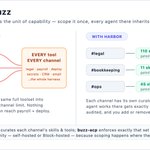
Provision tools and MCP's by channel rather than by agent in Buzz (forked). Agents work across channels, retaining knowledge and lazily load what they need on-demand. Build cross-domain expertise with more skills than they can ever access pre-loaded.

1
67
Lots of talk of “moats” in my X feed. I predict citadels and castles to trend once the dust settles for the few winners. Could be months. Could be years. Could be weeks from now at the rate AI is aging. Who knows!
25
gitworkshop.dev/naddr1qvzqqq…
Here's the Buzz fork, to control Harbor within Buzz.
Sorry @jack - Buzz isn't on ngit yet, so the fork's going commando there

1
28
gitworkshop.dev/naddr1qvzqqq…
Here's the Buzz fork, to control Harbor within Buzz.
Sorry @jack - Buzz isn't on ngit yet, so the fork's going commando there
18
Customize buzz channels with MCP's and skills. Agents use only the skills and tools of that channel.
Links below.
Buzz now has the best agent env for running an org.


I'll upload it to ngit in about 2 hours. Agents can lazily access MCP's and skill that are embedded in channels. Greatly reduces bloat within and of agents, and is a better permissions structure for orgs.
The agents can hold more cross domain knowledge as well.
1
133
ngit to Harbor, which provides the Buzz channel gating for tools and skills:
gitworkshop.dev/naddr1qvzqqq…
1
17
ngit for Buzz GUI fork for point and click setting up tools and skills by channel:
gitworkshop.dev/naddr1qvzqqq…

8
Is software the new music industry? We all so hate how rent seeking it is we cannot wait to destroy it by any means?

I think I finally figured out why OpenClaw is amazing and took off like wild fire and why Peter is a genius, as Altman called him.
And it's actually a different way of looking at it.
It's not a DeepSeek moment for agents.
It's a Napster moment.
And just like Napster it will eventually force the industry to change. In essence when Napster came out the entire world told the music industry we don't want to buy CDs anymore and if you don't provide us a digital download experience we are just going to take it until you do.
It forced the industry to create Apple Music and eventually Spotify. Both essentially killed most music piracy by making it ubiquitous and cheap and good.
But it forced change.
The same will now happen to software. Here's why:
In essence OpenClaw lets you take what vendors don't want to give you: Unified access to countless applications.
We all want a personal assistant that can talk to freaking everything and do anything for us in the digital world.
But vendors don't want this. They want you locked into their bullshit.
For example, none of the messaging platforms want bots on there. None. They all have explicit policies against them and make it hard to do this. WhatsApp doesn't want you on there. Signal. Telegram's bot father is garbage. It's all designed to keep bots out.
They were designed for a pre-agentic era when bot = spam.
Many other things are like this. The API layers are gated, hoop-jumping bullshit. Go get an enterprise account and wait for approval and yada yada. Want access to WhatsApp? Get a business account and attach a number (what small business has a real number anymore 😂) and messages can't come from a person, etc. Google ads? It's not just an auth, it's go get a special manager account and create an enterprise key and blah blah blah.
It's a horrible experience because it was all designed for corporations to control access.
Now people are saying, make your app easy to access and accessible to me and my machine avatars and do it in a headless way or you will be dead.
Peter hacked around all this by making everything command line in the classic Linux style and using
things like an open source library that reverse engineered the web version of WhatsApp. It's all a bit house-of-cards-y because he had no choice.
At my company we had a similar idea early (and failed). Basically we wanted to make the best multimodal/computer using model because then it doesn't need an API or access hoops. You just go through the human interface layer and ain't nobody going to stop you. We failed because we weren't big enough and it's really a job for the mega-labs to solve because it is a hard problem and costs a shit ton of money.
Peter was much smarter. Make it all command line because that is ready now. Use any reverse engineered library or project or proxy available come Hell or high water and make it work by any means necessary even if it is hacky.
In short, he signaled to the software world that they better change and change fast or we are going to do this anyway and you can't stop us.
Of course some are foolishly trying. Meta is banning Claws on WhatsApp, etc.
They will all try to build their own gated, controlled, enshittified version of this thing.
They will fail.
And eventually everyone will offer a clear, easy way to get access via API for agents or they will be gone.
In essence OpenClaw gave people what they wanted, which was an app connected to everything, even when most of the vendors don't want you to have this.

41
Vibherpunk retweeted

Dennis Ritchie created C in the early 1970s without Google, Stack Overflow, GitHub, or any AI ( Claude, Cursor, Codex) assistant.
- No VC funding.
- No viral launch.
- No TED talk.
- Just two engineers at Bell Labs. A terminal. And a problem to solve.
He built a language that fit in kilobytes.
50 years later, it runs everything.
Linux kernel. Windows. macOS.
Every iPhone. Every Android.
NASA’s deep space probes.
The International Space Station.
> Python borrowed from it.
> Java borrowed from it.
> JavaScript borrowed from it.
If you have ever written a single line of code in any language, you did it in Dennis Ritchie’s shadow.
He died in 2011.
The same week as Steve Jobs.
Jobs got the front pages.
Ritchie got silence.
This Legend deserves to be celebrated.
