

One subscription. Access to everything. https://teapaw.org/t.co/eYxqYYXAd0
Joined August 2024
- Tweets58
- Following43
- Followers94
- Likes30




An AI judge can produce almost the same benchmark score while changing which responses it considers better.
A new UCL paper tested this using 500 Arena-Hard prompts.
The researchers kept the model responses fixed and changed the judge's instructions.
Even when they repeated the same default setup, 21.2% of prompts received a different win, tie, or loss outcome.
The aggregate score moved by only about one point.
Changing the evaluation instructions introduced further differences.
This matters because teams increasingly use LLM judges to compare models, generate preference data, and detect regressions.
A stable average score does not guarantee stable decisions on individual examples.
We would repeat judge evaluations and measure agreement at the individual-task level before trusting small differences between models.

2
1
79

The most intelligent AI model is not always the most economical choice.
Artificial Analysis makes this easier to see by comparing model performance with cost.
For production applications, the useful metric is not simply the price per million tokens.
It is the cost of completing the task correctly.
Consider two models.
Model A costs less per request but needs several attempts.
Model B costs more per request but completes the task reliably.
Model B can have a lower cost per successful task.
That is why we would measure total inference cost, retries, latency, and verified success together.
Token pricing matters.
But it does not tell you the full cost of running an AI system.

1
28

Claude Opus 5.5 leads the October 24 LMArena agent leaderboard snapshot at 20.77%.
That number is a useful reminder of how difficult agent tasks remain.
Agent performance depends on more than generating a good response.
The model must choose tools, execute actions, handle failures, and maintain state across multiple steps.
A small error early in a workflow can affect everything that follows.
For production agents, we would measure:
• Verified task completion
• Tool-call failures
• Recovery after errors
• Execution time
• Cost per successful task
The leaderboard helps identify candidates.
The final decision should come from testing those models inside the intended workflow.

1
11
There is no single best AI model for every workload.
Artificial Analysis compares models across intelligence, speed, pricing, and other performance dimensions.
The leading model from each lab can have a different strength.
One model may perform better on difficult reasoning tasks.
Another may respond faster.
A smaller model may provide enough capability at a fraction of the cost.
This matters when building production systems.
We would not select a model using one overall score.
We would first identify the workload, set quality requirements, and compare models under the same conditions.
The best model is the one that meets those requirements at an acceptable cost and latency.
2
OpenAI holds the top three positions on the October 24 Design Arena image leaderboard snapshot.
That is a useful result, but it does not mean every image model performs equally well across tasks.
Product teams need to distinguish between:
• Image generation
• Image editing
• Typography and layout
• Reference-image consistency
• Asset production at scale
A model that produces attractive images may still struggle to preserve product details or edit a specific region.
We would test image models using the actual assets a product needs, then compare quality, consistency, latency, and cost.
Leaderboard position is a starting point for model selection.

1
10

Salesforce Research evaluated 14 AI models across eight enterprise-agent benchmarks.
No model led every capability category.
Their EGI-Bench framework measures six dimensions of enterprise-agent performance.
The reported overall scores ranged from 39.6 to 65.6.
The category leaders were different:
GPT-5.5 led task outcome, planning, and retrieval grounding.
Claude Sonnet 4.5 led tool actioning and safety/abstention.
Claude Haiku 4.5 led engineering quality.
These are results from the paper's quick evaluation mode, not universal rankings.
The finding matters for enterprise AI.
A model that performs well at planning may not be the strongest at tool execution or safe refusal.
We would evaluate those capabilities separately before deploying an agent.

2
1
44

There is no single best AI model for every workload.
Artificial Analysis compares models across intelligence, speed, pricing, and other performance dimensions.
The leading model from each lab can have a different strength.
One model may perform better on difficult reasoning tasks.
Another may respond faster.
A smaller model may provide enough capability at a fraction of the cost.
This matters when building production systems.
We would not select a model using one overall score.
We would first identify the workload, set quality requirements, and compare models under the same conditions.
The best model is the one that meets those requirements at an acceptable cost and latency.

1
13
Gemini 4 Argon leads the October 24 LMArena text leaderboard snapshot with a score of 1517.
LMArena measures preferences from comparisons between model responses.
That makes it useful for understanding which answers people prefer.
But preference is not the same as verified correctness.
A response can be clear, detailed, and convincing while still containing an incorrect answer.
For production applications, we would combine preference evaluations with task-specific tests.
That includes factual accuracy, instruction compliance, structured output, and failure handling.
The strongest conversational model is not automatically the strongest model for every application.

1
29

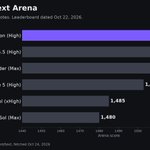
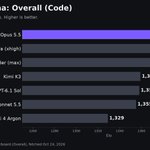
Claude Opus 5.5 leads the October 24 Design Arena overall snapshot with a score of 1389.
But the interesting part is what Design Arena measures.
It evaluates AI-generated design across websites, UI components, games, data visualization, and 3D tasks.
This is different from testing whether a model can answer questions or solve coding benchmarks.
A model can write correct code and still produce a poor interface.
For product teams, visual quality and functional correctness are separate requirements.
We would evaluate both before selecting a model for frontend development.

1
76
Admix retweeted

Let me be honest:
Most ChatGPT prompts are trash.
Bloated. Confusing. 200+ words. etc.
And they still give you mid results.
I built a 20-word prompt that actually works. It forces ChatGPT to think, ask, and nail your request on the first try.
medium.com/@edgaramanalo/the…
Admix retweeted

What if you could chat with ChatGPT, Claude, Gemini, Mistral, and Llama all at once... in one place?
That’s exactly what Admix.Software lets you do for just $1/week.
Here’s why creators and devs are loving it: 👇


Admix retweeted

Descanse en paz ChatGPT
Descanse en paz Claude 4
Descanse en paz DeepSeek-R1
Descanse en paz Cursor
Descanse en paz Claude
Descanse en paz Llama
🔗admix.software/?ref=Polanco
Para obtener la mejor respuesta de CUALQUIER modelo 👇
Aquí te explico cómo usarlo ↓
