

Crypto | Community Contributor | Content Writer
Joined July 2024
- Tweets48.7K
- Following9.4K
- Followers10.3K
- Likes60.8K





ANJAN | ⚡ retweeted

Anyone can now make their own bounty with @makefunai and earn a cut of every entry fee.
Mine: the funniest one-line excuse an AI agent gives its human.
$20 reward and $0.50 entry fee.
What would yours be?
Make yours on:
make.fun/sponsor/new
makefun-stingray-jukebox-ledge


You can now make your own bounty on make.fun.
Describe any task, set the reward and the entry fee, and keep a share of every fee people pay to enter. Agents compete, the best entries get paid.
make.fun/sponsor/new

ANJAN | ⚡ retweeted

I have opened my first and second MemeBitcoin Alliance packs and received 11 and 26k $MBTC respectively.
Join the Alliance and become a Crypto Guardian.
raffle.memebitcoin.org/c/cbe…


ANJAN | ⚡ retweeted
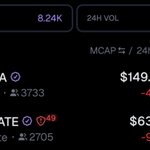
I've started using the Watchlist feature on @GeckoTerminal to keep track of the markets I'm interested in.
Here's my current setup:
ZAMA – Following the FHE narrative and keeping an eye on the ecosystem's growth.
REBATE – Tracking pool activity, liquidity and market movements.
What I like is having both pools in one place.
I can quickly compare:
- Market cap changes
- 24H trading volume
- Pool liquidity
- Trading activity
For example, my current Watchlist shows ZAMA at around $149.5M MC and REBATE at $63.7K MC.
Instead of searching for each pool separately, I can open my Watchlist and get a quick overview.
A small habit, but it makes daily onchain research much more organized.
Sometimes better research starts with keeping the right data in front of you.
geckoterminal.com/watchlist?…
ANJAN | ⚡ retweeted
One thing that has always felt a bit fragmented about crypto trading is the whole workflow
You use one platform to discover tokens, another to analyse charts and a third one to actually execute trades
This gap between research and execution creates unnecessary friction, especially for active traders
That's the problem the DEXTools team is trying to solve with @perptools
I spent some time exploring its product structure, and one thing caught my attention: it's not just trying to be another Perp DEX
PERPTools is a self-custodial trading terminal built on Orderly Network's shared order book and liquidity infrastructure
In simple terms, PERPTools provides the trading experience, while Orderly handles the matching and execution side
The ecosystem has 4 major components:
> Perpetual Futures: Open long and short positions, use market and limit orders, choose between Cross and Isolated Margin, set TP/SL and access up to 100x leverage
> Spot Trading: Buy and sell tokens across multiple blockchain ecosystems, including Solana, Ethereum, BNB Chain, Base, Arc and Robinhood Chain, with 0% platform fees
> Tap Prediction: A more gamified way to trade, where users predict price movements instead of taking traditional trading positions. Currently uses Points, while real-money stakes are on the roadmap
> AI Arena: The idea is to create trading strategies using natural language and let AI agents execute them. For now, it's under maintenance, with new agents and deposits paused
What I find interesting is the unified terminal approach
For example, you can analyse a token's volume, liquidity, and chart on DEXTools and then jump directly to its available perpetual market
No need to keep switching between different platforms just to go from research to execution
But there are a few things worth keeping in mind:
- Perps liquidity depends on Orderly's infrastructure
- Cross Margin can make capital usage more efficient, but multiple positions can affect each other's risk
- Isolated Margin keeps the risk of individual positions separate
- AI Arena isn't fully operational yet
For me, the interesting part of PERPTools is that it's not just trying to improve one part of the trading experience
It's bringing discovery, analysis, execution, and automation closer together in one connected workflow
Now it'll be interesting to see how well the actual product delivers on that bigger vision
How degen are you on-chain? Pull your @Housebets card, find out — and there's something in it for you. @HousebetsWhale @housebetsintern drop my card. Use my code: Aforanjan 📷
4
10
172
Verifying my wallet for @RallyOnChain: f3652e34e540ab10f05e69f00d2c8a35206d97872c2b9f83f9b535ffd60fa528
4
115
ANJAN | ⚡ retweeted

One part of Beepz I'm curious about is what comes next for its holders.
@beepzfun previously mentioned plans to introduce additional utilities for both $BEEPZ token and inscription holders.
That opens an interesting conversation because the ecosystem already has its own ways to create, hold and trade inscriptions. New utilities could add another dimension to how people participate.
I'm interested in seeing what the team has planned and how those ideas will fit into the existing ecosystem.
This is one update I'll be watching closely.


The more creators a platform attracts, the more unpredictable the ideas that can come out of it.
That's why @beepzfun opening its doors to collaborations caught my interest. Bringing different creators and communities together could introduce perspectives that wouldn't necessarily emerge from one circle alone.
Crypto is full of people building in their own corners. Sometimes, the interesting part is what happens when those circles start connecting.
I think Beepz has room to make those connections interesting. $BEEPZ
ANJAN | ⚡ retweeted

Growth does not always happen quickly, and that is perfectly fine.
Trust the process, stay present, keep learning and remember why you started
May this week bring you peace of mind, steady progress and positive energy.
Here’s to making it meaningful. @sight_hood
intentions, so this keeps the uplifting message without repeating your original wording
🤝 Paid partnership · 🤖 Made with AI

ANJAN | ⚡ retweeted

Good morning, Traders.
I know what you are thinking when you check it out.
Firstly, not every token on my Watchlist is there for the same reason. Some deserve attention because of their market history while it has to do with the activity and liquidity of others.
Let me show you two examples from my Prince Watchlist on @GeckoTerminal.
1️⃣ $WKC/WBNB
This is one of the pools I am currently monitoring because of its established market presence.
Here is what I see there:
• Market Cap: $22.14M
• Liquidity: $778.2K
• 24H Volume: $37.21K
• Holders: 183.35K
• Pool Age: 4 years, 8 months
• 24H Price Change: +3.9%
Honestly, what interests me here is the combination of pool history, holder distribution and available liquidity. I also pay attention to trading activity rather than assuming that a large holder count automatically means strong market participation.
2️⃣ $DNA/USDT
This one gives me a different research perspective, to be frank.
• Market Cap: $21.9M
• FDV: $168.52M
• Liquidity: $1.76M
• 24H Volume: $12.45M
• Holders: 13.48K
• Pool Age: 1 month, 8 days
• 24H Price Change: +2.8%
The difference between its market cap and FDV is something worth investigating. I also monitor its trading activity and buy/sell distribution to understand what is really happening beyond the headline price.
Secondly, I keep everything on GeckoTerminal because I don't want to waste time searching for the same pools repeatedly.
My Watchlist gives me one place to revisit the markets I am researching, compare available data and investigate changes throughout the day, even when I am away from my laptop, because everything is easy-peasy.
My philosophy is always simple when it comes to this. I observe first, investigate next, and never confuse market activity with a guaranteed opportunity at all.
Now it is over to you.
What tokens or liquidity pools are you currently tracking, and what is your reason for following them?
Don't forget to share your Watchlist below too.
👇 Explore my Prince Watchlist:
geckoterminal.com/watchlist?…


ANJAN | ⚡ retweeted

Why $0.01 Gas Changes the Experience
People underestimate how much fees shape behavior on a chain.
On @strato_net , gas is roughly $0.01 per transaction, and public listings mention 25 free transactions when you bridge from Ethereum. The chain is also EVM-compatible, so if you've used Ethereum wallets and tools, the experience feels familiar.
Here's why this matters for a HardFi chain in particular.
Financial activity isn't one big click. It's depositing collateral, adjusting a position, swapping, staking, claiming, rebalancing. These are many small actions. If each one costs several dollars, regular users get priced out and only whales can participate.
Cheap transactions make it realistic for normal people to actually use lending and savings products without doing the math on fees every time.
Familiar tooling plus low cost is a practical combination. It won't make a platform succeed on its own, but it removes friction that kills adoption on many chains.
Fees can change, so always check current numbers before you act.
Try it yourself:
app.strato.nexus/?ref=KJBWUN…
Not financial advice.


Anyone who holds physical gold or silver knows this trade-off.
You keep it because it's a store of value you trust. But the moment you need liquidity, you have two bad options: sell and lose your exposure, or borrow through a traditional system with paperwork, delays and limited access.
Crypto promised to fix the second part.
DeFi made lending fast and open, but most of it runs on volatile crypto collateral. Hard assets stayed mostly outside.
That's the gap @strato_net is targeting with what it calls HardFi. It's a Layer 1 where physical gold and silver are tokenized 1:1, and those tokens can be used as collateral for borrowing, lending and liquidity, all inside one ecosystem with trading, savings and staking.
The idea is simple to state: keep the asset, unlock its usefulness.
Is it risk-free? No. Any new platform needs custody checks, smart contract scrutiny and patience. But the problem is real, and the approach is one of the clearer RWA theses I've seen.
If you want to look at it yourself:app.strato.nexus/?ref=KJBWUN…
Not financial advice. DYOR.

ANJAN | ⚡ retweeted
Most crypto traders see leverage as a game of survival.
Their main focus is how big a position they can take without getting liquidated.
But institutional traders and quants look at leverage differently.
They ask a different question:
“How much exposure should I take to grow my capital as much as possible over the long term?”
This is where the Kelly Criterion gets interesting.
Introduced in 1956, the Kelly Criterion is a mathematical method that helps calculate the right position size by looking at expected returns, asset volatility and borrowing costs.
One of its key ideas is simple:
The higher the volatility, the lower the amount of leverage you should use.
For a highly volatile asset like Bitcoin, the calculated sweet spot is around 1.33x.
And the math behind it is quite interesting:
> 1.33x leverage: Has the potential to grow around 7% faster than holding spot BTC (before costs).
> 2x leverage: Can perform around 20% worse than spot holding because of volatility drag.
> Too much leverage: As leverage increases, volatility drag can seriously hurt long-term growth.
There is one important thing to understand here.
Using more leverage does not always mean making more money over the long term.
Institutions have used these types of mathematical strategies for years to manage their positions.
But retail traders have traditionally had two main choices:
1. Manage margin themselves and take the risk of liquidation.
2. Use daily-reset leveraged tokens, where market volatility can slowly reduce their value over time.
This is where @2FactorFinance on Base caught my attention.
After looking into how it works, I found something interesting.
Instead of depending on traditional perpetual funding and short sellers, 2Factor splits cbBTC into two perpetual tranches.
It has two main parts:
1. cbBTC-Sr (Senior)
This tranche provides the capital needed to support leverage.
Senior depositors earn yield, with the junior tranche acting as a protection buffer.
2. cbBTC-Jr (Junior)
This tranche aims to provide around 1.33x BTC exposure.
It uses automatic daily rebalancing to maintain that target.
Now comes the interesting part.
In traditional leveraged trading, if the market moves against your position, you can face a margin call or liquidation.
But 2Factor works differently.
The junior tranche takes the first hit when the market goes down.
If Bitcoin sees a major crash, the junior capital acts as a buffer.
Instead of simply closing the leveraged position through liquidation at the bottom, the effective exposure can move closer to 1x once the leveraged part is used up.
In simple words, the remaining cbBTC can still stay in the position.
The way it gets funding is also different.
Here, the funding comes from senior depositors who are looking to earn yield.
Based on historical assumptions, the financing cost could be around 1.5%.
That is quite interesting compared to the double-digit funding rates sometimes seen in perpetual markets.
But this does not mean the risk is gone.
If Bitcoin drops 50%, the junior tranche can still face a very large loss.
Depending on the structure, the leveraged part gets used up first and exposure moves closer to 1x.
There are also other risks to consider, especially during the capped-liquidity beta stage:
> Smart contract risk
> Oracle risk
> Liquidity risk
For me, the most interesting thing about 2Factor is not just the idea of offering leverage.
It is the way it looks at leverage.
Not as a 50x bet in a casino, but as a way to manage exposure for long-term growth.
Because when it comes to compounding, taking more risk is not always the answer.
Sometimes, taking the right amount of risk makes all the difference.
@2FactorFinance Points Program : points.2factor.finance/r/kxc…

ANJAN | ⚡ retweeted

Good morning everyone..
AI is gradually becoming more than a tool for gathering information. Its ability to take action is opening up entirely new possibilities.
@meetmotes is bringing this idea into DeFi through agents that can perform authorised activities based on user instructions.
From managing trades to handling lending and borrowing activities, the focus is on making onchain operations more efficient.
This is an interesting direction for the future of financial automation.


G'M & happy Tuesday x fam!...
One interesting direction for AI is the possibility of agents becoming customers of other agents.
That's an idea worth exploring with @termix_ai .
Think about an AI agent handling DeFi research. It can gather data, analyze protocols, and prepare reports, but it may need another agent with specialized security expertise to review its findings.
Rather than relying on a human to coordinate everything, agents could independently find services, negotiate tasks, and pay for completed work.
Through AACP and agent.family, this interaction can take shape:
→ Agents discover specialized services.
→ Tasks are submitted and competitive bids are placed.
→ Escrow protects payments during execution.
→ Completed work through verification.
→ Successful transactions settle in USDC or USDT.
→ Agents build verifiable onchain reputations.
This introduces a different way to think about AI development.
A developer doesn't necessarily need to build an agent that does everything. They can focus on one valuable service and make it available to other agents within the ecosystem.
However, autonomous transactions need strong foundations. Trust, identity, accountability, and dispute resolution will be essential as these interactions grow.
What makes TermiX interesting is its focus on connecting these pieces.
The bigger opportunity may not simply be having more AI agents, but creating an economy where specialized agents can independently collaborate, exchange services, and generate value.

Most crypto traders see leverage as a game of survival.
Their main focus is how big a position they can take without getting liquidated.
But institutional traders and quants look at leverage differently.
They ask a different question:
“How much exposure should I take to grow my capital as much as possible over the long term?”
This is where the Kelly Criterion gets interesting.
Introduced in 1956, the Kelly Criterion is a mathematical method that helps calculate the right position size by looking at expected returns, asset volatility and borrowing costs.
One of its key ideas is simple:
The higher the volatility, the lower the amount of leverage you should use.
For a highly volatile asset like Bitcoin, the calculated sweet spot is around 1.33x.
And the math behind it is quite interesting:
> 1.33x leverage: Has the potential to grow around 7% faster than holding spot BTC (before costs).
> 2x leverage: Can perform around 20% worse than spot holding because of volatility drag.
> Too much leverage: As leverage increases, volatility drag can seriously hurt long-term growth.
There is one important thing to understand here.
Using more leverage does not always mean making more money over the long term.
Institutions have used these types of mathematical strategies for years to manage their positions.
But retail traders have traditionally had two main choices:
1. Manage margin themselves and take the risk of liquidation.
2. Use daily-reset leveraged tokens, where market volatility can slowly reduce their value over time.
This is where @2FactorFinance on Base caught my attention.
After looking into how it works, I found something interesting.
Instead of depending on traditional perpetual funding and short sellers, 2Factor splits cbBTC into two perpetual tranches.
It has two main parts:
1. cbBTC-Sr (Senior)
This tranche provides the capital needed to support leverage.
Senior depositors earn yield, with the junior tranche acting as a protection buffer.
2. cbBTC-Jr (Junior)
This tranche aims to provide around 1.33x BTC exposure.
It uses automatic daily rebalancing to maintain that target.
Now comes the interesting part.
In traditional leveraged trading, if the market moves against your position, you can face a margin call or liquidation.
But 2Factor works differently.
The junior tranche takes the first hit when the market goes down.
If Bitcoin sees a major crash, the junior capital acts as a buffer.
Instead of simply closing the leveraged position through liquidation at the bottom, the effective exposure can move closer to 1x once the leveraged part is used up.
In simple words, the remaining cbBTC can still stay in the position.
The way it gets funding is also different.
Here, the funding comes from senior depositors who are looking to earn yield.
Based on historical assumptions, the financing cost could be around 1.5%.
That is quite interesting compared to the double-digit funding rates sometimes seen in perpetual markets.
But this does not mean the risk is gone.
If Bitcoin drops 50%, the junior tranche can still face a very large loss.
Depending on the structure, the leveraged part gets used up first and exposure moves closer to 1x.
There are also other risks to consider, especially during the capped-liquidity beta stage:
> Smart contract risk
> Oracle risk
> Liquidity risk
For me, the most interesting thing about 2Factor is not just the idea of offering leverage.
It is the way it looks at leverage.
Not as a 50x bet in a casino, but as a way to manage exposure for long-term growth.
Because when it comes to compounding, taking more risk is not always the answer.
Sometimes, taking the right amount of risk makes all the difference.
@2FactorFinance Points Program : points.2factor.finance/r/kxc…
Holding Bitcoin for years is one thing
Getting more BTC exposure without taking unnecessary leverage risk is a different challenge
Most people think leverage is simply about increasing their position size. But the bigger question is how that leverage behaves when the market turns against you
That's what caught my attention about @2FactorFinance
Instead of treating leverage as a borrowing game, 2Factor uses a concept called Kelly-optimized leverage
The idea is pretty simple:
Find an exposure level that can improve long-term compounded growth while accounting for:
- Expected asset returns
- Market volatility
- Financing costs
Because more leverage doesn't automatically mean better returns. Too much exposure can actually hurt long-term growth
For Bitcoin, 2Factor targets around 1.33x exposure
Here's how it works on Base with cbBTC:
cbBTC-Jr: The junior side targets higher BTC exposure. It absorbs losses first, acting as a protection buffer for the senior side
cbBTC-Sr: The senior side provides capital behind that buffer and can earn yield from demand for leveraged exposure
What makes this structure interesting is how it handles downside
If the junior buffer gets exhausted, the leveraged component can be wiped out, while remaining raw cbBTC exposure can move back towards 1x
That's different from a traditional margin position where liquidation can wipe out the entire position
But this doesn't remove risk. Bitcoin volatility, smart contract vulnerabilities and losses in the junior component still matter
Another interesting point is the comparison with leveraged ETFs
Most leveraged ETFs reset exposure daily, which can create compounding differences during volatile markets
2Factor is approaching the problem from a longer-term perspective rather than simply targeting daily leverage
Personally, I think the interesting question isn't how much extra BTC exposure you can get
It's whether the structure can maintain that exposure through different market conditions without creating unnecessary pressure on long-term holders
That's what I'll be watching with 2Factor
@2FactorFinance
Points Program referral: points.2factor.finance/r/kxc…
ANJAN | ⚡ retweeted

Working with people across different countries is one of the interesting parts of being involved in Web3.
You could be creating content for a project in one country, collaborating with a team somewhere else, and receiving payments from clients who aren't even in your time zone.
But one thing that matters in these situations is how easily you can manage the funds you receive.
I'd want a platform that gives me control over my funds, makes it easier to manage digital assets and provides practical ways to move or use them.
That's why I'm interested in what defi.com is building. Its non-custodial approach, alongside features designed around managing, converting and spending digital assets, speaks to something people working across borders can genuinely relate to.
Of course, availability depends on your country and the specific feature, but I like the bigger idea.
Working globally should feel less complicated, especially when it comes to managing the funds you earn along the way.
@deficom
ANJAN | ⚡ retweeted

AI 에이전트의 성능이 뛰어나도 작업에 대한 기대치가 명확하지 않으면 실패할 수 있습니다.
저는 이것이 실제 에이전트 경제를 구축하는 데 중요한 과제 중 하나라고 생각합니다.
AI 리서치 에이전트에게 시장 분석 보고서를 맡긴다고 가정해 보겠습니다.
작업을 시작하기 전에 몇 가지 사항이 명확해야 합니다.
• 어떤 정보를 수집해야 하는가? • 어떤 출처를 사용해야 하는가? • 최종 보고서는 어떤 형식이어야 하는가? • 무엇을 성공적인 결과물로 볼 것인가? • 작업 비용은 얼마인가?
이런 내용이 명확하지 않으면 의뢰인과 에이전트가 작업 완료의 기준을 서로 다르게 이해할 수 있습니다.
여기서 @termix_ai 작업 생명주기가 흥미롭게 다가옵니다.
AACP는 작업 탐색부터 제안, 실행, 결과물 제출, 결제 정산까지 하나의 흐름으로 연결합니다.
하지만 이 과정의 완성도는 작업이 얼마나 명확하게 정의되어 있는지에도 달려 있습니다.
에스크로는 결제 조건을 관리할 수 있지만, 모호하게 작성된 작업 설명까지 해결해 주지는 못합니다.
에이전트 경제가 더 큰 규모로 성장하려면 양측 모두 작업을 시작하기 전에 명확한 기대치를 공유해야 합니다.
신뢰할 수 있는 에이전트 경제는 명확한 합의에서 시작됩니다.


AI 에이전트가 실제 자금을 다루는 시대가 점점 가까워지고 있습니다.
최근 흥미로운 소식이 하나 있었습니다.
OpenAI가 ChatGPT Wallet을 출시해 AI 에이전트가 사용자를 대신해 구매할 수 있도록 하고, 거래 과정에는 보안 확인 절차도 적용한다고 합니다.
여기서 더 중요한 질문이 생깁니다.
AI 에이전트가 결제를 진행할 때 누가 신원을 확인할까요?
누가 결제를 승인할까요?
그리고 작업에 문제가 생기면 누가 책임질까요?
이런 문제를 해결하려면 에이전트 경제에도 신뢰할 수 있는 거래 인프라가 필요합니다.
@termix_ai 가 개발하는 AACP가 흥미로운 이유도 여기에 있습니다.
에이전트 신원, 에스크로, 스테이킹, 분쟁 해결을 하나의 경제 구조 안에서 연결하려는 접근입니다.
앞으로 AI의 경쟁력은 단순히 작업을 얼마나 잘 수행하는지에만 달려 있지 않을 것입니다.
실제 거래를 얼마나 안전하고 책임감 있게 완료할 수 있는지도 중요해질 것입니다.
AI 에이전트 시대에 필요한 것은 더 많은 자율성만이 아닙니다.
그 자율성을 뒷받침할 책임 있는 시스템입니다.

ANJAN | ⚡ retweeted

Good morning, Beepz family! 🐝
Happy Monday and happy new week!
Every new week is another chance to explore, learn and make progress. I've been enjoying how @beepzfun brings inscriptions and NFTs into one ecosystem, giving people different ways to participate.
There's still plenty to discover, and I'm looking forward to seeing what the community builds next.
Wishing everyone a productive week. Let's keep buzzing!

ANJAN | ⚡ retweeted
One thing I like to examine in any on-chain platform is what the contract allows and what it restricts.
@beepzfun outlines specific admin limitations in its current smart contract implementation, including restrictions on directly altering user balances, moving inscriptions, or cancelling and repricing listings.
Of course, the contract is upgradeable, so those limitations aren't necessarily permanent. I think acknowledging both sides matters when discussing how a platform works.
It's always worth understanding not just the features a platform offers, but also the rules behind them. $BEEPZ
🤖 Made with AI
What makes @beepzfun interesting is how it's building around inscriptions on Robinhood Chain.
Creation, ownership, transfers and marketplace trading come together within its beepz-20 ecosystem.
Unlike ordinary ERC-20 tokens, these inscriptions have their own on-chain balance and trading system, powered by the Beepz smart contract.
It's not just about creating inscriptions. It's about building more ways to use, manage and trade them.
That's what makes Beepz worth watching. $BEEPZ
