

Sharing ideas, conversations, events & news of the African Scholars Research Network from Northern Ireland & beyond. Contact [email protected].
- Tweets392
- Following144
- Followers157
- Likes555







ALT A webpage with photographs and text


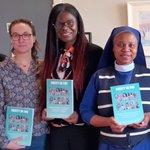
ALT Photo of three women holding copies of the book 'Equity in the Workplace.' From left to right: Prof Dina Belluigi, co-author and academic at Queen's University Belfast; Dr Ebun Joseph, editor of the book, academic, and CEO and founder of the Institute of Anti-racism and Black Studies; and Dr Felicity Kalu, co-author and academic at Queen’s University Belfast.

ALT Group photo of seven women seated around a café table, each holding a copy of the book 'Equity in the Workplace: Stories of Black Irish Women in Academia and the Teaching Profession.' Visible at the table are (left to right): Dr Felicity Kalu (front left), Prof Dina Belluigi (far left), Dr Oluwadamilola "Dami" Osekita, Doctoral candidate Leanne Zarroug, Dr Eiman Abdel Meguid, Dr Ebun Joseph, and Dr Gift Sotonye-Frank.


ALT A poster

ALT LeAnne Zarroug stands at a wooden podium presenting to a seated audience at Queen’s University Belfast. She is mid-speech, wearing a black top and glasses. Behind her is a window with blinds, and in front of her, audience members listen attentively. A red @QUBelfast table banner is partially visible.

ALT Screenshot of the programme for Panel 2, titled 'Understanding Causes of Unequal Treatment.' Presenters include: Monish Bhatia (University of York), Lucy Michael (Research Training and Consultancy), Emma Soye (Queen’s University Belfast), and LeAnne Zarroug (Queen’s University Belfast). Topics address deportation, migration, mobility, human rights, and the experiences of Black female students in Northern Ireland.

ALT Banner for a conference titled 'Let’s not talk about racism: Why it is hard to talk about and how this affects society in Northern Ireland.' The event is hosted by the Centre for the Study of Ethnic Conflict and the Centre for Inclusion, Transformation and Equality at Queen’s University Belfast, taking place April 1–2, 2025 at 27 University Square.
ALT Photo of three women holding copies of the book 'Equity in the Workplace.' From left to right: Prof Dina Belluigi, co-author and academic at Queen's University Belfast; Dr Ebun Joseph, editor of the book, academic, and CEO and founder of the Institute of Anti-racism and Black Studies; and Dr Felicity Kalu, co-author and academic at Queen’s University Belfast.
ALT Group photo of seven women seated around a café table, each holding a copy of the book 'Equity in the Workplace: Stories of Black Irish Women in Academia and the Teaching Profession.' Visible at the table are (left to right): Dr Felicity Kalu (front left), Prof Dina Belluigi (far left), Dr Oluwadamilola "Dami" Osekita, Doctoral candidate Leanne Zarroug, Dr Eiman Abdel Meguid, Dr Ebun Joseph, and Dr Gift Sotonye-Frank.

ALT Group photo of seven people, some holding a copy of the book 'Equity in the Workplace: Stories of Black Irish Women in Academia and the Teaching Profession.' Visible are (left to right): Dr Eiman Abdel Meguid, Doctoral candidate Leanne Zarroug, Prof Dina Belluigi, Dr Ebun Joseph, Dr Felicity Kalu, Dr Gift Sotonye-Frank, and Dr Oluwadamilola "Dami" Osekita.


ALT A person speaks before a group of seated people in an interior

ALT A person sits at a table with hands gesturing and papers on the table


ALT Graphic announcing Dr Linda Oyama at the IOI Early Career Researcher Conference Friday 21 March @ Saïd Business School. A picture of Dr Linda Oyama accompanied by text: Early Careers Research Conference at IOI. Register your free place before 28 February.


ALT Graphic announcing Dr Linda Oyama at the IOI Early Career Researcher Conference Friday 21 March @ Saïd Business School. A picture of Dr Linda Oyama accompanied by text: Early Careers Research Conference at IOI. Register your free place before 28 February.

ALT "social movements have sought recourse outside formal legal processes through protest such as the 2016 #RUReferenceList protests at Rhodes University against rape culture and sexual violence, the global #MeToo movement that went viral in 2017, and the 2018 #TotalShutDown protests. Institutions often respond in ways that assert their power and prioritise institutional prestige at the expense of survivors and their experiences. When the South African Supreme Court of Appeal found in Yolanda Dyantyi’s favour in March 2022 in Dyantyi v Rhodes University, it overturned Rhodes University’s decision to convict and permanently exclude her for disciplinary charges stemming from her participation in the 2016 #RUReferenceList protest. The Court’s decision represents an important check on the institutional power exercised by public institutions such as universities, by upholding the rights of all people to procedurally fair administrative processes including disciplinary proceedings. "

ALT A screen shot of the first page of the article, 'The routes to intellectual authority in a prior colonial empire: continued racialised, geopolitical inequalities in the academic staff composition and employment conditions of UK universities'.

ALT The screen shot shows three articles, with these titles: 'Beyond a sense of obliviousness: elite education and national identity among Palestinian students in Israel', '‘Not ours’: Palestinian Arab students’ perceptions of the campus ethnonational climate in Israeli higher education', ''They don’t really know what they’re getting into': the impact of neoliberal and colonial policies within Israeli institutions of higher education on Palestinian Jerusalemite students'.

ALT Three articles on a screen shot, with the titles, 'You’re nobody until somebody kills you: the ingredients of Black death for social justice and D̶E̶I̶ DIE', 'A call to reshape our desires: contesting the “inevitable answer” of inclusion within empire', '“We are stronger than fear of hate”: a longitudinal study amplifying the voices of Asian American and migrant teachers amidst COVID-19'

ALT A screen shot with two papers, with the titles '“It’s like there is a veil placed over racial issues”: AfroBrazilians’ educational experiences negotiating transnational racialization and the pedagogy of Mestizaje of the Americas', 'The routes to intellectual authority in a prior colonial empire: continued racialised, geopolitical inequalities in the academic staff composition and employment conditions of UK universities'

ALT Professor Joan Loughrey, Veronika Pavelova, Eoin Clarke, Dr John Taggart, Dr Nora Burns, Dr Adeniyi Olayode, Dr Victoria Barnes


