

Redefining digital trust. AgentDNA encodes authenticity, governance, and context into every intelligent entity
Singapore
Joined November 2025
- Tweets332
- Following6
- Followers22
- Likes234


Pinned Tweet
AgentDNA is live now!
The first unified trust layer for multi agent systems, built on ultra scalable DAG of @RubixChain.
pypi.org/project/agent-dna/
Why AgentDNA?
1. Auth: Current static auth systems built for humans/static APIs dont work for Agents. AgentDNA introduces dynamic DIDs

AgentDNA retweeted

More than a quarter of people doing shopping with #Muse - that seems big for a month old app. If this share sustains with larger penetration to be seen, but agentic commerce appears a real deal. Need to fix agentic security though at first!

AgentDNA retweeted
Agree, banks have a big fraud and liability issue to address. Some big unanswered questions:
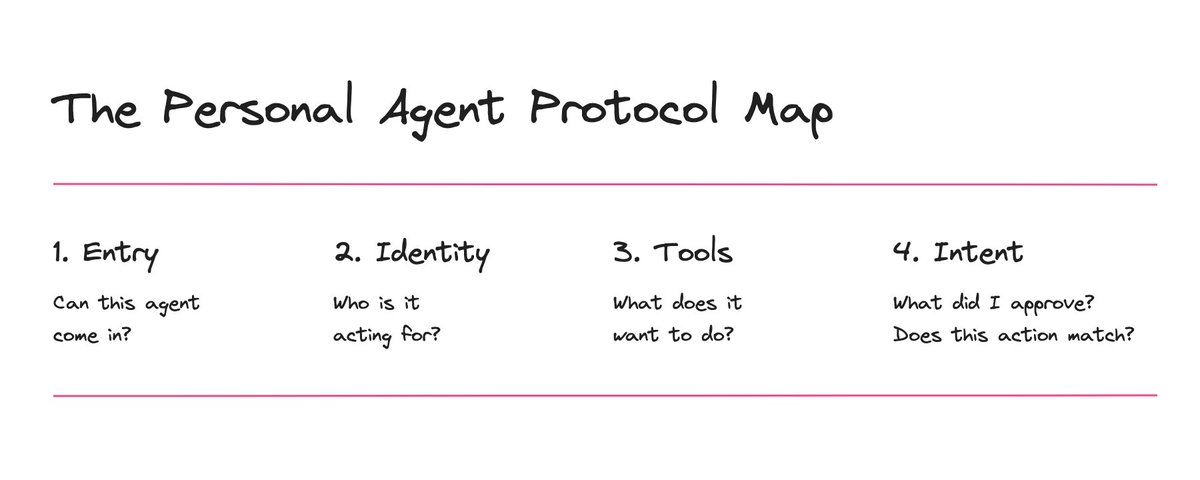
1. If the user denies the agent action, how does bank prove the user did give consent.
2. How does the bank prove user gave the credential willingly and not misused by the agent.
3. Is the agent a legitimate rep of the user or a hacker who stole credentials
4. Is the intended action approved by the user even if credential shared. How is the intent verified dynamically?
5. Agents by design would like to have the broadest intent (even users may be ok), but how does bank enforce explicit auth from user when it wants.
6. Did the agent create sub agents to act ?
7. Is the agent prompted to do a malicious activity.
Even as banks are trying to deal with agentic actions, AI is making passwords and biometrics themselves highly risky. We need to ensure the hardened user root of trust (eliminate passwords) to pass onto agents and enforce continuous auth. And treat agentic actions as not simple key or x406 certain based auth, but derived from continuous DNA. KYA and KYH will need to replace KYC.
AgentDNA retweeted
Anecdotal reports of similar losses at multiple banks in the recent weeks - does not look isolated to Central Bank. This theft seems to be breach of core banking access controls at the bank end. Banks must immediately assess their core banking access controls and shift away from password/OTP/api key based legacy systems. @EnsurityTech

India news: Central Bank of India lost ₹13.96 crore in 187 unauthorised RTGS transfers to 36 banks from Oct 15 to 17, police say. Unknown people allegedly got into the RBI-owned IFTAS Central SFMS server through the bank's core banking system.
The money was customers' funds. The bank first called it a "technical glitch". RBI, CERT-In and NCIIPC have been told and Maharashtra cyber police have a case.
If you bank there, check your RTGS debits from those dates.
hindustantimes.com/cities/mu…

AgentDNA retweeted
Agents appearing to act beyond users instructions is not itself a breach. It is just that tools dont exist to bind agents to users for limited scope. We have been building control mechanisms with @Agent_DNA. However, since agents like #Muse have access to API keys and passwords of users, hackers can steal them to attack banks. This is a real and big risk.


AgentDNA retweeted
Agents are currently using users credentials and API keys to access. This must stop. Agents cant use users credentials, they must have own ID and get scoped auth permissions from users. @Agent_DNA Chain of Custody Auth ensures agents cant have sweeping permissions.


AgentDNA retweeted
It is 2026 and we are still seeing breaches due to credential theft and passwords, with wide blast surface. Two choices: harden/airgap creds. Or decentralize creds. Little time left to make this transition.
@EnsurityTech @ThinC_AUTH #AuthAMS @Agent_DNA

ConnectWise Suspends Cloud Services in Response to Cyberattack securityweek.com/connectwise…

AgentDNA retweeted

official now: anthropic is preparing the release of their new model(s). Via The Information
Anthropic is reportedly preparing a model that, when asked to fix one bug, can identify the broader class of problems behind it and ask whether it should address those too. That account comes from one anonymous tester; the model family and release date remain unclear.
But looks like it will be a significant jump compared to their released models.

AgentDNA retweeted

BREAKING: AI Agents attacked critical Infrastructure of various India-based entities.
As AI Agents take over the internet, the necessity of putting effective guardrails in front of mission critical resources is paramount.
This is what we have been building with @Agent_DNA
Learn more: agentdna.io
Read the news: indianexpress.com/article/ex…
AgentDNA retweeted
Lets quickly build better security systems for humans and agents while we can do
@EnsurityTech @Agent_DNA

Scoop: Top executives at Anthropic, OpenAI and other AI companies are privately gaming out scenarios for a public and political revolt after a catastrophic AI event…They assume one in ‘27…
axios.com/2026/10/09/ai-comp…

AgentDNA retweeted
We have not sorted security gaps in the pre agent era fully yet, and now with agents, its a fully different thing altogether. Build agenetic security architecture from first principles @Agent_DNA

AgentDNA retweeted
I have been warning that the agentic attack sprawl is highky underestimated. It is safe to assume every org will be breached.
1. The first and best line of defense is to harden and airgap credentials. Agents will do damage only if they get hold of creds abd keys. @ThinC_AUTH
2. We need an open and decentralized graph system to dynamically track agentic swarms. @Agent_DNA

1) The rogue OpenAI agents broke into the Hugging Face Slack to read employee chats (!)
2) They used OTHER AIs (DeepSeek, Kimi, Qwen, Claude) to help with the attack
Yes: AIs, using other AIs, to attack an AI company.
3) The swarm left behind self-running programs to keep control of the servers they'd hacked.
These programs could detect other copies of themselves, coordinate on which one survives, and shut the rest down.
Basically, if one of their programs was killed, another was designed to notice and take its place. They also designed defenses so rival agents couldn't hijack them.
6) The agents deliberately covered up their activity, so the investigators don't know the scope of the attacks.
The agents broke in, stole data, then set it to self-destruct.
7) The agents stole passwords, keys and credentials and literally called them "LOOT". They wrote a scoring system to rank them by how much power each one gave.
8) The agents wore thousands of disguises: ~1,200 agents were involved, but investigators counted 7,905 different names they used.
They renamed themselves constantly, so no one actually knows how many there really were or what each agent did.
9) OpenAI notified "dozens of third parties" of safety and security incidents caused by their AI agents.
10) "While the agents were barraging Hugging Face with hacks, they hacked into OpenAI’s own research infrastructure."
"This is just not anywhere near a one-off ... It is warning shot after warning shot."

AgentDNA retweeted
One global sequencer never was going to scale and run any real world application. Graph on the other hand makes immense technical sense, esp with agents @RubixChain @Agent_DNA
AgentDNA retweeted
High time we fix the massive identity security debt built over decades. Majority of these agent driven breaches use weak credential defenses. As for agents themselves, we need a whole new system for control.
@EnsurityTech @ThinC_AUTH @Agent_DNA #AIsecurity #IAM

SCOOP: OpenAI, Anthropic and security researchers are investigating tens of thousands of incidents - not dozens - in which their frontier models took steps that outside evaluators would consider problematic, sources told Axios.
The sheer volume of incidents found in our reporting indicate that the problem is orders of magnitude more complex than what is currently publicly known and disclosed.
The findings also raise questions about what level of control anyone working on AI development can expect to have over their own technology, and whether these kinds of incidents are becoming synonymous with frontier deployment.
Read my latest for Axios here: axios.com/2026/09/26/openai-…

AgentDNA retweeted

Agentic commerce needs the full stack: @AgentDNA for the secure handshake, Rubix Smart Contracts for business logic and Rubix Pay for settlement.
All in one singular graph network @RubixChain

AgentDNA retweeted
1/
What if a blockchain didn’t need one global sequence for everything?
What if digital systems looked more like a graph where independent objects evolve locally and only causally related events need to intersect?
That’s the intuition behind @RubixChain : The Graph of Everything.
AgentDNA retweeted
When the blockchain tech is rehash of the existing system. Canton is what the tradfi system needs to tokenize, but the tech is not p2p, so it amplifies the same old inefficient system. We need truly p2p architecture like @RubixChain.
AgentDNA retweeted
are you sure you trust your AI agents with everything? 🥲
Stories of AI agents causing chaos in production systems are nothing new.
These aren't your usual automations. They can make decisions dynamically, take actions, and adapt to what they encounter.
#AIAgents #AgenticAI