

Beehiiv & ConvertKit Consultant ➖Homeschool insights & global family interviews @homeschoolhippo ➖ Parenting • Education • Creator Economy
Free Newsletter 👉
Joined July 2011
- Tweets2K
- Following235
- Followers1.4K
- Likes3.8K






Pinned Tweet
7 lessons I learned from interviewing 7 homeschooling families (that you need to know)
In the past few months I've published:
- 7 families,
- 50 + questions,
- More than 10,000 words,
- And unique homeschooling approaches
Here are my top takeaways:
Lesson #1: Taking the road less traveled is scary, but fulfilling.
When @CherronSue started homeschooling, she replicated the school-at-home model.
She was an authoritarian parent trying to impose a rigid curriculum.
Her homeschool had daily power struggles and tears.
But things changed amazingly when she:
- Debunked all traditional schooling practices
- Followed her children’s curiosities
- Became a co-learner instead of a teacher
- Ditched textbooks, tests, grades, and assignments
Coming from a traditional schooling background, unschooling and natural learning was a scary decision for her.
But it paid off big time.
The outcome?
- She spent more time with kids building a stronger relationship
- Her kids followed their natural curiosities and educated themselves
- Her kids asked more questions and trusted her with answers.
Advice from Cherron:
“I would encourage other homeschooling families to relax and let their children pursue their interests. To give them as much freedom as possible, especially in the teen years.”
Lesson #2: Make kids financially independent at a young age.
This mom homeschooled her kids without any support from family and husband.
No one believed in her ideas but she stood firm.
And, now everybody is amazed at how she is raising two teen entrepreneurs.
Her 19 yrs old son runs an online institute with her where he teaches young kids:
- Mental maths
- Coding
- Geography
- Language
- And Academic maths
Kids love learning from him.
Why?
Because of his non-traditional approach to teaching.
Her daughter (12 yrs) borrowed 10,000 Rupees from her father and started a handmade jewelry business.
The outcome?
- Son is financially independent at the age of 19.
- They know how to deal with customers and market their services
- Learned money management
Advice from Atufat:
“Don't copy anyone's idea. Every kid is unique. Find out their interests and cherish them. Turn their hobbies into entrepreneurship from a young age, at least. I tried to teach kids how to start a business with nearly zero investment and by utilizing already available resources.”
Lesson #3: Socialisation begins at home.
"But what about socialization?"
This is the top concern when people hear about homeschooling.
And it's a valid one.
Every parent wants their children to develop good social skills, like:
- Working in a team
- Solving problems
- Learning together
- Helping each other
But what kids get at school is quite different:
- Peer pressure
- Unhealthy competition
- Not-so-friendly learning
- Academic pressure
Kids might even get in trouble if they talk in class, right?
@BirdsongCarlos creates social experiences for his kids by letting them:
- Learn in a cooperative environment
- Make an order at a restaurant
- Going to the library and grocery
- Play with diverse age kids at the park
- Participating in the community
Advice from Carlos
“Be a Curator, Not Just a Teacher: You don't need to teach every subject yourself. Instead, learn to curate diverse learning experiences for your child, drawing from various resources and experts.”
Full Interview
Lesson #4: Leverage the Educational Potential of Gaming.
Is gaming bad for kids?
Not if done right.
@anafabrega11 has written extensively about the educational potential of gaming.
And she's even part of an online school (@synthesischool) that teaches kids logical thinking and problem-solving through games.
This homeschooling family uses Minecraft as a learning opportunity. Dad, a programmer, taught his daughter to code using Minecraft.
But that's not all.
He also taught her to use Google SketchUp to make a three-dimensional design for her future room.
She seamlessly incorporates her Minecraft-themed designs into Google SketchUp.
Advice from Irene:
“Find other homeschooling/unschooling parents. Create your own community, whether it is in person or online. We are surrounded by conventional education so if you ask someone in that world about homeschooling it can be frustrating. Start finding new people to lift you on your new journey.”
Lesson #5: Set Clear Boundaries and Handle Judgments with Grace.
Homeschooling parents already have a lot on their plates:
- Self-doubt
- Social pressure
- Managing home, kids, and finances
Even a single negative comment can take a toll on their mental health.
@JamesTippins knows the importance of setting clear boundaries and handling judgments with grace.
He doesn't allow people to insult or pass judgment on his family, whether they're homeschoolers or not.
He makes sure to:
- Communicates clear boundaries
- Don't take judgments personally
- Be assertive but respectful
- Focus on the positive
He even avoids homeschoolers who boast about their kids’ progress and do unhealthy competition.
Outcome?
- They focus on the right things
- They do not compare their family with others
- Their family is happy and in peace
Advice from James
“ Your children are yours and how you educate them is no one's business. I believe that we need to communicate more clearly and not permit people to have opinions or indirectly insult us or others in any form. Every child is different. Teach them differently.”
Lesson #6: Our education system can’t meet individual needs.
Dr Claire (@HippyMomPhD), a university professor, knew the flaws of the education system firsthand.
She saw every day how teachers struggled to meet the needs of each student in a classroom full of dozens of kids.
Every child is unique, with their own learning style, pace, and interests.
But in a traditional classroom setting, teachers are simply unable to give each student the one-on-one attention they need to succeed.
Claire started homeschooling during Covid19 and never looked back.
Homeschooling allowed her to spend more time with her kids.
She could teach each child their own way.
The result? Her kids are now:
- Happier
- Calmer
- Have fewer tantrums
Advice from Claire:
“Find someone to talk to who is currently making it work (even better if they have older kids) just get started. If it doesn't work, you can always go back. 6 months won't harm your kids but it might change their (and your) life.”
Lesson #7: Kids are not roadblockers to your dreams.
When @nikolaj_astrup and his wife started digital nomading the most common question they got was:
“Would you continue this free lifestyle after having kids?”
Their answer was:
“We would just travel with a big bunch of friends with kids”
Cool idea, right?
This thought led him to build the traveling village.
A project where he coordinates with other homeschooling and digital nomading families and they travel for four months together.
Benefit?
- Kids get other kids to hang out and play with.
- Adults never have to compromise on their dream lifestyle
- They can easily homeschool in any part of the world
Advice from Nikolaj:
“Find people who are already doing it and who are strong in beliefs. Your peers and family will likely not understand and in many cases be super negative about it, so you really need someone else in your community.”
--
If you read these interviews you will find an interesting thing.
They all have a different way of educating their kids but have a similar goal - raising kids who follow their own curiosities and educate themselves without compromising their mental health.
--
Every week I share stories of homeschooling and alternative learning families.
Follow me @AimenBatool if you want to learn how people are educating kids outside a traditional school.
Tweeting for the record:
Made my first sale as a creator today! 🎉
Started an Instagram theme page in March 2024.
Grew it to 70k in 9 months.
Launched an email-based course today and got my first sale!
Phew… finally!
One of my 2024 goals achieved. 🙌
More on this later.
3
3
294
From Dev -> Content Creator -> Email Marketer -> No-Code MBA!
Just snagged a @nocodemba by membership by @sethjkramer and can’t wait to dive into all the awesome content!
Looking for some ways to build and ship a quick product for my 47k Instagram followers. 🤩

It took me 9 months to get 122 subscribers to my first newsletter.
And it took me 4 weeks to reach that count with my second newsletter. Haven’t even sent the first issue.
Same niche: Homeschooling
Failures are the best teachers!
Ship fast. Fail fast. Learn fast.

3
3
369
I was away from Twitter for two months, and during this time:
- Started and grew an Instagram page to 25k followers.
- Launched a newsletter and got 100 subscribers (haven't sent the first issue yet).
- Became a beehiiv consultant on Upwork and worked with two new clients.
4
14
659
- Officially closed my baby project, @homeskoolershq.
Gained more clarity about what I want to do.
My creator mode is on, and I can't wait to share my journey building this new page and my email list.
Now, scrolling my timeline to catch updates from my creator fellows here! 🤩
1
147
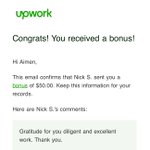
Started freelancing on Upwork in May and became a top-rated freelancer in just 5 months.
And yesterday, one of my clients surprised me with a $50 bonus!
Yoyo! 💃

5
24
1,391
I have spent the past 3-4 weeks deeply going into copywriting.
I had read a few threads in the past two years on this topic, implementing some of the frameworks (AIDA, PAS) in a couple of threads, and improved my own landing page’s copy by reading random resources.
But I never secured a single copywriting client on Upwork whenever I applied, and now I know the reason. Lol
I knew only 5% about copywriting and I will admit that I hadn’t invested the time and energy this subject deserves.
As much as I go deeper into studying and dissecting copies, I feel this is an incredible skill to have, especially if you’re running any kind of business.
@adityatheverma shared his Upwork screenshot a few days ago securing copywriting clients within 45 days of starting his journey that was pure joy to see, and I’ve given myself the challenge to secure my first copy client. Inspired by Adi, of course! 👊
I would prefer to go with Upwork in the beginning, I got a top-rated badge two weeks back on Upwork and I already have solid reviews with good rates in the writing domain.
So it should not be that hard to get my first copy client there.
I will start a new thread where I will share all my progress from mastering copy to getting my first client.
Let’s see how it goes.🤓
2
4
498
Oh God! Such vulnerable, pure, and heart-to-heart writing.
'Do you have the support system you need to sustain yourself through the highs and lows of entrepreneurship?'
We all know that a support system is the key to survival, but only a few focus on becoming that support system for others first.
Kindness and generosity are qualities that, when selflessly given to others, come back to you.
'No one’s coming to save you.'
Burning out, feeling stressed, and getting stuck are common in this journey, and EVERYONE goes through it, but only a few speak up and are vulnerable about it.
What I love about Alexandra is her willingness to share the real behind-the-scenes of her journey.
I remember when she shared how long it took her to build her newsletter; it was a big relief for me.
Good things take time to happen, and as a first-time founder/entrepreneur, things are tiring, frustrating, and demotivating most of the time.
And no one is going to save you except yourself.
So hang tight and keep going, even if it is slow.
—
Alexandra is one of the kindest people I met during WOP, and what I first noticed was her big, bright smile, which brightens up your interaction with her!
Happy Birthday, girl! 🎊

I turned 34 yesterday and I’m really excited about it because 33 was a rough year—largely due to the instability of entrepreneurship. My birthday feels like a symbolic “turn of the page” after making changes over the last couple of months to regain the groundedness I’d always felt within myself but had temporarily lost.
Being a solopreneur over the last two years was an adventure—one I’m glad I found the courage to embark on. I learned a ton about business, life, and myself in the process.
But one of the most important things I learned was this old adage in entrepreneurial circles:
“No one’s coming to save you.”
In hindsight, I was really burnt out—we’re talking fried—for the last 6 months of my two-year solopreneur run. As a result, I was barely making any money.
But I kept thinking I’d figure things out. And mostly, I had (what now was clearly) false hope that something or someone would swoop in and “right the ship.”
6 months later, someone did—me.
When I finally accepted it was 100% on me to initiate serious changes to a dynamic that wasn’t working, I was frustrated and demotivated. I’d wanted someone to just “give me the answer” to my problem. But that wasn’t going to happen. So I had to suck it up and accept that I alone was responsible for fixing my situation.
With that, I spent a couple of months weighing my options, going back and forth, and feeling conflicted.
Aside from losing a loved one, they were among the hardest months of my life. I felt depleted, confused, and at times defeated. And if it weren’t for my incredible family and friends, it would’ve taken me far longer than a couple of months to push through those lows.
This brings me to another old adage:
“It takes a village.”
As part of my solopreneur journey, I was lucky to participate in Quebec’s Self-Employment Program and one of the key questions they asked us at the start was “Do you have the support system you need to sustain yourself through the highs and lows of entrepreneurship?”
I’d encourage anyone considering entrepreneurship to consider this question carefully.
Even though I knew I could count on support from family and friends during my darkest hours, I have an even deeper appreciation for them after this most recent difficult period. And that led to a deeper appreciation of myself because every time I thanked someone for their support they would point out that “If the situation were reversed, you’d be the first person there for me.”
Most of us don’t see how valuable and impactful our support is to others because it’s just something we do by nature. So the upside to “falling down” is the opportunity it gives your loved ones to “catch you” in the ways you catch them when they fall. It’s a reminder that being strong means being vulnerable and that relationships need give and take.
Fast forward a couple of months, and I eventually landed in a great place.
I found a great full time role that would allow me to do work I love for an organization whose mission I believe in. And on top of that, it offered me a hybrid work environment that would allow me to lay deeper roots here in Montreal, while still giving me the capacity to take on the odd side project—adding more freedom to my career.
The company is within the health and well-being space and the essence of the work is in alignment with a newly emerging purpose I felt to help people on a deeper level (I like to think the training and development initiatives I’ve worked on in the past have always had TLC baked into them as a first ingredient).
I knew this role would give me the stability I felt I’d lost in the form of a clear direction, a steady paycheque, and most importantly—teammates to share the journey with. This brings me to another old adage:
(Continued in next tweet…)

“As adults, we tend to over-value mastery learning and under-value discovery learning.
We enforce practice on children who just want to play. We despair of their tendency to flit from thing to thing, and don’t value the way that they move so fluidly between interests.”
This thread is gold.

J: Mama, do you know our eyes are wet?
(My son while putting his finger inside his eye)
Me: Yesss, they are wet.
J: Mama, why are they wet?
Me: Umm… no idea, J. I’ll check and tell you.
—
Here is why:
Our eyes are kept wet by a liquid called aqueous humor, which is like a natural eye fluid.
It maintains a constant moisture level inside our eyes, making sure they stay comfortable and function well, a bit like having a built-in eye conditioner.
They prevent dryness, protect eyes, and support vision.
—
This reminded of Harvard researcher Paul Harris who discovered that, on average, kids between the ages of 2 and 5 ask a whopping 40,000 questions.
If we take the time to answer their questions, they can learn numerous scientific concepts beyond our imagination.
1
289


Why don't I get notifications for comments on my long-form post?
Is anybody experiencing the same?
1
331
Alright, so this post gained a lot of attention and brought forth some interesting and diverse opinions.
I find every comment valuable as it reflects each person's personal experiences.
Clearly, there are two types of people in the comments: 1) those who agree with the post, and 2) those who disagree.
Those who disagree argue that kids should be exposed to diverse topics and subjects to figure out their interests, and I strongly agree with this.
There is no second opinion about it.
I also believe that kids should be exposed to different subjects and areas of interest as early as possible.
But what I don't agree with is the idea of imposing those topics and subjects on them and teaching in a way that they start hating learning.
We all have gone through an education system where our focus on a topic is more about whether it will be in the exam or not.
If it's not in the exam, it automatically gets excluded from our learning list.
And those topics that are expected in the exams, even if we find them uninteresting, we memorize them for the exam and tend to forget them after some time.
So, where did we waste our energy? To get a good score on the exam?
Really?
Here is what our education system looks like:
- We set a fixed curriculum for all kids, ignoring their individual interests and passions.
- Then we make sure they memorize or learn even the topics that don't interest them.
- If they fail to memorize them, they get poor grades in exams (C, D, F).
- When they fail, we label them as incompetent.
- Then we categorize kids based on those labels (highly competent, average kids, and poor-performing kids).
- And then our treatment changes towards them based on their performances.
- What these labels do to kids is they start believing in them and start believing they are losers.
What if a child had the freedom to choose or quit any subject?
There would be no humiliation, no red lines, and no F grades on their report.
There would be no loss of self-confidence and self-esteem.
This aligns with Einstein's perspective on kids:
"Everybody is a genius. But if you judge a fish by its ability to climb a tree, it will live its whole life believing that it is stupid."
And most B, C graders grow up believing that they are stupid.
Every child is unique with distinct strengths and weaknesses.
Why do we judge everyone on the same parameters with the same curriculum?
@elonmusk explained this very well in a video, stating that our education system focuses on studying the tools but not on their implementation.
For example, if you have an engine, and you want to study how it works:
Here is what the traditional education system does:
- It will teach you about all the tools, wires, and body parts of the engine and will hardly take you to open an engine.
- It will expect you to memorize the names of all tools and how the engine works.
But here is what should be done in an ideal case:
- Take all the kids to an engine, open it, and explore.
- Allow them to use the necessary tools to understand how it works.
- Then, discuss the names of the tools and their purposes.
Now, kids not only know the purpose of the tools but are also learning in a real-world context.
Simple.
As I mentioned, I have never used derivatives in my life, but someone in the comments told me that derivatives are used in finance, and I was like, wow.
Finally, after years of doing derivatives (and now forgetting them), I know what they do.
But how much fun it would have been if I could practice it in real life at school.
This is the problem.
We keep memorizing topics without their use and context and just pass the exams.
And this kills the purpose of learning.
So what is the solution?
There are many but to sum it up I would like to mention project-based learning.
When engaging in project-based learning with a real-life problem, your primary focus shifts to solving that specific issue.
Acquire the necessary knowledge within the right context—this is known as interdisciplinary learning.
Choose a project and learn every physics, science, or math concept needed to successfully complete it.
This approach differs from memorizing concepts only to wait for a future opportunity to apply them in your life.
---
Thank you all for your comments and ideas.
I couldn't respond to all, so I decided to share my thoughts here.
I explore ideas on childhood education and the future of learning. Let's connect @AimenBatool if you are interested in learning how to raise curious kids.
I wonder, why did I learn derivatives and integrations in school?
I've never used them in real life.
Why did I dissect a frog in school?
I never wanted to do something similar in real life.
What was the purpose of memorizing chemical formulas and theorems in physics class?
All that brought to me was stress and constant anxiety about tests and quizzes.
There is a long list of subjects and topics I learned in school that I never implemented in real life.
Millions of children still go through this constant memorization and assessments every day.
And, no one questions this.
Our education system rarely gives children the opportunity for self-reflection to explore their curiosities or passions.
A predefined curriculum is imposed on them for years without considering whether the knowledge will actually benefit them.
While the main goal of education in our society is to secure a good job,
many graduates find themselves clueless about their career choices.
I don't know anyone who can confidently say that the education system prepared them for their job.
Everyone I know, including myself, has paved their own path after completing the traditional 16 years of education through self-learning and internet resources.
So, what was the purpose of spending 16 years in an educational system when I could have learned my chosen career in less than two years?
Childhood and teenage years deserve more play, free time, less stress, and more opportunities for exploration.
But we take away all the fun, joy, and curiosity from kids in the name of education.
We take away their power to think and decide for themselves.
This has to change.
Every child deserves the freedom to choose whatever they want to learn and how.
What about you?
Ever had a school subject you hated, had to learn, but later realized you've never actually used it in real life?
Oh! Cool. This post is taking off.
For the interested 👇
I send a weekly newsletter where I share:
- Interviews with homeschooling and alternative learning families
- Essays and curated resources on childhood education
You can subscribe here:
homeskoolers.com/
13
2,227
We were in the park, with my son (4 years ) and his homeschooled friend (6 years)
A lady came and asked which school my son goes to?
My son said he doesn't go to school.
She smiled.
Now, the lady was still processing this when, from behind, her friend popped out and said,
“I don’t go to school either.”
Awkward and funny at the same time lol

6
638
Yes, kids need only 2-3 hrs a day to learn, and that too when they reach higher grades.
And, your kids won’t turn out weird.
Excellent thread!

18 truths about homeschooling.
1. It shouldn't take 6+ hours a day of your time. 2-3 hours max.
2. You don't have to know everything yourself to teach your kids. Curriculums these days lay out everything you need. You certainly don't need a PhD to teach 3rd-grade math.

10
713
A child has her flesh blown of her arm due to Israel’s bombing funded by United States.
#cease_fire_now #IsraelWarCrimes
180