
Portfolio manager (Public Equity) at a private investment fund in Europe. Also a tech entrepreneur building a new product.
London, England
Joined May 2017
- Tweets24
- Following84
- Followers9
- Likes42







We may be witnessing a strategic shift in how Amazon is run. Since Jeff Bezos stepped down as CEO in 2021, a trend has emerged where revenue growth has slowed significantly, while profitability has reached historical highs.
It seems Andy Jassy has started managing the company with a focus on profitability. This might be another case of a “Steve Jobs to Tim Cook” transition, which isn’t bad for shareholders in the medium term.
Is it finally Day One at Amazon?

1
46
At a time when Google clearly needs to catch up with the competition and reinvent its main product, the new CFO declares yet another efficiency drive.
Anat Ashkenazi, SVP & CFO, Alphabet and Google:
“Overall for the business, this is one of my key priorities, is to look across the organization to see what we can do in terms of driving further efficiencies. There's really good work that was done, started by Ruth, Sundar, and the rest of the lead team, to re-engineer the cost base. But I think any organization can always push a little further.”
I don’t believe reinventing Google for the future can be done while the CFO is running the show and managing it like a super-mature public company—focused on quarterly targets, guidance, and cost efficiencies down to the last penny.
I bet they will kill “the next big thing” in their efficiency drive because the CFO won’t have the vision to see it through.
Since ChatGPT came out at the end of 2022, Alphabet has returned $113 billion through buybacks and dividends. As a shareholder, I don’t need all these buybacks right now. I want the management to take that capital and reinvest it to the point where the company crushes all the competition.
1
26
Looks like John D. Rockefeller embraced the “future of work” as early as the 1870s when building Standard Oil and working from home a few days a week. Seems like at that time you could build an oil giant just by phoning it in 😂

1
1
48
One of the biggest problems with @perplexity_ai so far is inconsistency. Here’s an example: the same search, word for word, one or two days later gives me a completely different answer.
It gave me the correct answer (Next Plc) the first time around (very impressive).
But one or two days later, it gives me a wrong answer, which is, ironically, the same as Google AI Overview.


71
@Google AI Overview still doesn't know that Next Plc is the largest online clothing retailer in the UK.
The correct answer is not even mentioned...


@nextofficial is still probably one of the most misunderstood public companies.
Back in 2017, when I first invested in the company, my variant perception was that Next was already the biggest online clothing retailer in the UK (ahead of ASOS, Boohoo, etc.), while most people saw it as a declining bricks-and-mortar business.
Now in 2024, it’s still the largest online UK clothing retailer, but it’s also transforming into an investment/infrastructure platform, taking majority ownership in companies like @REISS. Roughly 10% of the group’s sales and 8% of the group’s profit already come from this segment.
Overall, I can’t recommend Next’s annual and half-year reports highly enough. I learn so much from every report I read. I love their no-nonsense, direct approach.

46
Next Plc is one of the very few companies I’ve seen that has a hurdle rate for share buybacks.
“Any share buybacks would be subject to achieving a minimum 8% equivalent rate of return (ERR). As a reminder, ERR is calculated by dividing (1) anticipated NEXT Group pre-tax profits by (2) the current market capitalisation.
…
In the event we are unable to use surplus cash to buy back shares, as a result of the share price being above our ERR buyback limit (see above), we intend, subject to market conditions, to use remaining surplus cash to declare a special dividend.”
So, they are basically telling us that they will only buy back shares at an attractive price. Otherwise, they will let shareholders deploy the excess capital. Brilliant!
This is extremely rare, but crucial. As Warren Buffett teaches us, share buybacks only benefit shareholders when done at the appropriate price (meaning below the intrinsic value of the business).
57
@nextofficial is still probably one of the most misunderstood public companies.
Back in 2017, when I first invested in the company, my variant perception was that Next was already the biggest online clothing retailer in the UK (ahead of ASOS, Boohoo, etc.), while most people saw it as a declining bricks-and-mortar business.
Now in 2024, it’s still the largest online UK clothing retailer, but it’s also transforming into an investment/infrastructure platform, taking majority ownership in companies like @REISS. Roughly 10% of the group’s sales and 8% of the group’s profit already come from this segment.
Overall, I can’t recommend Next’s annual and half-year reports highly enough. I learn so much from every report I read. I love their no-nonsense, direct approach.
Creating interactive charts with @v0 is so much better than Excel / Google Sheets.
It’s also much quicker to give instructions in a chat format than keep searching through thousands of Excel chart settings to get what you want.
Probably can be a separate product on its own.


Watching Nestlé’s management shoot themselves in the foot by explicitly committing to keep increasing dividends in Swiss francs, while their free cash flow available for such payouts is, at best, not growing.
A quote from Nestlé’s CFO on their FY 2023 earnings call: “We are committed to maintaining our practice of increasing the dividend every year in Swiss francs … this will be the company’s 29th consecutive annual dividend increase, in line with our practice of increasing our dividend in Swiss francs.”
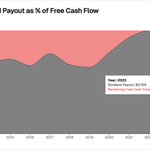
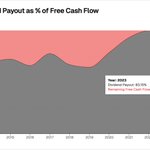
Dividend payments are already close to 100% of free cash flow (see chart below), so we can pretty much guess what happens next.
With high probability, management will try sticking with the policy until they no longer can.
The market will force them to admit reality and cut the dividend for the first time in sixty-something years. That will be a big blow to Swiss investors who rely on Nestlé’s “stable” dividend.

As a solo non-technical founder in my previous startup, I spent $50K+ to build a minimum viable product (MVP) with an agency before raising a pre-seed round.
If you are also a non-technical founder, your other options to build an MVP are:
1. Find a technical co-founder.
2. Raise a small angel round ($50K-$100K) to hire part-time developers.
3. Learn to code yourself (at least to the level of putting together a prototype with the help of AI).
I would choose option 3 now.
1
49
$META seems to be in a unique position where they don’t need to monetize their foundational model itself, unlike OpenAI, $MSFT, $GOOGL, and even xAI.
Instead, $META can afford to open source Llama to build an ecosystem that they will directly and indirectly benefit from in the years to come (think PyTorch and React).
$META is probably the only company right now that can already show ROI on their AI CapEx by delivering extraordinary revenue growth this year, logically explaining how AI contributes to this growth:
1️⃣ CapEx investments in AI ➡️ AI used for better recommendation algorithms ➡️ higher user growth and engagement ➡️ more ad impressions served
2️⃣ CapEx investments in AI ➡️ AI used to better serve advertisers (targeting and ad creation) ➡️ higher demand from advertisers ➡️ increased price per ad
143
This Google Trends chart nicely shows the value of the $ABNB brand over $BKNG and $EXPE. It’s not precise, but directionally correct.
How does this brand value manifest itself? Cheaper user acquisition. $ABNB spends 18% of their revenue on sales and marketing, while $BKNG spends 44%—more than 2x (!!!). Enormous difference.

313
“In practice, companies [...] look to buybacks as a means to manage EPS”...
That is the worst case actually, @bgurley. Take @Nestle, for example, where management compensation is tied to the “underlying” EPS growth (40% weight in their Performance Share Unit Plan).
Looking at a 4-year period (last pre-COVID year), the management reported “underlying” EPS growth from CHF 4.46 in 2019 to CHF 5.20 in 2023, i.e., 16.5% over 4 years. In reality, if we exclude the impact from share buybacks, “underlying” EPS was only CHF 4.70 in 2023, i.e., 5.3% growth over 4 years or 1.29% CAGR.
It is also worth mentioning that they didn’t fund the bulk of buybacks from free cash flow. Instead, they just increased Net Debt from CHF 35bn to CHF 54bn. And of course they've been doing it regardless of the share price level.

Been in a board room where someone recommends buying back stock to offset SBC dilution? Please share this. It never makes sense to be a buyer & seller at the same time. Act of self delusion, fooling only yourself. morganstanley.com/im/publica…
1
2
146

Looking at share price alone vs. Market Cap / Enterprise Value is meaningless.
Six months ago, I had a conversation with a colleague about Synchrony Financial (SYF) being attractive at $37 per share. The colleague reminded me that it was already up almost 50% from $25 per share when we looked at it in 2018, implying that most of the upside must have already been realised. My response? Synchrony’s valuation/market cap was actually lower at $37 in 2023 than at $25 in 2018, thanks to diligent capital return via share buybacks:
👉Market Cap in 2018: $25 per share * 710 million shares outstanding = $17.7bn
👉Market Cap in 2023: $37 per share * 418 million shares outstanding = $15.9bn
So, my point: it was still very attractive at $37 given the high earnings yield (roughly 14%) if you believed the earnings were sustainable. Lesson: don’t just fixate on share price, consider the whole capital structure.

1
117