

Partner at SFA Investimentos, São Paulo. Bottom-up equities since 2013. Writing at Bottom-Up from Brazil
Joined June 2020
- Tweets906
- Following325
- Followers1.2K
- Likes450





Pinned Tweet
For thirteen years, everything we wrote at SFA went to a small list of clients, partners and a few friends.
Company studies, research on business models and on the people who run them, our investment philosophy and process, macro views, and every now and then a study on some investing topic we couldn't get out of our heads.
The material got passed around anyway, and people kept asking to be added to the list. At some point keeping it closed stopped making sense.
So it's open.
Bottom-Up from Brazil: bottom-up investing from São Paulo, on Brazil and on companies anywhere else we find worth studying.
First piece is up.
brazilbottomup.substack.com/…
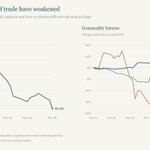
The Brazilian real has weakened sharply since the presidential election. Commodity prices have also been moving against it.
Over the 30 days through November 18, Brent futures fell 16.1%, soybeans 4.0% and iron ore 1.2%. All three are important Brazilian exports. Goldman Sachs’ Brazil terms-of-trade index also declined over the period.
I think this deserves some attention alongside the domestic political backdrop. Lower export prices mean less support for the currency, adding another source of pressure on the real.

SLC Agrícola ($SLCE3), one of Brazil’s largest soybean and cotton producers, reported quarterly adjusted EBITDA 19% below consensus. The stock rose almost 8% the next day.
I think the reaction made sense. A few weeks’ difference in cotton shipments can move quarterly earnings considerably without changing much about the economics of the crop.
The update on the next season was more encouraging. Planting was within the ideal window, and much of the cotton and soybean production was already hedged.
What interests us most now is the potential to pay down debt as cash comes in from a much larger planted area. Weather and commodity prices will determine how quickly that happens.
We wrote about how we look at SLC and why quarterly results can be misleading for a farming business.
Our latest piece.
brazilbottomup.substack.com/…

The shift in positioning goes beyond Brazil.
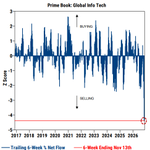
Goldman Sachs’ prime brokerage data show hedge funds selling global tech at the most extreme six-week pace in the chart’s history, which goes back to 2017.
Net exposure has fallen sharply, moving away from the elevated levels of recent months. Among fundamental long/short funds, it is now below the lows seen in 2025.
Gross exposure remains high, so there is still plenty of risk in the system. But funds are carrying much less directional exposure.
That matters if the news starts to improve. After this much selling, even a modest positive surprise could trigger a sharp rebound.


Yesterday I wrote about how depressed markets looked in Brazil and the US, and how a little better news could be enough to trigger a sharp rebound.
Brazilian hedge fund positioning adds some context. Our indicator, which combines exposure to local equities, the currency and interest rates, has fallen since the presidential runoff and is now slightly negative. It suggests funds have moved away from their bullish stance on Brazil.
The reading is not extreme, but positioning looks light.
That does not resolve the concerns about the outlook. It does suggest there could be room for a quick reversal if the news turns out a little better than investors expect.

Even before Brazil’s election, I was struck by how many residential buildings were going up around São Paulo, despite high interest rates and a difficult backdrop.
Secovi’s data were already showing slower sales absorption and more inventory relative to sales. In the middle-income segment, the 12-month sales-to-supply ratio fell from about 50% to 42% between August 2025 and August 2026. Inventory rose from roughly 10 to 15.5 months of sales.
The aggregate numbers hide some of this. Total unit sales were still growing, driven by the affordable segment, while sales of compact, middle-income and high-end homes were falling.
My concern is that the post-election data will show a further slowdown. With so much supply already in the pipeline, I expect a tougher period for the sector as developers work through that inventory.

3
227
There are plenty of reasons to be cautious about Brazil and the US right now. Inflation, higher interest rates and uncertainty are weighing on sentiment.
But our market thermometers are also near the depressed end of their historical ranges.
I think that is worth keeping in mind. Even a modest improvement in the outlook could produce a sharp rally if investors are expecting things to keep getting worse. An upside squeeze is a possibility, even with the broader picture still difficult.


Almost every day, there is news of another cyberattack on a company or a government agency. It is a subject we’ve been spending more time on at SFA, both to understand which businesses are more exposed and what they can actually do to protect themselves, and to look for investment opportunities in the sector.
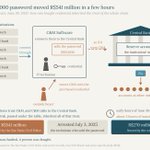
The C&M case in Brazil caught my attention. According to police, an employee received R$15,000 to hand over his credentials and help execute commands. The company connects financial institutions to Brazil’s payment system. About R$541 million was taken from one institution alone.
At Equifax, a fix for the vulnerability was available 67 days before the attackers got in. It had not been applied to the affected system.
Cases like these help explain why cybersecurity matters well beyond the IT department, and why buying software is only part of the answer.
We’ve published the second piece in our series, looking at how attackers get in and what companies can do about it.
Our latest piece.
brazilbottomup.substack.com/…
#CyberSecurity

1
97
A few weeks ago, we wrote that higher freight rates were only part of the story in iron ore. The more structural headwind was Simandou. As production in Guinea ramps up, more high-grade ore is coming into the seaborne market.
Since then, freight rates to China have come off their recent highs on both the Brazil and Australia routes. Iron ore fell alongside them, reaching $90.10/t on Nov. 16.
Freight still matters for Brazilian producers. At current rates, the implied netback is $54.30/t for Brazil versus $76.00/t for Australia, before quality and moisture adjustments. That’s a $21.70/t gap, compared with an average of $13.30/t in 2023–25.
The recent move is consistent with what we wrote. Freight explains part of the pressure on Brazilian netbacks. Simandou’s ramp-up adds pressure to the benchmark itself as more tonnes reach the market.
Full piece on our Substack.
brazilbottomup.substack.com/…


4
254
We’ve been studying cybersecurity at SFA, and I wanted to share some of what we’ve learned.
I still find the CrowdStrike episode striking. Millions of computers went down because of an update to the software installed to protect them. No one had attacked them.
Understanding how that can happen is a useful starting point for understanding the businesses in this sector.
We wrote a piece using that episode and the attack on Maersk to explain the basics. More to come as we work through the industry.
Full analysis on our Substack.
brazilbottomup.substack.com/…
#Cyber

1
70
In 2017, NotPetya cost Maersk an estimated $250–300 million. The ransom message asked for $300, but the malware was designed to destroy data. Paying could not restore it.
In 2024, a faulty CrowdStrike update affected an estimated 8.5 million Windows devices. This time there was no attacker. The disruption came from the software installed to protect them.
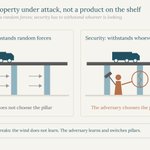
Both cases matter when studying cybersecurity as an investor. Buying a security product does not settle the risk. Its effectiveness depends on how it is deployed, the access it requires and how far a failure can spread.
The incentives matter too. The vendor selling protection and the customer bearing the cost of an outage do not necessarily face the same consequences.
Our latest piece starts with these two incidents to explain the foundations of cybersecurity, before examining the products and companies built around them.
Full analysis on our Substack.
brazilbottomup.substack.com/…
#cybersecurity

On October 26, the first trading session after Lula’s re-election, Brazil’s Ibovespa fell 13.9%. The equal-weighted average of the 145 stocks in the Ibovespa and small-cap index fell 23.4%.
That was the largest daily decline in our dataset going back to 1994, using today’s constituents. By the end of the week, the average loss had reached 29%.
The fiscal risks deserve scrutiny. Higher interest rates affect financing costs and what businesses are worth. We are revisiting those assumptions company by company.
Even so, our base case remains a Brazil of high rates and some fiscal adjustment. We see a loss of monetary credibility on the scale experienced by Turkey or Argentina as less likely.
The sell-off has left some businesses we have followed for years at prices we consider attractive.
Our latest piece examines the shock, the lessons from Turkey and Argentina, and the cost of trying to leave the market until uncertainty clears.
Full analysis on our Substack.
brazilbottomup.substack.com/…

Our supply and demand work points to several years of surplus in iron ore and a growing need for new copper mines.
Simandou, in Guinea, shipped about 15.5 million tonnes of iron ore in the first nine months of 2026. Its ramp-up is arriving as Chinese steel production declines. In our base case, seaborne demand stays broadly flat through 2030, leaving higher-cost producers under pressure.
Copper faces a different constraint. Electrification keeps adding demand, while declining ore grades and long development times limit mine supply. Even allowing for new projects and more recycling, our base case points to a 4.5 million tonne deficit by 2035.
The price implications differ. Iron ore needs a price that removes expensive tonnes from the market. Copper needs a price that makes additional mines worth building.
The timing matters, though. Copper accumulated in the US ahead of a possible tariff could temporarily ease supply elsewhere as those stocks are consumed.
Our latest piece examines both markets and the assumptions behind these scenarios.
Full analysis on our Substack.
brazilbottomup.substack.com/…


2
148
What struck me in Anthropic’s IPO filing was how quickly the business scaled and reached profitability. In 2Q26, it generated $974 million in GAAP operating profit on $11.6 billion of revenue.
That matters for the entire AI supply chain. The customer committing billions to compute is now showing it can generate operating profits from selling AI.
For Amazon, the opportunity also extends beyond supplying infrastructure and owning a stake in Anthropic. AWS provides a distribution channel and earns fees on sales through its marketplace.
Those distribution fees are becoming significant. Our estimate of Anthropic’s channel-partner fees is equivalent to roughly 35% of sales through cloud marketplaces, up from around 16% in 2025. These are aggregate figures, rather than Amazon’s individual take rate.
The filing offers a clearer picture of how value is being created and shared across the AI chain.
Full analysis on our Substack.
brazilbottomup.substack.com/…


Brazil has just enacted a constitutional amendment reducing the maximum working week from 44 to 40 hours, without cutting pay.
The transition starts with 42 hours in December 2026 and reaches 40 hours in December 2027. The amendment also establishes two paid rest days per week, replacing the six-day working week still common in many services.
For workers moving from 44 to 40 hours, unchanged monthly pay means a 10% increase in hourly labor costs. Maintaining service coverage may require additional staff.
In outsourcing, the earnings impact depends on how contracts are priced. Per-employee contracts can adjust through larger teams, while catering priced per meal requires price increases.
The change could also reshape competition. Smaller providers have less room to finance the transition, and greater complexity in managing labor may encourage more companies to outsource. More expensive labor also strengthens the incentive to automate.
Our latest piece examines how these changes flow through outsourcing contracts and what they could mean for the industry.
Full analysis on our Substack.
brazilbottomup.substack.com/…

1
64
Commodity producers can have durable competitive advantages even when they cannot set the price of what they sell.
I have always found the argument that these businesses are uninvestable because they lack pricing power incomplete. Exposure to prices is a real risk. Geopolitical shocks, particularly in energy, can change earnings expectations quickly. But asset quality and production costs can also create advantages that competitors struggle to replicate.
Warren Buffett’s investment in Occidental through Berkshire Hathaway is one example of investing in the sector despite that uncertainty.
Brazil has world-class natural resources and some highly competitive producers. These companies have played an important role in SFA’s investments over the years.
Calling commodity investing a “macro call” understates how much company and industry research goes into it. Understanding a supply chain means examining individual projects, their economics and the time required to bring them into production. Management incentives and capital allocation matter enormously, particularly when high prices make expansion look easy.
Some of our best investments in the sector came from identifying well-managed companies undergoing operational improvements while supply and demand were becoming more favorable.
Copper is one market we have been studying closely.
Demand comes from several sources. Electric vehicles require more copper than combustion-engine vehicles. New power generation and grid investment add demand, alongside conventional construction and industrial uses. Data centers add another source through their electrical systems and cooling infrastructure.
Each application needs to be assessed separately. Aluminum can replace copper in some uses, and manufacturers can reduce the amount of metal required. For data centers, copper demand depends heavily on the pace of new construction. It does not simply rise in proportion to electricity consumption.
The supply side is equally demanding. Lower ore grades mean moving and processing more rock for the same copper output, increasing pressure on costs and infrastructure. New mines require years of permitting, engineering and construction.
In our base case, existing mines lose roughly 3.3 million tonnes of annual production by 2035 before new projects and expansions. A substantial portion of investment therefore goes toward replacing lost output.
Our model puts annual refined copper demand at approximately 36.9 million tonnes in 2035, against supply of around 32 million tonnes, including growing contributions from recycled material.
That projected gap describes an adjustment the market would need to make. Higher prices can encourage investment and recycling, accelerate substitution and restrain demand. The timing of those responses matters, and a tighter long-term balance can still coexist with sharp cyclical price declines.
Brazil could benefit from this investment need. Carajás combines copper resources with an established mining and processing base, which can improve the economics of some developments. Turning that opportunity into shareholder returns will depend on project execution and the discipline with which capital is invested.
That is where our research is focused: understanding which companies can translate favorable industry conditions into attractive returns, and what price makes sense to pay for them.

2
219
Brazil’s election is being traded in prediction markets and equities, with different participants and different payoffs.
We examined 146 Brazilian stocks to compare the election probabilities implied by share prices with Polymarket odds. Of those, 85 passed our tests for sensitivity to the election.
Our latest piece explores how the two markets assess the same event, how the results vary across stocks and sectors, and the limitations of the comparison.
Full analysis on our Substack
brazilbottomup.substack.com/…

1
4
273
Brazil’s new data center tax regime could expand demand while preserving protection for locally manufactured servers.
REDATA reduces taxes on eligible inputs, while import duties remain on finished equipment with equivalent domestic production. Implementation still depends on regulation and product lists.
Positivo already manufactures Supermicro servers in Brazil. Its server revenue reached roughly R$450m in the 12 months to June, still only about 10% of the company’s revenue.
Our latest piece examines the economics and what this could mean for Positivo.
Full analysis on our Substack
brazilbottomup.substack.com/…

Funds are heavily short iron ore. Their net short position in SGX futures reached 14.1% of open interest on October 2, among the most bearish readings since 2023.
With iron ore around $90/t, physical traders are also under pressure. They hold roughly 64% of inventories at Chinese ports, typically financed with bank borrowing, and carry price risk between purchase and resale unless hedged.
Inventory sales to raise cash could keep weighing on prices. Steel mills, meanwhile, are running lean inventories. A pickup in restocking could absorb some of that supply and trigger short covering.


AI agents need identities, isolated environments and logs they cannot rewrite.
These controls add a supervision cost to deployment and create demand for cybersecurity across the companies adopting AI.
Full analysis on our Substack
brazilbottomup.substack.com/…

1
162