

PhD student in the Tavazoie Lab @RockefellerUniv via @cbm_student | @MCDB_Yale BS/MS '20 | 75% immuno, 25% comp bio, 100% baking bread | 🏳️🌈
Manhattan, NY
Joined April 2015
- Tweets39
- Following48
- Followers99
- Likes57




Pinned Tweet
Thrilled to cap off the year with the first paper of my PhD, out today in @ImmunityCP! We describe a population of exhausted-like microglia that accumulate in #Alzheimer's in both humans and mice in an age- and APOE4-dependent manner authors.elsevier.com/c/1iL2Z… Tweetorial below🧵

Was an honor to contribute to this tremendous study co-led by the brilliant duo of @gadmark and @shanshanliu1218. Check out the thread below to learn more about how SLC33A1 works to maintain ER redox balance!

Thrilled to share our new paper: SLC33A1 is the long-sought ER GSSG exporter, maintaining redox homeostasis in the ER. Huge congratulations to my co-first author @shanshanliu1218 and my PIs @KivancBirsoy and @HiteLabMSKCC for leading this work. nature.com/articles/s41556-0… 🧵 1/9

Was a joy getting to work with Hsi-Wen and @nicoledelgaudio on this beautiful story! Metastasizing breast cancer cells experience many stressors; now we know mitochondrial GSH is critical in regulating the ISR and protecting cancer during early colonization. More below:

New work from our lab describing a role for mitochondrial glutathione in breast cancer metastasis @nicoledelgaudio @RockefellerUniv aacrjournals.org/cancerdisco…
2
265
Had a great time chatting with @10xGenomics about our recent paper describing "exhausted-like" microglia in Alzheimer's disease - read below for more!

How do APOE isoforms influence #Alzheimersdisease? How is a new cell type involved? And how did #singlecell and spatial tools enable @alonmillet to answer these questions? Find out in a new customer interview blog: bit.ly/3Y1imoh

3
331
Tune in on Zoom tomorrow to hear me present our recent work on exhausted-like microglia in Alzheimer's disease!

OBS #Neuroimmunology Seminar
📆 Thu, Jan 18, 9 am PT/12 pm ET
🎙️@WeiSu19 @hongbo_chi @NatImmunol
🎙️@AlonMillet @Jhledo @SohailTavazoie @ImmunityCP
✍️ us02web.zoom.us/meeting/regi…
#CD8 #CXCR6 #microglia #APOE4 #Alzheimers
#Openscience


4
750
PS for anyone who wants to look at the data or the code, it's all public - github.com/alonmillet/apoe-a… is the manuscript repo and has all the info you need to reproduce any of the analysis or figures. All raw and processed data is available on GEO and Zenodo.

3
7
739
We’re really excited about this work and think it opens the door for lots of downstream questions. If you want to chat or have any questions about the paper/this tweetorial/anything else, my DMs are open!
1
5
737
Additional thanks go to @cbm_student and @RockefellerUniv for being wonderful environments to do science and to my labmates for all their feedback on science, figures, and manuscript text.
1
4
340
This project was a joy to work on, mostly thanks to mentorship and support from my fabulous PI @SohailTavazoie and co-first author @Jhledo. Immuno + neuro + compbio is a killer combo and it was so much fun to be a part of this team!
1
4
335
Finally, a provocative question for future work: we looked at AD, but what if neuroinflammation in general could generate TIM? This could have implications for other conditions like Parkinson's, multiple sclerosis, brain tumors, and much more.
1
7
331
We also speculate a bit about the ramifications of TIM being enriched in males - could it be connected to this fascinating epidemiological paper that showed that herpes vaccination was protective against AD later in life, but only in females? medrxiv.org/content/10.1101/…

1
4
346
The big one is that we think the identification of an exhausted-like microglial state in late-stage AD is really exciting for therapeutic reasons. Just like ICB unshackled exhausted T cells in the tumor microenvironment, maybe a similar approach could apply to TIM in AD.
1
6
327
So what's the big picture? We think there are a few takeaways, and we speculate a little bit about some of them in the discussion of the manuscript.
1
5
794
When we looked at microglial subclusters, the story was clear: aducanumab's recruitment of adaptive immune cells was mediated largely by increased signaling from effector-hi TIM!! This subset of dysfunctional microglia turns out to orchestrate the response to aducanumab🤯

1
5
651
We then looked at ligand-receptor interactions performed by microglia in the brains of these mice. Surprisingly, we found that while microglia from APOE3 and APOE4 became more inflammatory upon treatment, aducanumab actually *inhibited* microglial function in APOE2 mice!!

1
4
607
We therefore treated 60-week-old AD mice bearing human APOE variants with aducanumab or an isotype control before harvesting immune cells from their brains for scRNAseq. Interestingly, TIM in aducanumab-treated animals shifted profoundly from effector-lo to effector-hi!

1
4
546
Our final question was what aducanumab, a recently approved (and controversial) therapeutic for AD would do to the TIM state. We knew aducanumab recruited adaptive immune populations and were curious if this could somehow jump-start TIM out of their defective state.
1
4
501
The takeaway here is that APOE4 mice have their amyloid clearance weakened twice over: they have more TIM than other genotypes, *plus* their TIM are especially dysfunctional. We think this has clear implications for Alzheimer’s pathology and progression.
1
7
666
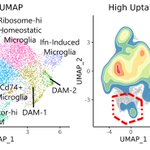
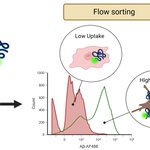
We were very excited to find that TIM were overwhelmingly enriched in the "low uptake" pool: in other words, TIM reliably endocytosed less amyloid beta than other microglia. Moreover, this was exacerbated in APOE4 mice, whose TIM were practically exclusive to the low uptake pool.

1
5
538
Given the enrichment of TIM near amyloid plaques, we asked the natural question: are TIM better/worse than other microglia at amyloid uptake? We designed an ex vivo incubation -> FACS -> pooled single-cell experiment to answer this as cleanly as possible.

1
4
507