





$ASTS
(Playing around with some numbers, trying to make sense of it all)
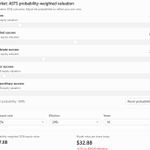
Based on a simple probability-weighted valuation model, I arrive at a fair value of approximately $87 per share today. (My "conservative" assumptions: ASTS probability-weighted valuation)
My assumptions:
1. 2036 probability-weighted equity valuation: ~$126 billion
2. Time horizon: 10 years
3. Discount rate: 12%
4.Additional share dilution: 20%
This incorporates a range of outcomes, from failure to extraordinary success, each assigned its own probability.
The result? ~$87 per share today, versus ~$34.50 in the market.
Of course, the valuation is only as good as the assumptions and probabilities behind it.
But I believe the market is significantly underestimating the probability of ASTS becoming a major global connectivity player. (Market: ASTS probability-weighted valuation table)
The opportunity is enormous. The risks are real. The asymmetry is what makes it interesting.


2
7
1,031
$ASTS
MY BIGGEST PRESENTATION TAKEAWAYS 🚀
1. THE TRILLION-DOLLAR OPPORTUNITY
Finally, Abel is talking about trillions of dollars when describing the addressable opportunity. This is the scale of the vision I've wanted management to communicate.
2. THE META REFERENCE
Particularly interesting. Another potential way to reach 3 billion customers beyond the traditional MNO model. The implications could be enormous.
3. GOVERNMENT
Huge opportunity, not just in terms of potential revenues, but also strategic importance, funding and government support.
4. LAUNCH CAPACITY
I believe management overestimated future third-party launch availability and is now adapting. Part of the reason may be that they didn't anticipate the explosive growth in demand for their own satellites as well as others that need launching.
5. BLACKLIFT: THE OPPORTUNITY AND THE RISK
BlackLift could ultimately become one of AST's greatest competitive advantages, dramatically reducing launch costs while giving the company control over deployment schedules.
But there's a paradox.
The very thing that could make ASTS almost impossible to compete with could also become its biggest vulnerability if execution falls short.
I'm more excited about the long-term opportunity than ever, but I'm also increasingly convinced that BlackLift execution is now one of the most important variables in the entire investment thesis.
With 100+ satellites covered by existing launch agreements, AST has a potential path toward global commercial service without BlackLift.
But to capture a meaningful share of that trillion-dollar opportunity, expand and continuously replenish a much larger constellation, independent, reliable and cost-efficient launch capacity is essential.
That's why BlackLift matters so much.
Let's go, BlackLift! 🚀
1
21
1,502
$ASTS
DAVID VS. GOLIATH 🚀
The CEO of $ASTS, Starlink Mobile's biggest technological competitor and one of the most strategically important partners for mobile network operators worldwide, comes to NYC to tell his story.
A company potentially reshaping the future of global connectivity.
And CNBC gives Abel a 5:00 AM slot when this story arguably deserves prime-time coverage.
Then even that gets canceled.
Think about that.
At least we are done waiting and taking control where we can. Abel talked about the gigantic opportunity that's there right in front of us. It's pretty clear that BlackLift has to be a success and with production sorted out this is now their number one priority. Let's go BlackLift!!
Btw I have enormous respect for what Elon has achieved, but he's not going to help AST succeed. With DPAS he's forced to launch us faster than he would have liked.

1
15
925
$ASTS
Did Abel just say having access to 3bln devices PLUS another 3 bln? META?
7
553
$ASTS
It seems Jensen's rocket has managed multiple launches in rapid succession across different parts of the world. 🚀
What kind of DPAS priority rating does this guy have?
Poor Abel can't even get through a BlackLift presentation without another launch stealing the spotlight. 😂
9
1,336
1/n
$ASTS
COMMUNICATION MATTERS, CONNECTIVITY EVEN MORE
I wrote this thread a couple of weeks ago, but it’s relevant for tomorrow I think.
I hope Abel takes the opportunity tomorrow to not only talk about BlackLift, but clearly articulates the size of the opportunity they are building toward, and that this message is heard loud and clear also by the MNO's. (This is also why I invested in AST.)
Because there is a striking difference between how Elon Musk communicates the future of connectivity and how U.S. MNO CEOs communicate satellite D2D.
The MNOs aren't dismissing D2D.
THE PROBLEM IS THAT THE OVERALL MESSAGE IS MUDDLED AT BEST.
2
7
760
9/n
And if we're talking about billions of additional intelligent endpoints, simply reaching them isn't enough.
CAPACITY MATTERS.
AST's spectrum strategy combines partner MNO spectrum with MSS spectrum, targeting ~100 MHz of spectrum access in the U.S. and 60+ MHz globally on a market-by-market basis.
Why is that important?
Because the opportunity could evolve from: “Can I get a signal here?”
to: “Can the network support billions of connected people + machines?”
COVERAGE SOLVES GEOGRAPHY. CAPACITY SOLVES SCALE.
AST's own 2026 materials already identify additional applications including IoT and AI edge compute. The pieces of a much larger TAM are starting to appear.
1
41
10/10
Now put it together.
AST doesn't need to own: The AI model. The cloud. The robot. The autonomous vehicle. The terrestrial network. Or even the end customer.
It just needs to become: THE SPACE-BASED CONNECTIVITY LAYER BETWEEN THEM.
And this brings me back to where I started.
I THINK THIS MESSAGE SHOULD BE COMMUNICATED LOUD AND CLEAR
(And tomorrow is a great platform)
Not simply: “We can eliminate dead zones.”
But: “WE ARE BUILDING THE CONNECTIVITY LAYER THAT CAN EXTEND THE EXISTING MOBILE NETWORK INTO A WORLD OF BILLIONS OF PEOPLE + INTELLIGENT MACHINES.”
That's a very different message. And potentially a very different TAM.
Because the question isn't simply: How many people live outside terrestrial coverage?
The bigger question is: HOW MANY PEOPLE + MACHINES NEED CONNECTIVITY EVERYWHERE?
2
36
$ASTS
If $ASTS were still a private company, and Thursday's presentation were its IPO roadshow with Goldman Sachs/Morgan Stanley/ JPMorgan as lead underwriters, I believe it would command a valuation of at least $50 billion.
The pitch? A potentially enormous global market, differentiated technology, 3,900+ patents and patent claims, partnerships with 60+ MNOs representing billions of subscribers, strategic spectrum assets, prod 6 sats a month, DPAS, BlackLift, J-LEO and expanding sovereign and defense opportunities, beta testing, imminent service, etc.
The risks would be the same. The opportunity would be the same.
The only difference? Investors would be buying the future rather than trading the past.
$ASTS Thursday's most important task is to attract NEW investors. Existing shareholders are unlikely to increase allocations while BlackLift introduces additional execution and financing risks.
The next leg higher needs fresh institutional capital, not more conviction from those already invested.
2
25
1,780