

Amnesty International in East Africa, the Horn, the Sudans and the Great Lakes.
Nairobi
Joined April 2015
- Tweets6.7K
- Following1.1K
- Followers49.2K
- Likes1.3K





Pinned Tweet
When citizens call for protests over high cost of living, public debt and taxes, how should governments react? How have they reacted this far? This morning in Nairobi - @amnesty launches a new report looking at the Kenyan government's reaction in the finance bill protests. 1/
One year after El Fasher’s capture, accountability remains elusive. @Amnesty calls for an immediate ceasefire, an international civilian protection force and an end to arms transfers.
amnesty.org/en/projects/suda…

Women and children detained in El Fasher schools faced severe food shortages. Some children became malnourished. Famine remains a serious threat across Darfur. amnesty.org/en/latest/news/2…

Civilians in El Fasher in North Darfur, Sudan, are still suffering detention, torture and limited access to humanitarian aid one year after the Rapid Support Forces (RSF) captured the city and committed brutalities against civilians. amnesty.org/en/latest/news/2…
Sudan: One year after the RSF captured El Fasher, civilians still face unlawful killings, torture and arbitrary detention. New testimonies gathered expose the ongoing atrocities. amnesty.org/en/latest/news/2…
Amnesty Eastern Africa retweeted

NEW: Civilians in El Fasher, #Sudan suffer unlawful killings, detention and torture one year after city’s capture by the RSF – new @Amnesty research 🇸🇩
"A pervasive pall of fear hangs over El Fasher" - @AgnesCallamard
amnesty.org/en/latest/news/2…
Sudan: El Fasher civilians suffer unlawful killings, detention and torture one year after city’s capture by the RSF – new testimony amnesty.org/en/latest/news/2…
Amnesty Eastern Africa retweeted

The International Criminal Court and its officials have been awarded the European Parliament's 2026 Sakharov Prize for Freedom of Thought.
Learn more about the laureate here ➡️ link.europa.eu/rVBvTR

ALT A group of judges in blue robes sit in session at the International Criminal Court. The text reads: “2026 Laureates of the Sakharov Prize for Freedom of Thought, The International Criminal Court and its officials, Democracy in action.” The European Parliament logo is in the bottom right‑hand corner.
Amnesty Eastern Africa retweeted

We condemn the horrific killing of a migrant in the Durban CBD this morning. @SAPoliceService all those found to be responsible and part of the group that attacked the man, must be arrested and prosecuted. No one has the right to take another person’s life, regardless of the reason. This attack is not an isolated incident. It represents the latest wave in a rising tide of violence against migrants in South Africa. The justice system must start acting as a deterrent to these attacks and killings.
@GovernmentZA has a legal obligation to protect everyone within its borders, regardless of nationality or immigration status. This includes taking strong measures to combat xenophobia, hatred and discrimination, preventing violence, responding swiftly when attacks occur, and ensuring justice for victims. Stronger political will is needed to put an end to discrimination against migrants, refugees and asylum seekers. Xenophobia must be rejected. The right to life must be protected.
Everyone has human rights, regardless of nationality, language, documentation or where they call home.
#NoToXenophobia #RejectXenophobia #NoToHate #HumanRights #HumanityMustWin


“There is simply, on a human level, a reason to engage with what’s going on in Sudan…it is not just a conflict which is contained, which you can keep at arm’s length.”
@CrisisGroup Trustee, @TheZeinabBadawi explains why the world’s eyes must remain fixed on Sudan.
Amnesty Eastern Africa retweeted

AUTHORITARIAN RESPONSES TO PROTESTS AND SOCIAL ECONOMIC INEQUALITY AND TAXATION
Since 2023 there has been an upsurge in civic
action in Kenya including through protests and digital activism.
Mostly youth-led, these protests have largely
been triggered by the rising cost of living, the removal of subsidies and increased regressive taxation that
have reduced household finances and induced public resentment against the government. These economic
factors have in turn undermined access to basic goods and services.
Instead of redressing these economic challenges, the government has used both authoritarian narratives, such as vilification of protesters as economic saboteurs, as well as authoritarian methods such as excessive use of force to counter or supress public protests and other forms of dissent.
@Amnesty's new report underlines how authoritarian practices underpin the formulation of tax policy, decision-making around the national budget, and debt management policies and practices.
It reveals how the Kenyan government has imposed its control over these functions by, for example, disregarding public petitions related to taxation, undermining public participation requirements in public finance, and overriding oversight institutions such as the judiciary and watchdogs such as the media.
If you are in Europe right now, all of these may sound familiar...
#RESIST
amnesty.org/en/latest/news/2…

Amnesty Eastern Africa retweeted

✨ After 123 days in detention, Somali social media activist and rickshaw driver Sadia Moalim Ali has been released.
On August 12, a court overturned her conviction and three-year prison sentence.
You can help others facing similar injustice.
🔗 amnesty.ca/urgent-actions

Amnesty Eastern Africa retweeted

Farida Isiak: Facing Trial at Sharia Court for a Social Media Post
The Nigerian authorities must drop bogus charges and sham trial of journalist Farida Isiak who was arraigned before Sharia Court Division 1 Kawo Kaduna. In a rushed trial she was sentenced to 4–years in prison with an option of N1.7 million fine.
Farida Isiak, a reporter with Nagarta Radio in Kaduna, was arrested and detained around 10:00 p.m. on Monday, 20 October, by officers under the command of the Divisional Police Officer of Mararaban Jos, Usman Adamu. The situation began as a minor civil disagreement between her mother and a neighbour over a 100 naira change dispute during a sale of charcoal. Police officers initially arrested her mother and later detained her father when he went to secure her release, using their detention as leverage to force Farida to come to the police station.
When Farida arrived at the station, police officers accused her of defaming them because of a Facebook post she wrote criticizing the unlawful treatment of her parents. Even though she complied with police demands to deleted the post and apologize in hopes of securing her parents' release, officers kept her in custody and rushed her to a Sharia Court in Kawo. The presiding judge sentenced her to four years in prison or a fine of 1.75 million naira on charges of defamation, completely ignoring the initial police violations and the abusive actions that led to the incident.
Farida was released yesterday evening on bail, with the trial set to commence again on 3 November.
Clearly, police are weaponizing the judicial system to punish Farida Isiak, instead of following due process of law.

Amnesty Eastern Africa retweeted

On Saturday, our third Privacy First Campaign cohort officially launched #ChunguzaKwanza , a youth-led campaign tackling misinformation and disinformation in Kenya’s digital spaces.
Bringing together around 80 people, the launch was a powerful step towards helping young people become more intentional about the information they consume and share online. The campaign champions a simple but important habit: Pause. Question. Verify. Because before you hit that share button, take a moment to ask yourself: Is it true?
We believe young people deserve digital spaces where they can access reliable information, think critically and make informed choices. We’re excited to see them turn this vision into action, starting in Kisumu and beyond!
#SioKilaStoryNiTrue


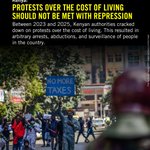
1. Kenyan authorities have increasingly used authoritarian tactics, including arbitrary arrests & detention, abductions, malicious prosecution of protesters, surveillance, & media repression, to crackdown on protests.
amnesty.org/en/latest/news/2…
2. This crackdown is against deepening economic hardship and the government’s aggressive fiscal policies. Read our new report, out now.
amnesty.org/en/latest/news/2…
Amnesty Eastern Africa retweeted
@amnesty has this morning launched a new report examining how economic hardship and fiscal policies have fuelled youth-led protests in Kenya, and how the state has responded with practices that restrict dissent and raise serious human rights concerns.
Download the report here: amnesty.org/en/latest/news/2…
Amnesty Eastern Africa retweeted

Masculinity doesn’t mean:
❌ being dominant
❌ being in control
Gender equality cannot be achieved without the involvement of men and boys.
See how @UNFPA is working with them to advance gender equality around the world: unf.pa/mbs

ALT A card with the following text in white: ‘You can be masculine without being toxic’. The UNFPA logo is at the bottom right.

Amnesty Eastern Africa retweeted

Kenyan authorities must address economic grievances underpinning protests, end the escalating crackdown on dissent, and ensure accountability for human rights violations.
bit.ly/3U0sLSo

Amnesty Eastern Africa retweeted

Today @AmnestyEARO has released a report calling out the Kenyan government for suppressing protests using authoritarian tactics. Read amnesty.org/en/latest/news/2…

Gen-Z type protests are spreading around the world and 2026 Nobel peace prize winner #NaviPillay told me that protests shouldn't be supressed & she is worried that dictatorships continue in Africa.
#FocusOnAfrica @BBCAfrica