

Passionate Railwayman, Compelling Storyteller; Compulsive traveller; Cultural Explorer. Watch out for Food posts and Lunchtime humour. Views strictly personal.
Joined June 2021
- Tweets59.1K
- Following201
- Followers30.1K
- Likes208K





Pinned Tweet
Friends, finally, after some delay, my podcast with @kunalvijayakar on the History of the Bor Ghat railway line on @IVMPodcasts is live! It has come out well though the editing could have been a little better. I regret if there are any errors in the podcast. I would request you to watch it on YouTube in leisure (as it is 47 minutes long 🙂) and let me know how it came out! Thanks! 🙏 #podcast #IndianRailways #History
youtu.be/wVF2NIsF-DM?si=lgNH…

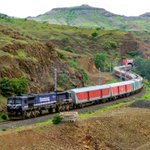
The beautiful capture of a train snaking it's way out of the tunnel close to the Shindawane Ghat around the rugged landscape on the Pune-Satara route, in the jurisdiction of @drmpune in @Central_Railway! Pic courtesy, Anagh! #IndianRailways #photography #Maharashtra @godbole_shilpa @docbhooshan

The Madurai-Gurvayur Express with the Vistadome coach going over the landmark Pathimoonu Kannara or the 13-arch bridge for the first time near Aryankavu station on the Sengottai-Punalur line! #IndianRailways #Vistadome

This Vistadome coach looks so good on its first ride - just as beautiful as the landscape outside. And it's introduction just as the monsoon began has been a big bonus! Video courtesy, Sabari Varkala! #IndianRailways #Vistadome
This Vistadome coach looks so good on its first ride - just as beautiful as the landscape outside. And it's introduction just as the monsoon began has been a big bonus! Video courtesy, Sabari Varkala! #IndianRailways #Vistadome

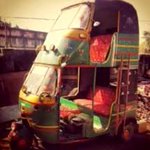
Ever heard of or seen this kind of double-decker - a double-decker auto! This is from a town in the western part of India. 🙂 #transport #humour

LT GEN SAGAT SINGH(1919-2001):
THE GENERAL WHO NEVER LOST A BATTLE AND WON THE 1971 WAR FOR INDIA-
A Beautiful and Brilliant piece
The Government of Portugal offered a reward of US Dollars 10,000/- for Sagat Singh, a Brigadier in 1961, for anyone who could capture this liberator of Goa. Posters depicting him as a ‘wanted man’, sprung up all over Lisbon!
Sagat Singh was born in Kusumdesar Village in the Churu region of the Bikaner Kingdom on 14 July 1919 to Brijlal Singh Rathore (a soldier in the Bikaner King’s army) and his wife Jadao Kanwar. In 1938, after his Intermediate exam, Sagat Singh was enrolled as a Naik in the Bikaner State Forces.
When World War II broke out, he received a commission as a Second Lieutenant from the King of Bikaner. In 1949, he was absorbed in the Indian Army with the 3 Gorkha Rifles Regiment.
In 1961, Sagat Singh was promoted to the rank of Brigadier and was given the command of India’s Paratroopers - 50 Parachute Brigade. ‘Operation Vijay’, for the liberation of Goa from the Portuguese commenced on 17 December, 1961. Although, 50 Parachute Brigade was given a secondary role in the original operational plan, the rapid advance and initiative under the dynamic leadership of Brigadier Sagat Singh from Belgaum towards Goa, made it the first to reach Panjim, the capital of Goa. On the morning of 19 December 1961, Panjim fell to the forces of 50 Para Brigade under Brigadier Sagat Singh.
The Portuguese Governor General and Commander – in – Chief, Major General Vassalo De’ Silva fled to Marmagao, but surrendered later.
At 11 am on19 December 1961, the Indian Tricolour was hoisted on the Secretariat Building at Panjim, by Brigadier Sagat Singh’s forces.
In 1965, China issued an ultimatum to India to vacate the border outposts of Nathu la and Jelep La in Sikkim, which belonged to India. Lt. Gen. Manekshaw was the Eastern Army Commander and Lt. Gen. J S Aurora was the Corps Commander of 33 Corps, responsible for Sikkim. Major General Sagat Singh was the General Officer Commanding (GOC) of 17 Mountain Division which controlled Nathu La.
Orders to 17 and 27 Divisions were that in case of hostilities they were to vacate outposts and fall back to the main defences. Sagat Singh, however, refused to pull back. The GOC of 27 Division (deployed East of 17 Div.) pulled back from Jelep La and to this day, this vital pass leading to the Chumbi Valley is still with the Chinese. During August – September 1967, the Chinese tried their best to make Indians withdraw from Nathu La, but General Sagat Singh made his forces hold on, though as per orders, he could have vacated this outpost. During this engagement, both sides suffered casualties, but Nathu La in 1967 gave a bloody nose to the Chinese under General Sagat’s audacious leadership and helped the Nation and the Indian Army, overcome some regrets of the military defeat in 1962.
During his posting in Shillong, the Mizo separatist rebellion under Mizo National Front (MNF) had started and since the area was under his responsibility, General Sagat Singh set into motion the strategy for counter – insurgency operations in Mizoram which quelled the rebellion for sometime.
In December 1970, he was promoted to Lieutenant General and assigned the command of IV Corps. The initial plans for the liberation of Bangladesh did not involve the capture of Dacca. The plan was to liberate areas upto the major rivers surrounding Dacca and thereafter to declare Bangladesh as liberated. The Army Headquarters directive to Eastern Command did not envisage Dacca as the final objective of the campaign in the East.
Cont'd... 1/2 #IndianArmy #legends

The hierarchy above General Sagat was the same as it was in Nathu La in 1967 – Lt. Gen. J S Arora now as the Eastern Army Commander and General Manekshaw as the Army Chief. Orders given to Lt. Gen. Sagat Singh were to advance upto River Meghna from Tripura in the East and capture areas upto the river line.
He was ordered not to cross the Meghna. Lt. Gen. Sagat Singh the military genius that he was, clearly identified the two centres of gravity of the campaign in the East – the fall of the capital Dacca and the capitulation of all Pakistani forces in East Pakistan. Undaunted by the massive Meghna, Lt. Gen. Sagat Singh, launched the first ever Indian heliborne operation across the river and the rest is history, as his IV Corps raced to Dacca, in a blitzkrieg. This led to the fall of Daca and the surrender of 93,000 Pakistani soldiers who were taken as Prisoners of War (PoW). It would perhaps have been appropriate for General Sagat Singh who captured Dacca, to have accepted the surrender of Pakistani forces from Lt. Gen. Niazi.
General Sagat has the unique distinction of contributing at the National level in the liberation of Goa as a Brigadier in 1961, aggressively resisting the Chinese and giving them a bloody nose at Nathu La in 1967, streamlining the counter insurgency campaign against Mizo secessionists, and the crowning glory of liberating Bangladesh as a Corps Commander. The award of a Param Visisht Seva Medal (PVSM) and Padma Bhushan falls far short of the exceptional contribution of this General with “a talent for war”.
General Sagat Singh settled down in Jaipur having retired from the Army in 1979. His house in Jaipur is name “Meghna” as is his eldest granddaughter. On 14 July 2019 and the week after that, Lt. Cherish had the unique privilege of organizing the 100th anniversary of the birth of this illustrious General. A prominent road in Jaipur has been adorned with a bust of General Sagat Singh and named after him. The Jaipur Literary Festival in end January 2019 witnessed readings from his biography by his ADC in war – later Major General Randhir Sinh. A seminar was organized in Jaipur, where Generals who fought the war with him, as well as his son Colonel R V Singh and his relatives paid tribute to him in a much publicized event.
He breathed his last on 26th September 2001, at the age of 82. Truly, Sagat Singh was the General who never lost a battle and won the 1971 War for India, thus liberating Bangladesh. #IndianArmy #legends
Ananth Rupanagudi retweeted
My local Railway staff has given us a list of 31 temples and these are supposed to be the most important ones. We seem to be racing against time to cover these today and over the weekend. Challenging task indeed! 🙂 #Kumbakonam #temples
Friends, help required. Please guide me on some good pure vegetarian restaurants in Thanjavur-Kumbakonam area. We are here on a temple run trip. #restaurants #temples
People disembarking from a river ferry at the jetty — Calcutta, 1914.
A glimpse of everyday life along the bustling Hooghly River, where ferries served as a vital link for commuters across the city. The ferry service on the Hooghly River in Kolkata is a historic and vital lifeline that connects Howrah Station and Kolkata across the water, carrying hundreds of thousands of daily commuters.
Early steam navigation and private operators—such as the Calcutta Steam Navigation Co. Ltd.—ran regular routes between Chandpal Ghat and Howrah ghats like Ramkrishnapur as early as the early 20th century. The East Indian Railway also used launches from Armenian Ghat between 1854 and 1874 to ferry rail passengers before the floating bridge opened.
Companies such as the Ghatal Steam Navigation Company Limited (GSNCL) and Indo-Swiss Trading Company Private Limited (ISTCPL) co-initiated and managed early cross-river routes like the Ahiritola–Bandhaghat service. This era featured a structured, competitive landscape of steam navigation and local boat operations as commercial and daily commuter demands grew across the twin cities. #Kolkata #ferryservice #history @TheRightGhose

A beautiful aerial picture of Crawford Market, Bombay, c. 1937. The Central Hall, topped by the clock tower, is on the right. Crawford Market (officially renamed the Mahatma Jyotiba Phule Mandai) is a historic South Mumbai marketplace completed in 1869, designed in the Victorian Gothic style by British architect William Emerson.
It was originally named after Arthur Crawford, the first Municipal Commissioner of Bombay. The construction was funded and donated to the city by Parsi philanthropist Cowasji Jehangir. In 1882, the building made history as the first structure in India to be illuminated by electricity. It served as Mumbai's primary wholesale fruit and vegetable market until March 1996, when wholesale operations moved to Navi Mumbai.
Designed by William Emerson with early influences from William Burges the structure combines a V-shaped plan featuring two low, long wings joined at a prominent 128-foot-high clock tower. It was built using local Kurla stone and red stone brought in from Bassein (Vasai), topped by a 50-foot-high iron-framed roof designed to maximize natural ventilation and daylight.
The exterior walls and entrance archways feature detailed sculptural reliefs, friezes, and stone fountains designed by John Lockwood Kipling (father of author Rudyard Kipling) and students from the J.J. School of Art, depicting agricultural scenes and local workers. #Mumbai #market #history @mumbaiheritage @dhavalkulkarni

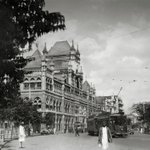
Late 1920s, Elphinstone College, Bombay (Mumbai). Elphinstone College in Mumbai is one of India's oldest institutions of higher education, famous for its rich colonial history and Victorian-Gothic architecture.
The institution is named after Mountstuart Elphinstone, the Governor of Bombay from 1819 to 1827, who promoted Western-style education. Classes began around 1836 through the Bombay Native Education Society, and it was formally constituted as a separate college on April 1, 1856.
The college played a foundational role in establishing the University of Mumbai in 1857, hosting its early classes before they moved to the Fort campus. It formally affiliated with the university in 1860. It helped pioneer legal education in India with the setting up of the Perry Professorship of Jurisprudence in 1855, which led to the creation of the Government Law College, Mumbai.
The college first moved into a dedicated building in Byculla (opposite Jijamata Udyaan) in 1871. It later shifted to its current prominent building in the Fort/Kala Ghoda area in 1889. Its historic halls shaped many iconic leaders and reformists, including B. R. Ambedkar, Bal Gangadhar Tilak, Dadabhai Naoroji, Jamshedji Tata, and Homi J. Bhabha.
The current Fort building (officially the Sir Cowasjee Jehangier Building) was funded by Parsi philanthropist Sir Cowasji Jehangir Readymoney. The structure was designed by architect James Trubshawe and completed by Public Works Department engineer/architect John Adams.
The building exhibits a striking Venetian Gothic and Early English Gothic Revival style. It is characterized by pointed arches, fine stone carvings, decorative detailing, covered arcades at the ground level, and stained glass windows. Inside stands a prominent bust of its benefactor, Sir Cowasji Jehangir. #Mumbai
#college #history

Please remember that happiness doesn't depend on who you are and what you have; it depends solely on what you think. Good morning, friends, and have a great Friday! 🙏 #FridayMotivation
In 1943, the Gestapo finally caught Raymond Aubrac, one of France’s most wanted Resistance leaders. The German secret police sentenced him to death, and his execution was only days away.
At the same time, his wife Lucie was six months pregnant with their second child. Most people in her position would have gone into hiding, grieved quietly, and prayed for a miracle.
Lucie Aubrac decided to do something completely different. She got her hands on forged identity papers, created a believable cover story, and walked straight into the office of Klaus Barbie. History would later remember Barbie as the brutal Butcher of Lyon, but Lucie did not let fear stop her.
She looked him in the eye and successfully convinced him to grant her a final visit with her condemned husband. But Lucie did not risk her life just to say a tearful goodbye. While she was inside the prison area, she was secretly memorizing the positions of the guards, counting the minutes between patrols, and mapping out the exact route the prison truck would take.
She was treating a desperate situation like a military operation. On October 21, 1943, that prison truck rolled through the streets of Lyon. It was carrying Raymond and several other prisoners toward what should have been their final destination. What the German soldiers did not know was that Lucie had spent weeks quietly assembling a dedicated team of Resistance fighters.
She planned an ambush with absolute precision. When the truck finally reached the chosen ambush spot, her team struck fast, coordinated, and without a single moment of hesitation.
In the middle of the sudden gunfire and chaos, Raymond Aubrac was pulled free from the truck. Lucie, who was visibly and unmistakably pregnant, had organized every single detail of his dramatic liberation.
Right after the rescue, the couple had to go into deep hiding. A few weeks later, Lucie gave birth to their daughter in a secret safe house while German forces searched frantically for them across France. They managed to evade capture until the war ended.
When liberation finally came, the Aubracs did not just try to sit back and recover from their trauma. Instead, they rebuilt their lives and continued to serve their country.
Raymond became a celebrated engineer and entered public life to help rebuild France's infrastructure. Lucie became a respected historian, pouring decades of her life into making sure that the women of the French Resistance were never forgotten.
She wanted to make sure these women, who were so often unnamed in the history books, were written permanently into the record. Together, the couple raised three children, traveled the world, argued, laughed, and grew old side by side.
Years later, journalists asked Lucie what had compelled her to risk everything on that dangerous October day. She did not hesitate for a second. She looked at them and said, "He was my husband. What else would I do?"
In his final years, he continued speaking publicly to young generations about the Resistance, the power of memory, and the absolute obligation to tell the truth about history.
When Lucie passed away in 2007 at 94, and Raymond followed her in 2012 at 97, they left behind a 64 year marriage that was a testament to the ultimate triumph of life and family over hatred. Their love didn't just survive a war it blossomed into a lifetime of shared smiles, proving that the greatest force in the world is a heart that refuses to give up on the one it loves. #France #History

Have you been to this station - the station with the "original" longest name? #IndianRailways #stations

Can see my batchmate and good friend, Mr.O.P.Meena, @drmmadurai, in the video! #IndianRailways #Vistadome

A beautiful frame of three powerhouses - the majestic WP locomotives- at the Howrah Shed, captured by Mike Tisdale, in January 1980. The image perfectly encapsulates the twilight era of main-line steam traction in India. The three 4-6-2 "Pacific" broad-gauge locomotives are positioned symmetrically on parallel yard tracks, creating a dense, muscular wall of steel that emphasizes their massive scale.
During the 1970s and 1980s, Howrah Junction served as one of the most critical hubs for the iconic WP-class steam locomotives. As the primary terminal for the Eastern Railway (ER) and South Eastern Railway (SER), Howrah was responsible for sending out high-profile, heavy-load mail and express trains across the subcontinent.
The Howrah Steam Loco Sheds (and neighbouring maintenance points like Bamangachi and Tikiapara) housed large pools of these broad-gauge giants. The sheds handled routine overhauls, boiler washing, and heavy maintenance for indigenous WPs built by the Chittaranjan Locomotive Works (CLW) as well as earlier imported variants. #IndianRailways #Howrah #History

That's why the best thing to do is not to buy an iPhone. I am happy with my Samsung S25. #mobile

Lunchtime humour - I saw a guy at Starbucks today.
No iPhone.
No tablet.
No laptop.
He just sat there.
.
.
.
Drinking coffee...
.
.
.
Like a Psychopath. 😃😛😂
The railway lines that pass through such green and scenic rural agricultural landscapes also make for a good capture - a train passing close to Jabbalagudda station (Koppal district, Karnataka), in the jurisdiction of @drmubl in @SWRRLY! Pic courtesy, Gautham Karthik! #IndianRailways #photography #Karnataka @DrDeepakKrishn1 @anilbhatortho
