In this video, we review the six paired extraocular muscles that move the eyeball. Another extraocular muscle, the levator palpebrae superioris, is not covered in this video. Instead of moving the eyeball, it elevates the upper eyelid.💡
#anatomy #MedTwitter #Medstudent
The external carotid artery terminates by dividing into two branches: the superficial temporal artery and the maxillary artery. As shown in the illustration, it also gives off six side branches.💡
#anatomy #MedTwitter #Medstudent #medicalstudent
The nasal cartilages form the structural framework of the external nose and contribute to the shape of the nasal bridge, tip, and nostrils. The nasal ligaments connect and support the nasal cartilages, reinforcing the cartilaginous framework.💡
#anatomy #MedTwitter #Medstudent
4
229
Happy Halloween from the Anatomy.app team!🎃🦴
May your Halloween be full of treats, good company, and just the right amount of fright. Don't lose your head out there!👻💀
#Halloween #HappyHalloween #TrickOrTreat #anatomy
71
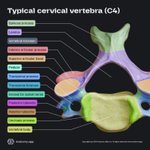
Typical cervical vertebrae (C3–C5) feature small bodies, triangular vertebral foramina, transverse foramina, anterior and posterior tubercles, and short, bifid spinous processes.💡
Learn human anatomy fast at Anatomy.app!🧠
#anatomy #MedTwitter #Medstudent
Learn which muscles are responsible for forearm pronation and supination. The biceps brachii, which also acts as a supinator, was covered in one of our previous videos.💡
Learn human anatomy fast at Anatomy.app!🧠
#anatomy #MedTwitter #Medstudent #medicalstudent
1
164
The deep part of the posterior compartment of the forearm muscles is primarily responsible for extension of the thumb and index finger, as well as supination of the forearm.💡
Learn human anatomy fast at Anatomy.app!
#anatomy #MedTwitter #Medstudent #medicalstudent
2
119
Muscle hypertrophy is the increase in muscle size that occurs when resistance training stimulates adaptations within muscle fibres. Through progressive overload, adequate nutrition, and recovery, muscles gradually grow and become stronger over time.💡
#anatomy #MedTwitter
5
253
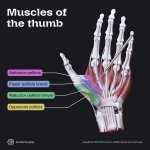
The thumb muscles are a group of four intrinsic muscles located at the base of the thumb on the radial side of the palm. The abductor pollicis brevis, flexor pollicis brevis, and opponens pollicis form the thenar eminence.💡
#anatomy #MedTwitter #Medstudent #medicalstudent
2
126
🚦Not all highways carry cars! This time, take a 360° tour of the vascular network of the gastrointestinal tract.😎
Learn human anatomy fast at Anatomy.app!🧠
#anatomy #MedTwitter #Medstudent #medicalstudent
3
320
The deltoid is a large, thick, triangular-shaped shoulder muscle. Based on its sites of origin, the deltoid can be subdivided into three parts: clavicular, acromial, and scapular spinal (or simply the spinal part). 💡
#anatomy #MedTwitter #Medstudent #medicalstudent
When the sternocleidomastoid contracts unilaterally, it produces lateral flexion of the neck to the same side and rotation of the head to the opposite side.💡
Learn human anatomy fast at Anatomy.app!🧠
#anatomy #MedTwitter #Medstudent #medicalstudent
The eyeball consists of three distinct layers, each composed of specialized structures with unique functions.👀
Learn human anatomy fast at Anatomy.app!🧠
#anatomy #MedTwitter #Medstudent #medicalstudent
1
103
The biceps brachii is a two-headed muscle of the anterior compartment of the arm. It acts as an antagonist of the triceps brachii and, while it is best known for flexing the forearm, both heads also contribute to forearm supination.💪🏻
#anatomy #MedTwitter #Medstudent
1
351
The facial muscles are a group of thin skeletal muscles located beneath the skin of the face and scalp. They control movements of the overlying skin and enable expressions such as smiling and frowning.💡
#anatomy #MedTwitter #Medstudent #medicalstudent
1
201
This time, we shift our focus to such a complex movement as arm abduction. Read more about it and the biomechanics behind it on Anatomy.app.💡🧠
#anatomy #MedTwitter #Medstudent #medicalstudents
6
389
The biliary system is a series of ducts and organs involved in the production, storage, transport, and release of bile into the descending part of the duodenum, where it aids digestion. 💡
anatomy.app
#anatomy #MedTwitter #Medstudent #medicalstudent
124
Take a 360° look at the muscles of the upper limb and explore their anatomy from every angle. 💪
Discover the muscles and their attachments in our 3D Muscles of the Upper Limb article 👉🏻 anatomy.app/article/muscles-…
#anatomy #MedTwitter #Medstudent #medicalstudent
🦶 Did you know the foot has 26 bones?
The bones of the foot are divided into three groups: 7 tarsals, 5 metatarsals, and 14 phalanges. The tarsals include the talus, calcaneus, navicular bone, cuboid, and three cuneiform bones.
#anatomy #MedTwitter #Medstudent #medicalstudent
🦴 Can you name all the bones of the skull? 🤔
Test your knowledge with our 3D Skull anatomy article👉🏻 anatomy.app/article/skull
#anatomy #MedTwitter #Medstudent #medicalstudent