

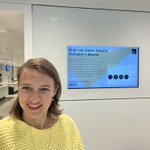


Thanks for having me and listening to me talk about both my science but also my career to date! It was great to meet so many ECRs

Last week we kick-started the 2024/2025 academic year with our first Future Leader seminar, featuring an amazing talk from Dr @AnnaMallach and a full room!! Thanks to all @ImperialBrains ECRs who joined us, we hope you found it as inspiring as we did! See you all next month✨

AnnaKMallach retweeted

Interested in psychedelic research?!? The LGBTQ+ Allies network @ImperialBrains is hosting a special symposium featuring @DavidErritzoe @tommaso_barba @joannavamvako from the @ImperialMed Centre for Psychedelic Research and Gary Gilmor from @COMPASSPathway. More details 👇

AnnaKMallach retweeted

Hurry and get your applications in quick! Only a few days left to apply for an exciting postdoc position in my lab harnessing structural #proteomics to better understand neurodegenerative disease @CmdOxford @UniofOxford.
tinyurl.com/mshnw9j9 – at Oxford, England

Excited to start as Emerging Leader at @UKDRI and continue to study cellular crosstalk in neurodegeneration

We're delighted to announce 3 new UK DRI Emerging Leaders: @M_Malpetti, @AnnaMallach, & @val_jaramillo! 🎉 🙌 👏
The initiative supports exceptional ECRs on their journey to setting up an independent lab. Find out more about our new Emerging Leaders👉buff.ly/47lcA4a

AnnaKMallach retweeted

Applications are invited for a Research Associate in vascular-immune epigenomics to join the lab of Dr Alexi Nott in the UK DRI at Imperial. @UKDRI @nottalexi Closing date: 25th September.
dementiaresearcher.nihr.ac.u…

AnnaKMallach retweeted

A warm welcome back to all ECRs, another exciting academic year is starting 👩🎓🧑🎓✨ We are back for another year of seminars, workshops and socials🍕✍️👩💼🥪 We will kick-start our new 2024-2025 season of the Future Leader seminar series with a talk from Dr @AnnaMallach
AnnaKMallach retweeted
We have been awarded @alzassociation funding to study the epigenome of the vasculature in dementia using single nuclei approaches🧠. We are looking for a motivated postdoc to join us @UKDRI & @ImperialBrains. Post closes Sept 25th & email me any questions.
lnkd.in/gmqAFpUr

Super cool work!

Delighted to share our paper on task-switching and prediction errors.
nature.com/articles/s41467-0…
How does the brain update its current knowledge of the world to guide flexible behaviour? Prediction errors are key! Pls read & share if you find these questions interesting. Thread:

2
418
AnnaKMallach retweeted

Our new findings 👀 Combining zebrafish and human iPSC models of FOXG1 Syndrome we uncover a role for FOXG1 in the cytoplasm, where it controls mitochondrial translation, integrating cell fate decisions and regulation of metabolic activity. @CorinneHouart @HouartLab

A cleaved cytosolic FOXG1 promotes excitatory neurogenesis by modulation of mitochondrial translation - a new therapeutic target for ... biorxiv.org/cgi/content/shor… #biorxiv_neursci
Join us now


In the Salon at 12pm BST tomorrow - What it's really like doing a #PhD.
We’re going to demystify the PhD journey, discussing everything from the challenges of research and time management to the joys of discovery and academic contribution. Whether you’re considering pursuing a PhD or are just curious about the process, this event will provide a realistic look at the daily life, struggles, and successes of PhD students across various disciplines. Don’t miss this opportunity to gain valuable insights from our brilliant speakers and from our wider Salon contributors – so if you’ve lived through the PhD, please attend anyway, because you can help other members of the Salon.
Already got your PhD? Then join us to share your tips with the audience.
#PhDToolkit #phdlife #PhDApplication
Speakers
@AnnaMallach – holds a BSc in Neuroscience from King’s College London and a MRes in Experimental Neuroscience from Imperial College London. During her BBSRC-funded PhD at UCL, Anna worked with Jennifer Pocock, Selina Wray and Thomas Piers to study microglia – neuron interactions using induced pluripotent stem cells. Her postdoctoral research focussed on applying spatial transcriptomics to resolve the cellular responses to Alzheimer’s disease pathology to study dysfunctional cell-cell interactions working with Lorena Arancibia and Bart De Strooper.
@Rags326 – works at the University of Birmingham and NIHR ARC West Midlands. He is leading on a project exploring life in rural areas of the West Midlands with dementia. Exploring how people living in these communities access healthcare and get a diagnosis, and how they are supported following diagnosis, and what could be done better, and how this differs from those living in urban areas. Chris did he PhD at Bournmouth and University of Stirling and finished in 2015.
Programme
The format of the event is a 30 minute livestream where the speakers will each present their thoughts on this topic for 10 minutes each, the host will then ask questions and the livestream will end. The speakers will then join the online chat and interact with the audience, answering questions and giving those who attended a chance to share their thoughts on the topic.
RSVP
communities.dementiaresearch…

ALT "Promotional poster for a Salon event hosted by the British Science Association titled 'What it's really like doing a PhD'. The event features Dr Chris Poyner from the University of Birmingham and Dr Anna Mallach from Imperial College London. The event is scheduled for 7th August at 12.00 PM BST."
I have an exciting PhD position available to join my lab starting this October at the @UKDRI . If you are interested in understanding how microglia contribute to Parkinson's disease and want to study cellular interactions using different methods, apply! findaphd.com/phds/project/th…

AnnaKMallach retweeted

💡Interested in the cell biology of microglia in Alzheimer’s? Exciting opportunity for a Research Fellow to join the De Strooper/Arancibia lab at the UK DRI at UCL (based at the Crick)!👉buff.ly/4eynjeR

Can only recommend the lab, Tom is an incredible supervisor!!

Last few days to apply for this exciting PhD studentship for those interested in human disease modelling using iPSC-derived organoids with @PsyEpigenetics and me.
@ExeterBRC @uniofexeHLS @ExeterMed @ExeterNeuro Application deadline 24th June 2024: exeter.ac.uk/study/funding/a…
Great to see our work discussed @PharmaTimes
Using Alzheimer's mouse models, new UK DRI, @TheCrick & @CBD_VIB research shows how communication between support cells in the brain can disrupt signals between neurons🧠
@Arancibia_Lor comments in @PharmaTimes⬇️
buff.ly/3Rujspa
AnnaKMallach retweeted
Using Alzheimer's mouse models, new UK DRI, @TheCrick & @CBD_VIB research shows how communication between support cells in the brain can disrupt signals between neurons🧠
@Arancibia_Lor comments in @PharmaTimes⬇️
buff.ly/3Rujspa
Super exciting to see my paper so widely discussed at the @TheCrick - it was great working with the core facilities to get early access to these incredible technologies


Researchers at the Crick, @UKDRI and @CBD_VIB have found that chatter between support cells in the brain is closely linked to Alzheimer’s disease in mice.
The findings open up potential research avenues in the search for new Alzheimer’s treatments.
crick.ac.uk/news-and-reports…

It is so exciting to see my postdoc paper (finally) out! cell.com/cell-reports/fullte… Here we tested novel spatial transcriptomics platforms to investigate how cells interact in a model of Alzheimer's disease. We found... 1/n

Researchers at the UK DRI, @TheCrick & @CBD_VIB led by @AnnaMallach & @Arancibia_Lor
have found that communication between support cells in the brain is closely linked to Alzheimer’s in mice🧠
The findings could lead to new therapeutic targets👉buff.ly/459UtNw

that around some plaques a lot more microglia accumulate, which led to the development of disease-associated phenotypes in both microglia and astrocytes. Astrocytes emerged as key signalling hubs in the local plaque environment and... 2/n
1
1
177
AnnaKMallach retweeted
Researchers at the UK DRI, @TheCrick & @CBD_VIB led by @AnnaMallach & @Arancibia_Lor
have found that communication between support cells in the brain is closely linked to Alzheimer’s in mice🧠
The findings could lead to new therapeutic targets👉buff.ly/459UtNw