

Founder & CEO SeedLegals, the largest closer of funding rounds in the UK. Now in the US. The man behind the BBC iPlayer.
London
Joined August 2008
- Tweets7.5K
- Following2.1K
- Followers6K
- Likes2.3K





Anthony Rose retweeted

Interesting data from @seedlegals and @anthonyrose on UK startups and founders moving to the US.

Is there really an exodus of UK startups to the US? A few days ago I wrote that founder WhatsApp groups are full of talk about how hard it is to raise in the UK right now and that founders are increasingly looking to the US. But is it really a thing?
At @SeedLegals we have data on that. We went back through this year’s calls between founders and our UK team and pulled out conversations where the founder brought up the US. Thanks to AI, searching tens of thousands of call transcripts is now an afternoon’s job rather than a summer intern’s.
Turns out the WhatsApp groups were right. Founder interest in the US is up in every quarter of 2026, and it’s up by nearly half since January.
About half the time founders were weighing up a Delaware flip or setting up a US entity. More than a quarter were raising from US investors without restructuring their UK company. And about a fifth already had a US company and were working out what comes next.
Quite often a US investor or accelerator had told them they’d need a Delaware company before writing a cheque. Which makes sense, US investors want QSBS, their version of SEIS/EIS, and that needs a US C corp.
Importantly, flipping doesn’t mean giving up on UK investors. You can raise and invest SEIS/EIS into a Delaware company, so you can take money from both UK and US investors. Far too few founders and investors know about that, more at
seedlegals.com/resources/sei…
Thinking about raising from US investors? DM me or head to seedlegals.com/talk-to-an-ex… we'll help you do the Delaware flip swiftly and inexpensively with SeedLegals and our tax & legal partners.
If you’ve already done the flip, or are thinking about it, was it your idea or your investor’s? I’d love to hear your experience.
Anthony Rose retweeted

The UK's Online Safety Act is a massive censorship statute.
Parliament has extended it to cover new categories of wrongthink several times following its entry into force. The OSA is like a Christmas tree on which new censorship demands are regularly hung.

Anthony Rose retweeted

Are you one of the estimated 40 million Apple iCloud users in the UK?
Well, your government has now been forced to admit that it has served Apple with a technical capability notice (TCN), an order that can force companies to make customer data accessible to UK security services, even when it's encrypted.
In short, your government has likely had unfettered access to all your private documents and photos stored in iCloud.
It's hard to know where to start with this, but in no particular order:
- this absolutely has to stop. We need politicians to remember that they work for us, not the other way round
- everyone has a basic right to privacy regarding their home, family and personal life. This is only limited by proportionality, and if you think scanning the private information of 40 million people is proportionate, you should probably be sectioned for your own protection.
- as we know they won't actually stop trying, it's up to you to protect yourself and your data. See my pinned post for some guidance. I'm typing this on a phone running @GrapheneOS, a privacy hardened operating system. Look into @Nextclouders for your photo back up. Investigate simple plug and play home servers like @umbrel , easy for anyone to set up. Stop making it easy for government to meddle disproportionately in your private life. They have no right to do so.
- People should not be afraid of their government. Governments should fear their people. We need to remind them of this at every chance we get.


The UK Stalker-State is looking through your personal and private nudes; laying further groundwork for future live-cam surveillance.
As I predicted, and thanks to a successful legal challenge by @libertyhq and @privacyint, the UK Government has had to admit that they issued @Apple with a Technical Capability Notice compelling them to accept device-level UK State surveillance, impacting up to 40 million UK iCloud users.
Apple’s UK-only terms and conditions state that they are deploying “proactive technology” such as “image detection technology” to facilitate this.
Users could have potentially lawful content restricted, or removed, and also be “suspended or terminated from Apple Software or Services”.
This unacceptable, and unwarranted surveillance has privacy implications for all users, especially amateur and sex-worker generated adult content.
libertyhumanrights.org.uk/is…

Anthony Rose retweeted

BREAKING:
Alongside @privacyint, our legal challenge has forced the Government to confirm their secret order to break Apple encryption.
This is a huge win for our privacy rights.
libertyhumanrights.org.uk/is…
Do you know how restaurant chains develop their menu? Did you know they build them to a price point? When you go to a restaurant chain, they've got all these things on the menu.
You may have wondered how they got to be on the menu. Is there an in house chef? Do they outsource? Do they A/B test dishes in the same way that startups A/B test product designs?
So I was delighted to meet Grégoire Dettai from kitchensoftomorrow.com at a @SeedLegals event in Paris. Grégoire is a chef consultant for food tech startups, I figured we had to do a podcast on that.
We spoke about how new food products are developed, the future of robots for food preparation, and more.
If you're doing a food tech startup, developing a new beverage, snack, restaurant chain, whatever, Gregoire is the guy to talk to to help you tantalise not just customers but investors. He'll help you create a winning pitch and business plan that will have investors want in, and create a delicious product that can be shipped at the right price point.
Anthony Rose retweeted

DocuSign wants $8,100/yr from a 15-person team just to sign PDFs. So I built SignuDoc: open source, one-click deploy to your own @vercel account, $0 per seat.
White-label branding, full audit trails, tamper-evident seals and your documents never leave your cloud.
Is there a problem with fundraising in the UK right now?
The chat in founder WhatsApp groups is it's harder than ever to raise investment in the UK. Financial uncertainty, CGT increases, higher interest rates. If they can't raise from UK investors, founders are increasingly looking to the US for investment.
US investors have their own equivalent of SEIS/EIS. It's called QSBS, and it's one reason why US investors almost always require a Delaware C corporation as the top company.
That's leading more and more UK founders to look into incorporating in Delaware in the first place, or doing the Delaware flip and turning the UK company into a US one.
Importantly, hardly any UK founders or investors know that you can raise and invest SEIS/EIS into a Delaware company. That means you can create a Delaware company and then go on to raise from both UK angel investors and US investors. It's a win-win.
But setting up a US company means exposure to US tax laws, reporting, transfer pricing, and more. Time to call in an expert! So I spoke with Stephen Pell from NorthArc, a cross-border tax and structuring specialist.
Thinking of raising from US investors or exploring doing the Delaware flip? DM me or head over to seedlegals.com
Anthony Rose retweeted
"A very small legal team of two or three people managed to absolutely embarrass Ofcom in a very public and global way for exactly zero dollars."
"We plan on doing exactly the same thing to any other foreign regulator who dares cross our border again."
youtube.com/watch?v=5xZucdXd…

Anthony Rose retweeted

This is a huge unforced error in UK AI policy. By default this will force many firms to comply entirely, pushing us to align with the failed project of European technology regulation and risking a further exodus of firms and talent.

So today the UK Government has agreed that part of the UK be subject to aspects of the controversial EU AI Act, a law we did not make and cannot change. There will inevitably be pressure for the rest of the UK to align. bit.ly/4javamY
Anthony Rose retweeted

⚠️The Government wants to force Britons to submit ID checks to use eBay and other online shopping websites.
We warned that the Government's eye-watering internet control plans wouldn't stop with social media restrictions.
Now, any platform where users can talk to each other could be put behind the Great British Firewall.
Britain must not sleepwalk into this authoritarian nightmare. We must say no to passports for the internet - our freedoms hang in the balance.
Read⤵️
bbc.co.uk/newsround/articles…

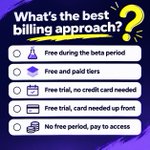
When should you start billing for your product? Free or paid? Free trial period? Free while still in beta?
It's a big founder dilemma, so here are the pros/cons of different billing models:
𝙁𝙧𝙚𝙚 𝙙𝙪𝙧𝙞𝙣𝙜 𝙩𝙝𝙚 𝙗𝙚𝙩𝙖 𝙥𝙚𝙧𝙞𝙤𝙙
You've just launched the product. You're embarrassed to bill for it.
Pro: Reduce friction, get the maximum number of signups. And if it doesn't work no one's going to blame you for taking their money.
Con: Sounds like a great idea but investors are going to grill you as to how you're going to turn those free users into paying customers. They may hold on investing until you've switched to a paid model & proved that people will pay for the product.
𝙁𝙧𝙚𝙚 𝙖𝙣𝙙 𝙥𝙖𝙞𝙙 𝙩𝙞𝙚𝙧𝙨
The classic Free / Pro / Enterprise model.
Pro: Super easy for people to get started, no friction.
Con: Your problem will be coming up with a sufficiently differentiated product to avoid users staying on free forever. One of my favourite sites, Similarweb.com (analyse competitors' web traffic), their free tier is pretty good, paid tier is insanely expensive. So I stay on the free plan, never switching to paid. Also, investors are going to grill you on this model and wait until you've got the upsell numbers before they'll invest.
𝙁𝙧𝙚𝙚 𝙩𝙧𝙞𝙖𝙡, 𝙣𝙤 𝙘𝙖𝙧𝙙 𝙣𝙚𝙚𝙙𝙚𝙙
I'm a big fan of allowing people to try your service before you ask for their credit card so this is what we do at SeedLegals, there's a 7-day free trial that gives unlimited access to many platform features.
Pro: No friction for people to get started.
Con: If your users are looking for a one-time action (PDFSplit is a good example) and can do that on the free trial, they may love your service but never sign up to the paid plan.
𝙁𝙧𝙚𝙚 𝙩𝙧𝙞𝙖𝙡, 𝙘𝙖𝙧𝙙 𝙣𝙚𝙚𝙙𝙚𝙙 𝙪𝙥 𝙛𝙧𝙤𝙣𝙩
A common way to avoid the problem above is to require credit card details up front, promising the user that you'll only start billing after 7 or 30 days. The onus is on the user to log in later to cancel the subscription, if they forget to do that, you start billing them.
Pro: Most people are going to forget to unsubscribe and will be billed as a result.
Con: It adds a barrier to trying out your product, particularly if you have competitors who don't require a card up front. And your customer support team is going to have lots of unhappy customers who say they weren't aware they were going to get billed later or forgot to unsubscribe in time.
𝙉𝙤 𝙛𝙧𝙚𝙚 𝙥𝙚𝙧𝙞𝙤𝙙, 𝙥𝙖𝙮 𝙩𝙤 𝙖𝙘𝙘𝙚𝙨𝙨
If you're so confident in your product that you can require people to enter their card details before they've even had a chance to try it then this is the brave way to go.
Pro: Avoids all the problems of free trials, you get to book revenue from day one.
Con: It's a huge leap of faith for people to enter their card details before trying your service. It needs sufficient word of mouth out there that your service is so hot that people will pay without even trying it first.
🤖 Made with AI

Anthony Rose retweeted

UK Government internet policy is now “if there is somewhere where people can talk to each other, they need to show their ID” 🫠
It’s not a serious policy to keep children safe - it’s just creating an authoritarian checkpoint internet. We can’t allow it.
thetimes.com/article/9c9d338…

The Adventures of Alice, Startup Superhero, Part 1: Taking The Leap
Have an idea that you've been dreaming of building? Thinking of giving up your day job to do your own startup?
Hundreds of thousands of people across the country are thinking exactly this, but scared to take the next step and not sure where to start. Meet Alice, Startup Superhero.
Head back every day for the next episode to see how Alice takes the plunge, validates the idea, find investors, raises investment, and builds her dream. With @seedlegals there to help every step of the way.
More episodes along with tutorial videos and articles at
seedlegals.com/resources/the…

4
165
I’m giving away an hour of my time to one founder. If you’re getting ready to raise investment, the pitch is where it all comes together. Or falls apart. So I’d love to help you make yours amazing.
You can choose:
🎯 A 60-minute 1:1 coaching call, we can work on your pitch, talk through your funding plans, look at your product or tackle whatever’s on your mind about growing your startup.
🎥 A recorded founder interview with me, tell your startup’s story in a professionally recorded interview, then share it on your channels, and ours.
It’s free to enter and takes less than a minute:
👉 seedlegals.com/ask-anthony-d…
If you know a founder who’d love this, tag them in the comments. Open until 27 November.
You don't have to be a @SeedLegals customer to enter (if you are planning to raise investment, of course @SeedLegals is the fastest, most reliable and most delightful way to do that).
There are 2 MILLION potential angel investors in the UK, but only 30,000 SEIS/EIS investors each year.
SEIS is such an brilliant tax benefit for investors - the best in the world. Investors can deduct 50% of their investment from their income tax & pay no CGT if they keep the shares for 3 years. How amazing is that!
What is more amazing is that 100% of people don't know about it. We need to spread the word! The more people who know about it, the more companies will get funded, a win for all.
Our @SeedLegals team put together this awesome e-book - download it, share the link, spread the word
seedlegals.com/ebooks/s-eis-…

What do you think of the term 𝙎𝙪𝙥𝙚𝙧 𝙄𝙣𝙩𝙚𝙡𝙡𝙞𝙜𝙚𝙣𝙘𝙚 instead of 𝘼𝙧𝙩𝙞𝙛𝙞𝙘𝙞𝙖𝙡 𝙄𝙣𝙩𝙚𝙡𝙡𝙞𝙜𝙚𝙣𝙘𝙚?
Super Intelligence is silly - every time you ask Claude to do some task like extract data from a PDF you're going to say "I got Super Intelligence to do it". Ridiculous.
So, how about 𝘼𝙪𝙜𝙢𝙚𝙣𝙩𝙚𝙙 𝙄𝙣𝙩𝙚𝙡𝙡𝙞𝙜𝙚𝙣𝙘𝙚?
(whose acronym, for better or worse, is also AI)
That nicely describes how we use AI to augment what we can do ourselves, which will be increasingly important as it translates into augmented touch, smell, sight, and physical add-ons.
Also, Augmented Intelligence sounds benign, it's that massive computing power working alongside us, to enhance us, rather than displace us.
🤖 Made with AI

Anthony Rose retweeted
Blocking UK users is actually counterproductive from a law enforcement POV.
The users still get to you, only via VPN or Tor. For those, much of the available data for e.g. a search warrant will be garbage.
What Ofcom describes as a "win" for safety is in fact a massive L

This is meant to be about how Ofcom can issue but cannot collect fines against firms. But my biggest takeaway is her comment around it being good that services have blocked UK users.
Before the Online Safety Act became law, we were repeatedly told that Ofcom wouldn’t become an internet censor but that’s precisely what’s happened.


