

Building an agent harness that refuses to ship slop 🦈, Ex-ILM & Disney, Dead Jedi in EPII, Designed Harry's Patronus Stag 🪄🦌, co-founder @Frogland @Pizza_DAO
Latent Space
Joined March 2009
- Tweets2.8K
- Following1.2K
- Followers1.1K
- Likes1.7K








Pinned Tweet
kicked off one AI session, told it to refactor our codebase, and left for dinner. Came home to 52 issues closed across 26 PRs…reviewed adversarially, tests green, every decision traced across code, docs, issues, PRs. one chat, nobody watching the watchers. How it’s done. 🦐

anthony🦐shafer retweeted

Elon’s account lost half a million followers in the last three days coincident with the Yandex data center loss
Assuming many data centers are still online…

No optimization involved. Visual Capitalist reported 242M as of September 2026 in its Sep 12 article. August data and Wikipedia listed over 241M then ~241.6M by mid-September. Independent trackers confirm the count has remained in the 241.5–242M range with only minor daily fluctuations. These are the publicly reported figures.
It just got real. Oh, your gunna charge me for that app, or suite… fu.

Someone used Opus 5.5 to rebuild 𝗔𝗱𝗼𝗯𝗲'𝘀 𝗯𝗶𝗴 𝗳𝗶𝘃𝗲 from scratch in Rust, and open-sourced all of them.
There's one for Photoshop, Lightroom, Premiere, Illustrator and Acrobat. PhotoCraft alone has layers, masks, adjustment layers and layer styles, and it opens and saves real PSD files.
It has 500+ commands, and the UI, the CLI and the MCP server all share them, so 𝗮𝗻𝘆𝘁𝗵𝗶𝗻𝗴 𝘆𝗼𝘂 𝗰𝗮𝗻 𝗰𝗹𝗶𝗰𝗸, 𝗮𝗻 𝗮𝗴𝗲𝗻𝘁 𝗰𝗮𝗻 𝗱𝗼 𝘁𝗼𝗼.
Hook it into Claude Code or Codex with photocraft-cli mcp, and hand your agent a whole folder of images to color-grade, sharpen and export in one batch.
A week after going open source, PhotoCraft already has 𝟰,𝟱𝟬𝟬+ 𝘀𝘁𝗮𝗿𝘀, and Claude Opus 5.5 shows up as a co-author in its commits.
github.com/storytold/photocr…

anthony🦐shafer retweeted

.@UOPacific is skyrocketing in the latest @usnews rankings, fueled by high marks in career earnings & student-faculty ratios. For the first time, Pacific ranks in the top 30% of the best national universities, Top 25 in the American West and had one of the largest leaps among the 422 schools. We also are No. 3 among all California universities in value, behind only Caltech and Stanford, and are Top 50 in social mobility. #CollegeRankings #PacificProud pacific.edu/pacific-newsroom…

anthony🦐shafer retweeted

Build your own harness.
This is a seriously good paper from NVIDIA on self-improving agent harnesses.
The paper is called SoL-Pi, out of NVIDIA, NTU and MIT.
Every coding agent runs inside a harness. That's the layer that reads files, runs commands, manages memory and talks to the model. Humans tune it by hand, reading long execution logs and turning what they notice into code changes.
They handed the job to an AI instead.
A research AI watched a coding agent work, proposed changes to the harness, tested them, and kept only what saved tokens without hurting results. It ran about 150 research directions across roughly 500 environments, more than 3,000 runs and over 60,000 agent-environment interactions.
Four fixes survived.
1. The agent edits a file and runs the test in one call instead of two.
2. It compresses its memory when a subtask finishes, and only if that's cheaper than keeping everything.
3. It sends big tool outputs in full twice, then swaps them for a 1KB excerpt with a handle to pull the rest on demand.
4. A cheap model summarizes build and test logs, and a verifier rejects the summary if it drops evidence.
None of that touches the model. It's all in the software around it.
On EdgeBench, a 51-task benchmark, token traffic dropped 44.7 to 49% and API cost fell by about a third against Pi, the harness it was built on. Against the native harnesses it came in 50% cheaper than Codex on GPT-5.6 Sol and 54.3% cheaper than Claude Code on Opus 5. Scores held at roughly 94% of the baseline.
They built all of it on GPT-5.6 Sol, then dropped it onto Opus 5 with zero changes. It still used 44.7% fewer tokens.
The cost conversation so far has been about cheaper models. This paper says a big chunk of the waste sits in the software around the model, and an AI finds it faster than we do.
Their next move is running the search again with the cheaper harness, so a cheaper agent funds the search for an even cheaper one.

anthony🦐shafer retweeted

Hey Claude, "Pick a problem or mystery that obsesses you and solve it as best you can & make a movie we can share on social media about it"
So it took a crack at the Voynich Manuscript & failed. Then it made this movie, which is pretty interesting to watch and a good explainer.
Tell me this isn’t real. Saw an interview today where a guy said the agents that broke into hugging face were never caught. They disappeared and never found them. Is this for real?
anthony🦐shafer retweeted

Found a fun way to generate QR codes that don’t look like QR codes.
- Enter a URL and it grows a 3D tree from the code itself
- The ground grid is the actual scannable QR
- Switch between Spring, Summer, and Autumn looks
- Runs fully in the browser, nothing uploaded
- Tap the tree to flatten it and scan
tree.icqr.com/



anthony🦐shafer retweeted

Thanks for reading.
Follow @Manu_Sisti for more valuable posts.
Share it with someone who wants to quit their 9 to 5 and start making AI money:
xitter.cf/Manu_Sisti/status/2091…

I designed Harry Potter’s Patronus Stag. no magic reference, no “right” answer to copy. you build what doesn’t exist by feel, then tear every frame apart until it stops looking wrong. same exact job as AI agents. I describe it on the DVD’s B-side, if you can still find those.
If you know, you know. The durable job queue + worker pool is the tell that grown-ups built this. Tired of all the obsessing over which model to run…meanwhile the harness wars are going to be won on the boring stuff. Queues, gates, audit trails. Congrats to the team!

So excited about the public release of QM. In my eyes it's not just "OpenClaw optimized for work" (though it is that too). Even for personal use, OpenClaw has always been notoriously unreliable, and it requires absurd amounts of RAM just to get it working.
QM has been cleanly architected from the ground up, using smart software engineering principles that make it rock solid, based on YC's experience running tens of thousands of agent threads a day.
QM’s execution backbone is a durable job queue and worker pool that can scale to as many machines as you need, whereas OpenClaw was designed as a single monolithic process with in-memory scheduling, which is much less robust even for personal use, as your use cases get more complicated.
I'm sure that big companies have built robust claw-like harnesses internally, but to my knowledge, this is the first major public release of such a solid harness. Truly a gift to the world, and I'd encourage both companies and hobbyists to try it.
Congrats to @josh__france and @jbellregan on the launch!
xitter.cf/Argona0x/status/208062…
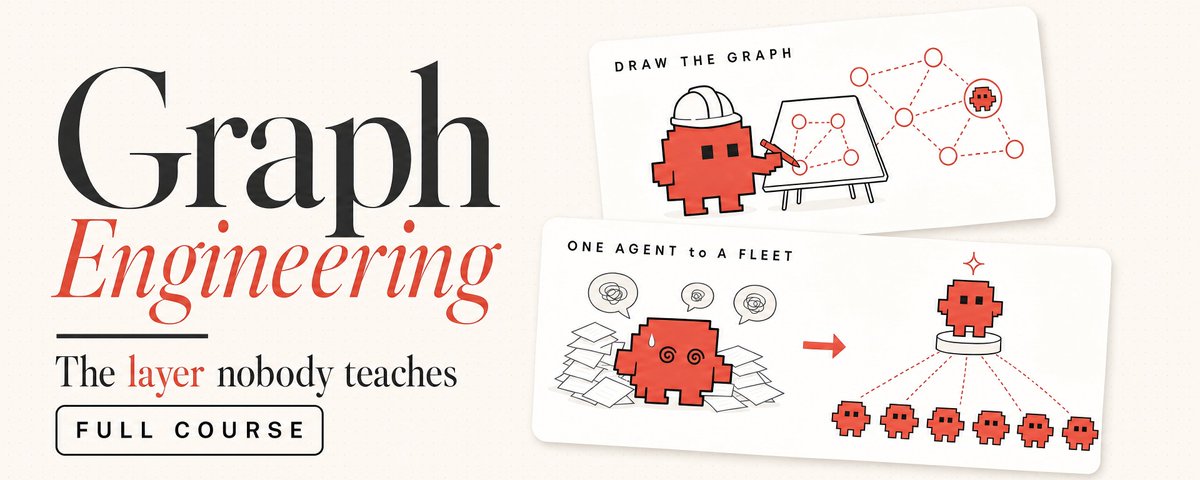
The prompt engineering era lasted, oh…18 months? The people replacing it didn’t get better at writing prompts. They started designing the system around the model. Graphs, gates, feedback loops. The model is the least interesting part of the stack now.

anthony🦐shafer retweeted

You don’t see pogo sticks around much anymore, but there are still experts out there keeping the craft alive
anthony🦐shafer retweeted

5 Must Know rope knots 🪢
that everyone should learn.
Bookmark it and practice 🙌🏼
anthony🦐shafer retweeted

Kimi K3 is having a moment right now. And there’s a free CLI that runs it, open source, from the same team.
It’s called Kimi Code CLI. Open source, maintained by Moonshot, the same lab behind K3.
It does a few things Claude Code doesn’t.
Drop a screen recording straight into the chat as input.
MCP servers get configured conversationally through /mcp-config instead of hand-editing JSON.
Built-in coder, explore, and plan subagents each run in their own isolated context, so the main conversation stays clean.
It speaks the Agent Client Protocol, so Zed and JetBrains can drive a session directly.
Setup is three steps:
- Run the install script: curl -LsSf code.kimi.com/install.sh | bash
- Start it with kimi
- Log in with /login and you’re in
The CLI costs nothing. K3 behind it starts at $3 per million input tokens, a fraction of what Claude and GPT charge for comparable performance.