

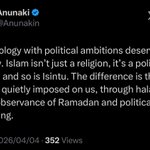


There’s always money and manpower to subdue South Africans. They can’t deploy these soldiers at the border for some funny reason. They can’t use the money to hire more police officers and immigration officers.

As South Africans we have never truly had the freedom to define our home and identity without foreign influence, both white and otherwise. The Halaal debate is about more than food, it speaks to a broader struggle over who gets to shape South Africa, its identity, and its future, while the indigenous people of this land increasingly feel displaced in their own home.


You can’t protect her from public criticism. She chose a job that exposes her to such, and @Solphendukaa didn’t say anything wrong, he was just disappointed with the reporting. She’ll grow and do better, but like everyone else she’ll be baptised in the fire of criticism. Let’s not infantilise women at work. She’ll be fine, it’s part of the process.


Anunaki retweeted
"Everything I disagree with is a conspiracy by extra-national interests"

Our problem in South Africa is part economic and part the scarcity of controlled violence. Kukwa velazbhuqe, and when you try to correct wrongs, you’re told about rights, constitution and international law, ube umonakalo usanda.


Anunaki retweeted

100%!! There is no justification for the government to require Halaal certificates from service providers. South Africa is not an Islamic country.

The good thing is that many of us don’t blindly follow ideologies or borrow our opinions from others. We have no problem with people practising their religion freely. But when religious practices start influencing access to public institutions, government contracts or economic opportunities in ways that disadvantage or exclude others, we will certainly speak out. Religious freedom should never come at the expense of fairness and equal access in our public institutions.
I didn’t agree to anything, I was merely correcting your flawed assumption about grievances. My question to you was when or what do you require to accept that grievances zabantu are legitimate? What’s the criteria you use to determine that?

Anunaki retweeted

lol have you realised that according to liberals, black people being in unity with others is black people letting it go of who they are to accommodate others.
It’s funny because throughout history black people have always been forced to accommodate others. They used guns and oppressive laws then. Now they use passive aggression.
Anunaki retweeted

Halaal and kosher certifications are forcefully imposed on the broader market. Non-halaal and non-kosher consumers are forced to subsidise these regimes; paying higher prices, accepting restricted options, and funding certification processes they did not ask for and do not need.
The weaponisation of a grievance does not invalidate its underlying legitimacy.
Well, it’s not my fault that all your sociopolitical thoughts are always aligned with paid campaigns. It is an unassailable fact that these are funded campaigns. Take, for instance, this account, at the forefront of the halaal discussion, exposed by DM
dailymaverick.co.za/article/…

What must we say as South Africans for you guys to be convinced we’re not being paid to say it?
Clearly, according to you, we can’t think for ourselves and we have no grievances as South Africans.

What is actually of our own thinking kuwe mfowethu?
Kwanto that we bring up, we’re being paid to say it, we’re bots, ngo Bell Pottinger, Jacinta is thinking for us etc. thina side sizicingele entweni kuni as South Africans?
We actually are being forced to buy halaal products. South Africa has monopolies when it comes to food items and you know this. Most of them are labeled halaal currently, meaning we are being forced to participate in a religion we want nothing to do with.

