

Advocating for systemic reform in long-term care & nursing homes. Creator of The Moss Files 📁. The Power of ONE. Ask Better Questions. Views my own.
USA Long Term Care Advocate
Joined March 2014
- Tweets11.5K
- Following4.7K
- Followers1.2K
- Likes5.2K



Pinned Tweet
This is granular. Going over the basics here. Statues and Regulations are what most people have a working knowledge of. It is the guidance -the "sub regulatory" where the trouble lies. Unfixed and can change overnight.

A major antitrust lawsuit against HCA Healthcare and Mission Hospital has hit a critical roadblock in NC business court.
@susanrmims @MountainXpress @DutchRojas @MyNCSenate
Judge Mark Davis denied class action certification, ruling that plaintiffs relied on broad assumptions and failed to prove common, system-wide impacts on healthcare quality.
The motion was denied without prejudice, giving the plaintiffs an open door to adjust their economic models and file again.
Read the full breakdown on how this impacts healthcare costs and monopoly pushback in Western NC: northcarolinahealthnews.org/…

📁MF #116 Presbyter Power Speaks
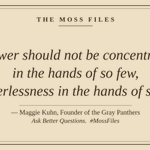
In 1970, Maggie Kuhn was forced to retire from her work with the Presbyterian Church at age 65. The message was familiar: her time was up. The emerging ideal of retirement encouraged older people to withdraw from public life, taking their experience and accumulated knowledge with them.
Kuhn broke the mold. She helped found the Gray Panthers, organizing older people to challenge ageism and reclaim their place in shaping society. In an era when the Black Panthers had made collective action impossible to ignore, Kuhn helped older people turn shared experience into a public voice. She did not wait for permission or for conditions to become favorable. She called the organization—and society—to attention.
This is capacity in action. Kuhn drew on what she and others already possessed: experience, judgment, conviction, and the ability to organize. By bringing people together around a common purpose, she helped turn individual capacities into collective power. The work changed what older people could do—and what society had to reckon with.
The word presbyter means elder. Kuhn gave that word renewed force. Her history reminds us that capacity can exceed the roles an organization assigns and the expectations a culture imposes. Self-renewal begins when people recognize what is already there, exercise it, and create possibilities that did not previously exist.
Kuhn did not wait for the world to make room for elder power. She helped make that power a force the world had to answer.
@CMAorg @ConsumerVoices @RonWyden
@GrayPanthersNY @GrayPanthers
Ask Better Questions.
📁MF #115 The Knowledge Is Already Here
Organizational capacity begins with what people already know.
A CNA may notice a subtle change in a resident because she has seen that person through many ordinary shifts. A nurse brings clinical assessment and knowledge of the resident’s condition. A family member may recognize a familiar expression, routine, or shift in personality that no one else has seen. Environmental and housekeeping staff may notice patterns in the surroundings that affect comfort, movement, or daily life.
Each person sees from a different position, and each position reveals something. Together, these perspectives build a fuller understanding of the work and the people it serves.
The opportunity for an organization is to recognize this knowledge, understand what each kind contributes, and create reliable ways for it to inform decisions. When observations can travel across roles and reach people who can act on them, experience becomes an organizational resource.
The first step toward renewal is learning to see what is already there.
@consumervoices @NYNHCare @INOmbudsman
Ask Better Questions.
📁WF #17 Capacity for Self-Renewal
An organization’s capacity for self-renewal is its ability to learn from its own work, connect what it knows, and develop new ways of meeting its purpose.
Every organization has resources. People bring experience, judgment, technical knowledge, relationships, and pattern recognition. Processes and programs supply structure. Leadership sets priorities and allocates resources. The real question is how these elements work together—and what becomes possible as a result.
Some resources keep daily operations running. Others enable people to learn, share knowledge across roles, and build capabilities that strengthen the whole organization. Seeing the difference means looking at the organization’s composition: what its parts do, how they relate, and what emerges when they work in concert.
Capacity develops through use. Assessment establishes Point A—coordinates clear enough to understand where you stand. Point B remains in view. The work itself builds the road between them.
This week we examine how an organization recognizes the capacity it already has, creates the conditions for that capacity to grow, and carries learning into practice.
What does an organization need to understand about itself to renew its capacity?
@mtaylorstark @ConsumerVoices
Ask better questions.
The parenthetical on Great Bend and the “at least 25” figure do broaden the piece beyond the Marshall–Tasset facts. The sharper claim is the one right before it: PE securing doctors as owners “in name only” so the vehicle can still claim the physician-ownership advantages while the equity and extraction sit with the sponsor.
@CMAorg
That’s the pattern that shows up across the PE footprint—roughly 9–10% of hospitals and 10–12% of nursing homes, with several firms accelerating acquisitions during COVID. Clicking the red underlines in that section pulls up the underlying sources (including the Great Bend docket). The disclosure-compliance suit against Great Bend was dismissed without a finding of liability, so it doesn’t itself prove the model is corrupt.
It does illustrate how contested the “physician-owned” label has become once PE is involved.
The ACA restrictions on self-referral were aimed at the risk that physicians would steer volume to facilities they own. A PPO network has its own version of that incentive: the plan profits by keeping care inside the contracted network and limiting out-of-network options. Both arrangements create structural pull toward preferred facilities; the difference is who captures the margin and how visible the ownership is.


The piece isn’t treating all physician-owned facilities as the problem. It specifically flags how PE has co-opted the label—“securing doctors who are hospital owners in name only”—so the vehicle can claim the advantages of physician ownership while the equity, control, and extraction sit with the PE sponsor.
That’s the pattern Maureen has tracked for years: physicians lend their names and licenses, PE runs the financial engineering. The Marshall–Tasset/Nueterra examples are presented as instances of that, not as an attack on independent physician-led models. @moetkacik
Deborah Buchanan retweeted

Admirable traits of strong leadership:
1. Humility - a beginner’s mindset that is open to new ideas and less judgmental. A mindset free of prejudice. A quiet mind that values actions and impact above words.
2. Honestly - radical transparency with grace and dignity. The ability to give feedback without causing resentment is a superpower. The ability to admit mistakes quickly and to ask for forgiveness. And a willingness to show vulnerability.
3. Self-awareness (situational awareness) - reading the room and balancing one’s contributions to ensure a value exchange that benefits all. Knowing when to speak and when to listen. Knowing that given a choice of being clever or kind, being kind is right choice. It is balancing ambition with value.
4. Sense of humor - do not take yourself too seriously and stay accessible. Show passion and ambition but not at a cost to others. Make people comfortable and at ease. Laugh loudly but welcome humor with open arms. But not at the expense to others. Happy people smile more.
5. Active listening (hear the unsaid and listen with your eyes) - if you are waiting for a pause, so that you can speak, you are not truly listening. And the most important part of listening is the ability to hear the unsaid. Sometimes the best way to support and help others is to give your undivided attention.
6. Interest in others (empathy) - be interesting first. The goal is to leave people better than when you found them. Everyone you meet knows more about something than you do. Care more about the people around you. This is my definition of servant leadership.
7. Generosity (giving) - the coolest people I know are unselfishly generous with their time and knowledge. Give more than you take. And give without expecting a get. The strongest leaders give more than they take. Takers may end up with more, but givers sleep better at night.
8. Intellectual curiosity -learn to search for the grounded truth. And be willing to change your mind when the facts and the truth contradicts your prior beliefs. The strongest leaders are lifelong students. And also lifelong teachers. Start with 4 word: what do you think?
9. Good manners - be nice and polite to all. This may be life’s biggest hack. Say ‘thank you’ and ‘please’ more. Hold doors a bit longer. Do not interrupt people. Do not brag. Do not shout or speak poorly of others. Be a good person, but do not waste time trying to prove it.
10. No sense or entitlement - the world does not owe you a thing. The best people that I know are not chasing compliments or validation. Learn to fight for your happiness and do it with dignity, optimism and grace. Fall in love with the work, not the praise.
11. Positioning for shared success - In a celebration, lead from the back. In a crisis, lead from the front. In the company of someone that has a better idea, follow first. Leadership is all about positioning and standing in the right places.
12. Legacy of servant leadership - The best leaders leave everything and everyone better than when they found them. You will be remembered by how often you helped others achieve their goals.
13. Grit and persistence - Some things are hard to teach: sense of urgency, critical thinking, creativity, customer empathy, team commitment, humility, unselfish giving, judgement, grace and dignity, positivity, optimism, bias towards results, active listening; Strong leaders teach the hard stuff.

📁MFR*V #114 — The Power of Unity: What Becomes Possible Together?
This week began with a deceptively simple proposition: the power of unity lies in the value of people.
Each person brings knowledge, experience, judgment, ability, and potential. That capacity exists before people assemble. The organizational question is how to recognize its value and create conditions in which it can contribute to a shared purpose while allowing individuals to retain their distinct perspectives and strengths.
A shared point of orientation brings those distinctions into relationship. Relationships allow knowledge to travel, perspectives to inform one another, and contributions to build on what others have already accomplished. In this way, a collection of capable people can develop shared capacity that no individual possesses alone.
Shared capacity changes what a group can sustain. Unity can become load-bearing: people together can carry weight that would otherwise overwhelm individuals. Participation can expand individual capacity while strengthening the group's ability to meet demands, solve problems, and support its members.
The process can become self-generating. The work changes the people doing it; those people change what the group can do; and the group's growing capacity changes what becomes possible next. New knowledge, stronger relationships, and new resources can expand the field of possibility still further.
Yet these outcomes depend on the conditions in which people work. People can influence some of those conditions, and institutions have considerable power to shape them. Institutional decisions can cultivate the capacity on which an organization depends, or erode the resources and relationships that sustain it. When those supports are diminished, the burden shifts to individuals and residents. Calling for unity cannot excuse that transfer of burden.
The question, then, is whether an organization enables people to develop their capabilities, support one another, and build a capable whole—and whether it takes responsibility for sustaining the conditions that make this possible.
The week's progression
MF #107 — The Value of People: Recognizing the capacity people bring and the potential that remains undeveloped.
MF #108 — A Shared Point of Orientation: Bringing different perspectives into relationship with a common purpose without requiring uniformity.
MF #109 — The Work Between Us: Understanding how relationships transform individual capability into shared capacity.
MF #110 — The Weight We Carry: Recognizing unity as load-bearing capacity, not merely the redistribution of tasks.
MF #111 — A Whole That Generates More: Exploring how collaboration can renew and expand the capacities of both individuals and the group.
MF #112 — Changing the Conditions: Recognizing people's ability to create new relationships, resources, and fields of possibility.
MF #113 — The Institution We Make Possible: Examining whether organizational decisions cultivate human capacity or consume it.
Reflection
Unity is not sameness. It allows people to bring distinct capacities into relationship with a shared purpose, even when their perspectives differ. Its strength lies in the relationships that enable people to contribute, learn, and build on one another's work.
When those relationships are supported, the group can carry more while individuals gain capacity of their own. At its most generative, unity creates conditions for further growth.
Shared purpose provides orientation. Relationships make cooperation productive. Stewardship determines whether the resulting capacity is cultivated and sustained.
The power of unity lies in the value of people—not only in what they bring, but in what they can develop, sustain, and create together.
Looking forward
Unity opens the possibility of shared capacity. The next question is how that capacity develops within the systems where people work.
How does shared knowledge become collective intelligence? How does collective intelligence inform decisions? And what organizational structures allow human capacity to travel through a system and become reliable institutional capability?
These questions lead toward the next focus: Capacity for Self-Renewal. We will examine how organizations recognize the capacity they already possess, develop it through the work itself, and create the conditions to move toward what becomes possible next.
Unity establishes what people can begin to accomplish together. Self-renewal asks how that capacity can continue to develop.
@NYNHCARE @mtaylorstark @INOmbudsman
Ask Better Questions.
#TheMossFiles #AskBetterQuestions


Living on their own terms
When asked how easily they can live life on their own terms, 20% of residents said very easily. Forty-three percent said it is somewhat or very difficult, and 18% said very difficult.
The comments explain why. Residents described being woken at 4 or 5 a.m. for medications, showers given when it suits the schedule, and no one asking what time they would like to get up.
The report’s conclusion is worth sitting with: even the residents with the better experiences were mostly adjusting to the building’s schedule, not the other way around.
When the schedule belongs to the building and not the person, what exactly is the resident adapting to?
@mtaylorstark @ConsumerVoices
Ask Better Questions
theconsumervoice.org/wp-cont…
Capacity for Self-Renewal
What makes an organization capable of improving itself?
W. Edwards Deming directs our attention to the system: how work is designed, how people are supported, and how management shapes the conditions for results.
Peter Senge takes us into the learning organization, where people develop the ability to examine assumptions, recognize patterns, and learn together.
Put these ideas alongside each other and an important question emerges:
Does the organization have the capacity to learn from its own work—and use what it learns to improve what becomes possible next?
That is the deeper promise of continuous improvement. Each cycle of learning can strengthen the organization's capacity for the next.
Where does that capacity for learning actually live in an organization?
@INOmbudsman @ConsumerVoices
Ask Better Questions.


The Obamacare Boiler Room
Perhaps no Florida health care scam has so concisely illustrated the burning need to rethink our broken health care system.
Just miles from Mar-a-Lago, two men are on trial for allegedly defrauding Obamacare of $161 million through the Fiorella Insurance Agency.
Their scheme? Classic Florida style: recruit homeless and vulnerable people at bus stops, shelters, and clinics with cash, gift cards, food, and alcohol. Coach them to lie about income, get kicked off Medicaid, use fake SSNs and addresses, then enroll them in subsidized ACA plans—often high-deductible bronze plans from Centene’s Ambetter that leave patients with massive bills and denied claims.
Prosecutors say this one operation generated $162 million in fraudulent subsidies over four years. Broader complaints to CMS hit 208,000 in just eight months of people fraudulently switched onto ACA plans.
Between 2020 and 2025, the annual cost of ACA marketplace subsidies nearly tripled—from $53 billion to over $143 billion. Florida alone went from ~1.4 million enrollees to nearly 5 million. Much of the growth was driven by these boiler-room tactics in non-expansion states, cheered on by private equity (Fiorella was bought by GTCR-backed AssuredPartners, later sold for $13.45 billion).
Enhanced subsidies made the system explode—and made the fraud more lucrative. Now the enhanced credits are expiring, premiums are set to skyrocket, and millions face the cliff.
This isn’t a glitch. It’s the predictable result of a system built on private brokers, private insurers, and incentives that reward enrollment over care.
Full investigation: prospect.org/2025/11/18/obam…
@CMAorg @jordanrau @DutchRojas @mtaylorstark @JaniceDean
#ACA #Obamaca
#HealthCare #PrivateEquity
Ask Better Questions

A Major Roger Marshall Donor Is a Hospital Bandit
Inside the Kansas senator’s multilayered relationship with one of the most audacious profiteers in rural health.
Private equity firm Nueterra Capital (via Noble Health, led by Dan Tasset) bought two struggling rural Missouri hospitals—Audrain Community Hospital in Mexico and Callaway Community Hospital in Fulton—promising revitalization.
Instead, it absorbed nearly $20 million in federal COVID-19 relief, Medicare, and Medicaid funds, then ran the facilities into the ground. By the collapse, unpaid vendor debts and liabilities reached $45–50 million.
In April 2022, Noble stopped paying more than 440 employees outright. Worse, it continued deducting medical, dental, vision, and life insurance premiums from paychecks—over $1 million total—without forwarding the money to insurers. Coverage was canceled without workers’ knowledge.
Department of Labor interim findings put damages to workers at $5.4 million. Consequences were personal and severe: the daughter of a 63-year-old janitor sold her father’s possessions at a garage sale to cover cremation after his $60,000 life insurance policy went unpaid; an ultrasound technologist faced nearly $300,000 in medical bills after her husband died of cancer.
Executives faced no meaningful accountability. Meanwhile, local clinics aggressively pursued dozens of low-income patients and young mothers—some sued, handcuffed, or jailed—over balances as low as $101.
The same network had deep ties to Kansas Sen. Roger Marshall: $218,000+ in campaign contributions from Tasset and employees, a $100,000 super PAC gift, direct investments by Marshall and his wife in Nueterra funds, Marshall’s son employed by a Tasset entity, and legislative actions aligning with the firm’s interests.
These hospitals served Audrain and Callaway Counties.
@HawleyMO @SenEricSchmitt @RepBobOnder @RepJasonSmith
@CindyOLaughlin @JimSchulte
@CMAorg @DutchRojas
Rural hospitals don’t close in a vacuum. Where is the oversight?
#RuralHealth #PrivateEquity
Ask Better Questions.
