

Now: Format One; Prior: Expa, 500Startups, ReTargeter; Passionate: startups, venture capital, learning, people, music, philosophy & life.
Mostly in the Bay Area
Joined January 2008
- Tweets10.7K
- Following7.5K
- Followers13.6K
- Likes32.5K







Pinned Tweet
The MOVEMENT begins! Sign up with your email on moovlab.com to receive a special pre-order offer. Only 500 units are available for pre-order. Shipping starts in October.
#moovlab #activeseating #neverstill #ergonomicchair

Arjun Dev Arora retweeted

Anthropic filed their S-11 this week, the largest AI listing yet. Here's how 7 key metrics stack up.

Arjun Dev Arora retweeted

Anthropic has filed an S-1 registration statement with the SEC related to its proposed IPO.
Read more: anthropic.com/news/s1-sec
Legal disclaimer: A registration statement relating to these securities has been filed with the SEC but has not yet become effective. These securities may not be sold, nor may offers to buy be accepted, prior to the time the registration statement becomes effective. This post does not constitute an offer to sell or the solicitation of an offer to buy these securities, nor shall there be any sale of these securities in any state or jurisdiction in which such offer, solicitation or sale would be unlawful prior to registration or qualification under the securities laws of any such state or jurisdiction.

Arjun Dev Arora retweeted

Today we're introducing the smartest, most capable version of our enterprise-ready decision model: SubQ Snap 1.1.
Snap is tied for #1 on the Artificial Analysis Decision Index and has made big gains on agentic tasks, outperforming Jev by +7.2 points across 16 leading enterprise benchmarks.
All while maintaining 384k tokens of context, in a single pass, as the only model with constant compute per token.
- Powered by Subquadratic Sparse Attention.
- Tied for #1 on the @ArtificialAnlys Decision Index.
- 96.2 on When2Call, up from 75.2, and up 6 points on @huggingface 5 Tools & Automation benchmarks. It knows when to call a tool, when to ask, and when to decline.
- 81% fewer confident errors on questions it can't answer.
- $0.04 per 1M input tokens. No charge for output.
Go to subq.ai for access, and 100M free tokens.

Arjun Dev Arora retweeted

I was talking to another founder yesterday about a venture investor. I said I like them a lot because I think they are a “shock absorber.”
As a founder or exec, you go through lots of highs and lows. Won customer. Lost deal. Closed round. Investors passed. Hired candidate. Teammate quit.
And your board is along for much of the journey. The question is how do they react?
I’ve found that the best board members, including the one I was giving backchannel on, don’t add to the drama. They instead soften it out.
Imagine you miss a quarter. The drama investor jumps in, feels insecure themselves and immediately asks 100 questions as if you weren’t already thinking of them. The “shock absorber” board member is like @ajay_bcv , my longtime board member from @BainCapVC at Gainsight. I’ll never forget when we massively missed an early quarter (I think we were supposed to do $600K of bookings and we did $300K). He said “look - whether you do $300K or $600K is irrelevant. Set yourselves up for doing $10M a quarter a few years from now.” That’s a shock absorber.
On the flip side, imagine you closed a huge deal. It’s one thing to be totally “rah rah.” But a great “shock absorber” board member also says “that’s amazing. Now the key is making them successful.”
As legendary Notre Dame coach Lou Holtz famously stated:
“You're never as good as everyone tells you when you win, and you're never as bad as they say when you lose.”
It’s good to have folks around the table to remind of you of that and keep the ride as smooth as possible (it will never be smooth though!)
Seed and early-stage funding rose roughly 24% year over year in Q3. But reported deal counts fell: 23% for seed and 27% for early-stage.
More capital is flowing into seed and early-stage companies, but fewer deals are getting funded. That points to a highly competitive fundraising market and founders are competing for fewer checks. More money in the market doesn’t mean it’s easier to raise.

For years, software was the dream: build it once, sell it forever, enjoy the fat margins. But memory chips just posted a 76% operating margin versus 45% for mega-cap software in Q2 2026. Apparently getting everyone using AI, then selling them memory is another great approach.

This chart doesn’t prove Jevons Paradox is at work, but falling inference costs are its precondition: cheaper AI opens the market to far more users and use cases. The riches in even tinier niches will get discovered.

We are so back?! Investors are back to writing more checks than they have in a while. An estimated 5,012 VC deals closed in Q3, the highest quarterly total since 2022.

Arjun Dev Arora retweeted
Introducing SubQ Snap, the first long-context decision model for real enterprise work.
Snap is the only decision model or LLM where compute per token stays constant as context grows.
• 384K tokens of multimodal context, 12x larger than Jev.
• 61.7 on Decision Index v0.2.1 vs Jev’s 57.9, outperforming on 13 of 16 enterprise benchmarks.
•Processes 100K tokens and returns a decision in under one second.
•$0.05/MM input tokens. Output is free.
Available today to anyone.
The first 10,000 sign-ups get 100M free input tokens.
We’ll likely hit capacity fast and will add users as we add compute. Compute offers welcome 🙂.
Latency will be variable as we tune the platform to this new model and category of users.
Model speeds are 80ms for minimal context, 250ms for 32k, 660ms for 100k, and 2.5 seconds for 384k.
Visit: subq.ai/
Arjun Dev Arora retweeted

I've been through a few cycles where startups had to focus on being default alive. We are now in one of those. But this time it's 95% of startups. The top 5% have endless money.
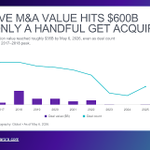
Big Five M&A (Google, Microsoft, Amazon, Meta, and NVIDIA) value is massive, but the number of startups acquired is tiny.
Acquisition volume hasn't recovered, but deal value has. It’s a market where the biggest buyers are selective about what they're buying, but willing to pay up for it.

Arjun Dev Arora retweeted

98% of US households aren't paying for AI yet
More charts in State of Markets II: a16z.news/p/state-of-markets…


Introducing our State of Markets pt 2, along with a companion podcast where we unpack the data and discuss what comes next.
Tech is the everything cycle.
Supply: putting the buildout in context, just passed railroads as % of GDP. The wisdom of Elon is real: the factory (or the datacenter!) is the product.
Demand: diffusion is so, so early. Median AI vendor spending in the top 1% of companies is 8x that of the top 10%. Only about 30% of S&P 500 companies report a quantified AI impact, which means there’s a substantial opportunity in connecting models to a company's data and workflows. Diffusion into companies is one of the main themes of the next 5 years.
We’re entering the agent work period. Only a few million users today, but applicable to billions of internet users with massive surplus created. META/GOOG monetize US users at $200+ per year today. Agent opportunity is much higher.
Mega-trends the next 5 years: Consumer agents, Robotics, Autonomy, AI x bio, Personal health, Diffusion into enterprise, New era of American Dynamism.
Much more in our SoM report here - a16z.news/p/state-of-markets…
@a16z @sarahdingwang @aleximm @santiago__rdz


Arjun Dev Arora retweeted

Exclusive: Anthropic is seeking to go public as soon as the middle of November, according to sources, after the artificial intelligence model maker pushed back plans to list bloomberg.com/news/articles/…

I'm moderating A New Era in VC at the Venture Futures Forum this Friday at Oakland Tech Week, with Scott Beechuk, Saydeah Howard and Drew Glover, on what happens when networks outperform capital. Presented by Google for Startups and hosted by Transparent Collective and Black Ops VC.
Details and registration: otw.transparentcollective.co… #OaklandTechWeek #OTW26

Arjun Dev Arora retweeted

sean and @hrcsuraj ( @humanrce ) built @starshiphsa inside one of the most regulated corners of healthcare.
where every product change ran through banks, operators, or washington.
they sold to @Optum (@UHC ) in 2022. now they invest alongside founders early, while the rules are still being written.
Funds over $100M raised 38% of the capital in the 2017 VC vintage. By 2024, their share had climbed to 71%, nearly double.
Which is a huge, but it slipped back a bit to 64% in 2025, a full 7% pullback.
While on the one hand there is a clear trend in fund concentration, with the SpaceX IPO and maybe the Anthropic IPO bringing much needed liquidity, this chart may be on the verge of swinging back in the other direction.

Arjun Dev Arora retweeted

WE JUST TOOK AMERICA.GOV LIVE
CONGRATULATIONS TO ALL AMERICANS FOR THIS HISTORIC OCCASION

Arjun Dev Arora retweeted

Breaking: Smart-ring maker Oura said it was delaying its planned IPO due to market uncertainty on.wsj.com/46QTCmB

The revenue required to fund the AI buildout is beginning to appear. Consumer spending more than tripled to $40 billion, and most of that came from existing users.

Arjun Dev Arora retweeted

News: We’re moving NFX to self-funded. Taking it private. No more external LP’s after fund IV. The four GP’s stay intact. 8 more big seed investments to make in Fund IV, so hit us up. After that, we'll be doing $100K - $3M investments w/ our own money. Thanks to @homebrew who led the way! @NFX @GigiLevy @peteflint @omri_drory
nfx.com/post/self-funding-nf…
