

A Broader Perspective | Law Firm
Madonna House, Westlands.
Joined July 2025
- Tweets942
- Following206
- Followers6.7K
- Likes601





Pinned Tweet
🚨🚨 BREAKING: COURT OF APPEAL DECLARES - A TITLE DEED CANNOT DEFEAT A PROVEN TRUST
In Erick Kipkurgat Kiprono v Patrick Kimutai Kiprono, the Court of Appeal has sent shockwaves through land ownership disputes after ordering a registered landowner to surrender half of land he held solely in his name. The dispute traces back to around 2000 when two parties allegedly agreed to jointly purchase 10 acres from Lonrho Agribusiness for KSh 350,000. Because one party worked in Nairobi, the other handled the transaction. The sale agreement expressly stated the purchaser was acting as agent for both and even allocated 5 acres each in the schedule. However, when the title was eventually issued, the entire land was registered in only one name. When the excluded party later demanded his share, the registered owner flatly denied any joint purchase, contribution, or trust.
The Court of Appeal was not convinced. After re-evaluating the evidence, the judges found the intention to jointly own the land was not speculative; it was written into the very sale agreement used to obtain Land Control Board consent. Testimony from the attesting advocate, the vendor’s lawyer, and the vendor’s representative all confirmed the joint purchase. The Court emphasized that a trust will be implied where parties’ intention is clearly established, and that equity will not allow a registered proprietor to approbate and reprobate by relying on the same agreement to obtain title while denying the beneficial interest recorded in it. Crucially, the Court held that the Land Control Act could not be used as an instrument of fraud where consent had already been obtained on the basis of a disclosed joint interest.
For the ordinary mwananchi, this decision is a serious reality check. Many people believe the name on the title deed is the end of the story, it is not. If evidence shows land was bought jointly or one party acted as agent for another, courts can and will slice through the register and enforce a trust. What many are not ready for is this: informal family arrangements, handshake land deals, and “weka kwa jina yako kwanza” transactions are legally dangerous. Going forward, anyone entering joint land purchases must document contributions clearly and align registration with the true intention; because in today’s Kenya, the courts are increasingly willing to look beyond the title and follow the money and the intention.
Kindly retweet widely.
@georgediano @Thuranira_1 @DavisThuranira @joshuamalidzo @NelsonHavi Iran #NunuaGariUsijenge #MainaAndKingangi World Wildlife Day #UsalamaBarabarani Road Safety Reforms Trump Kuwait Wamuthende Dubai

ROBA & ASSOCIATES LLP retweeted
🚨🚨 WERE YOU FIRED DURING THE 2020 COVID-19 PANDEMIC ON GROUNDS OF REDUNDANCY? YOU MAY STILL HAVE A CLAIM FOR COMPENSATION. READ THIS! ⚖️🔥
When COVID-19 hit, many businesses struggled, and workers lost their jobs. If your employer declared you redundant during that period, you may have accepted it as part of the crisis and moved on. But did your employer follow the law before sending you home? In Kenya Engineering Workers Union v M/S Garage and Industry Ltd [2026] KEELRC 14694, two employees who had served their employer for about 15 years were declared redundant in May 2020 because of reduced work. The court accepted that the pandemic had caused genuine business difficulties. However, the employer failed to prove that it had issued the required redundancy notices to the union and the labour officer before terminating the employees. That failure proved costly.
On 22 October 2026, the Employment and Labour Relations Court declared the terminations procedurally unfair and awarded the two employees severance pay of KSh 248,700 and KSh 189,179.40 respectively, plus six months’ salary each as compensation. They were also awarded certificates of service, and the employer was ordered to pay the costs of the suit. The message is simple: even during a pandemic, employers were not free to ignore the law. If you lost your job during COVID-19 on grounds of redundancy, it may be worth having your termination documents reviewed to establish whether you have a viable claim. Did your employer follow the law when you lost your job during the pandemic?
Kindly retweet widely🙏
ROBA & ASSOCIATES LLP retweeted
🚨🚨 WHAT IF YOU RETURN TO YOUR LAND AFTER 22 YEARS - ONLY TO FIND OUT THE LAW MAY NO LONGER BE ON YOUR SIDE? 😳
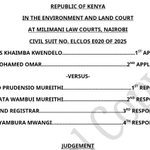
Can you lose your land because someone else has occupied it for years while you did nothing to reclaim it? That is the question arising from Bonphas Khaimba Kwendelo & Omar Mohamed Omar v Leopold Prudensio Mureithi & Others, decided by the Environment and Land Court at Milimani, Nairobi, on 22 October 2026. The two applicants went to court claiming they had occupied parcel Nairobi/Block 99/257 in Highridge since 2003, living on and developing the property openly, continuously and without the registered owners’ permission. They sought to acquire ownership through adverse possession. None of the respondents opposed the claim, but the court still had to determine whether the applicants had presented sufficient evidence to establish their entitlement.
The court found that the applicants had proved their claim and declared the first and second respondents’ titles extinguished. It ordered the Chief Land Registrar to register the two applicants as proprietors and restrained the respondents from selling, transferring or otherwise interfering with the property. Under sections 7, 13, 17 and 38 of the Limitation of Actions Act, a person may acquire land through adverse possession after at least 12 years of qualifying occupation, provided all the legal requirements are satisfied. This does not mean that simply entering or occupying another person’s land makes it yours. The occupation must meet the strict legal test. So, should landowners lose property they legally own because they failed to reclaim it for years, or is adverse possession a fair way of protecting people who have occupied land openly for decades? 🔥
Kindly retweet widely🙏
ROBA & ASSOCIATES LLP retweeted
🚨🚨 YOUR CASE CAN BE DISMISSED FOR DELAY-BUT WHAT IF THE COURT GETS THE FACTS WRONG? THIS IS WHAT HAPPENS NEXT! ⚖️
Imagine going to court to recover your money, winning the case, then watching the person who owes you money drag their feet when they try to reopen it. Surely, at some point, the court must say enough is enough? That was the battle in Kelvin Kithendu Kioko v Beatrice Muthoki Kiamba, HCCA E013 of 2025. Kelvin wanted the court to set aside a judgment entered against him after he failed to file a defence. His application stalled for months, and the trial court eventually dismissed it for want of prosecution. But when the matter reached the High Court, Justice Cherere spotted a problem: the trial court had relied partly on a direction allegedly given on 15 March 2023, yet there were no proceedings on record for that date. A court cannot simply rely on a direction that the record does not confirm.
🔥 The High Court set aside the dismissal and ordered that Kelvin’s application be heard urgently. This was not a declaration that he owed nothing, nor did it erase the original judgment. He still has to convince the trial court to reopen the case. The point is that delay matters, but so does fairness; a court must consider the circumstances and whether a less drastic option, such as costs and an expedited hearing, would do justice. So, where do you draw the line? Should a litigant lose their chance to defend a case because they delayed, or should courts give them another chance when the record itself raises questions?
Kindly Retweet widely🙏
ROBA & ASSOCIATES LLP retweeted
🚨🚨 WHAT DO YOU DO WHEN YOU APPEAL A LIFE SENTENCE, ONLY FOR THE COURT TO GIVE YOU THE DEATH PENALTY? THE COURT OF APPEAL HAS AN ANSWER! 🔥
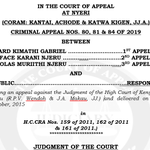
Imagine appealing a life sentence, hoping for a better outcome, only for the High Court to replace it with a death sentence. That is what happened to Edward Kimathi Gabriel, Boniface Karani Njeru and Nicholas Muriithi Njeru. But here is the twist: the prosecution had not cross-appealed for a harsher sentence, and the appellants had not been warned that their appeals could leave them worse off. In its judgment in Edward Kimathi Gabriel & 2 Others v Republic, the Court of Appeal held that the High Court had erred in enhancing the sentences in those circumstances. The Court relied on established jurisprudence, including Aggrey Mugesani v Republic and M’Itiri v Republic, reaffirming that an accused person must be warned of the risk of a harsher sentence before the appeal proceeds where enhancement is contemplated. An appeal must not become a procedural trap.
So, what happens next? The death sentence is set aside but the conviction still stands! The Court of Appeal dismissed the challenge to the appellants’ robbery-with-violence convictions but overturned the unlawful sentence enhancement and restored the original life imprisonment sentences. This is the crucial distinction: the appellants did not walk free, and the Court did not find them innocent. It corrected the process through which their punishment had been increased. The ruling sends a powerful message: even where a conviction is upheld, appellate courts must respect procedural safeguards before imposing a harsher sentence. If you appeal a sentence, should the court be allowed to make your punishment more severe without first warning you? 🔥
Kindly retweet🙏
ROBA & ASSOCIATES LLP retweeted
Wakenya, we celebrate you today.
Happy Mashujaa Day, Kenya!
🤖 Made with AI

ROBA & ASSOCIATES LLP retweeted
🚨🚨 YOU DEFAULTED ON A BANK LOAN, THEN THE BANK SOLD YOUR LAND WITHOUT PROPER NOTICE - WHO OWES WHOM NOW? THIS COURT OF APPEAL RULING IS A BOMBSHELL! 🔥
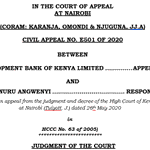
Imagine borrowing money from a bank, falling into arrears, then discovering that your land has already been auctioned without the legally required notice. That is what confronted Jimmy Nuru Angwenyi in Development Bank of Kenya Limited v Jimmy Nuru Angwenyi, Civil Appeal No. E501 of 2020, decided on 16 October 2026. The bank sold his Thika property for KShs 650,000, despite its own valuer placing the forced-sale value at KShs 1.2 million and the open-market value at KShs 2 million. The critical problem? Evidence before the Court showed that the bank had not served the required statutory notice under section 69A of the then-applicable Indian Transfer of Property Act. The Court reaffirmed that a borrower’s default does not give a bank permission to ignore the law. A lender exercising its statutory power of sale must comply with the required notice procedure and take reasonable steps to obtain the best price reasonably obtainable.
Now here is where it gets interesting. The High Court had awarded Angwenyi KShs 2 million in damages, representing the property’s open-market value at the time of sale. The bank appealed, arguing that the damages should instead reduce the outstanding loan debt, while Angwenyi cross-appealed seeking KShs 20 million. The Court of Appeal dismissed both the appeal and the cross-appeal, leaving the KShs 2 million award undisturbed because the higher valuation relied on by Angwenyi was not supported by comparable evidence. The lesson? Owing a bank money does not strip you of your legal rights, and a bank’s power to auction your property is not a licence to disregard the law. Banks must follow the required procedures; borrowers must also prove their claims with credible evidence. So, if a bank sells your property unlawfully, should it still be allowed to pursue the outstanding loan without accounting for the damages it has been ordered to pay? 🔥
Kindly retweet🙏
ROBA & ASSOCIATES LLP retweeted
🚨🚨 HAVE YOU SEEN THE TRENDING NEWS ABOUT MURAGE OF MODERN PACIFIC FURNITURE AND CONTENT CREATOR SPARKY? HERE IS WHAT THE LAW SAYS ABOUT DEFAMATION! 🔥
There has been a lot of talk online following reports that Murage is considering suing Sparky over a video allegedly targeting his wife and business. But beyond the online drama, there is a serious legal question worth discussing: what does someone actually need to prove to win a defamation case in Kenya? First, the words complained of must be defamatory - that is, capable of lowering a person's reputation in the eyes of reasonable members of society. They must also refer to the claimant and have been communicated to at least one other person. A viral video may satisfy the publication requirement, but views, shares and online outrage do not automatically prove defamation. The actual words, their context and whether they conveyed damaging false allegations all matter. Truth may be a defence, while fair comment or honest opinion may also protect certain statements. A business can sue over injury to its trading reputation, while a person seeking redress for remarks about their spouse's personal reputation will ordinarily need to bring their own claim.
Freedom of expression protects criticism, opinions and discussion of matters of public interest; it does not give anyone a blank cheque to publish false, reputation-damaging allegations. Equally, feeling insulted does not guarantee victory in court - the claimant must prove the legal ingredients of defamation, and the person sued may have valid defences. In Kenya, civil defamation claims are generally subject to a 12-month limitation period, so delay can be costly. For now, this is a reported threat of legal action, not a court finding that Sparky defamed anyone. The lesson for content creators, businesses and ordinary Kenyans is simple: before you post, expose or accuse, ask yourself whether you can substantiate what you are saying. Now let’s discuss: should content creators face legal consequences for damaging allegations, or could defamation lawsuits be used to silence legitimate criticism? 🔥
Kindly Retweet widely🙏
ROBA & ASSOCIATES LLP retweeted
🚨🚨 BREAKING FROM THE COURT OF APPEAL: YOU CANNOT CLAIM A MILLION-SHILLING SALARY JUST BECAUSE A CONTRACT SAYS SO - PROVE IT IS GENUINE!
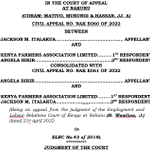
In Jackson M. Italakua & Angela Birir v Kenya Farmers Association Limited (consolidated Civil Appeals E060 and E061 of 2022), the Court of Appeal has delivered a warning to employees and employers about disputed employment contracts. Two senior employees claimed they were contractually entitled to a basic salary of KShs 170,000 per month, plus house allowance and gratuity, but said they were paid only KShs 119,070. Their employer argued that the KShs 170,000 contracts had been procured through misrepresentation and did not reflect an authorised salary review. The Court examined the signed contracts, board decisions and payslips, finding that the evidence supported a basic salary of KShs 119,070 and that the employees had failed to establish a valid contract entitling them to KShs 170,000. It dismissed both appeals and awarded costs to the employer.
The lesson is bigger than the figures involved: a signature dispute, a disputed contract or an allegation of underpayment must be resolved through credible evidence, not assertion alone. Employees should preserve authentic contracts, renewal letters, payslips and records of salary reviews. Employers, too, should maintain clear documentation of board approvals and contractual changes. The Court also reaffirmed that appellate courts must examine the evidence carefully while giving appropriate weight to the trial court’s factual findings. If your employer pays you less than the salary stated in a contract, what evidence would you need to prove your claim? And should an employer be allowed to rely on a lower-paying contract when the employee disputes signing it?
Kindly retweet widely🙏
ROBA & ASSOCIATES LLP retweeted
🚨🚨 BREAKING FROM THE COURT OF APPEAL: ADVERSE POSSESSION CAN SURVIVE DEATH! YOU MAY STILL CLAIM LAND THROUGH A DECEASED PARENT.
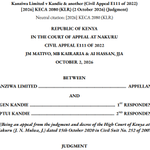
In Kanziwa Limited v Kandie & another [2026] KECA 2080 (KLR), the Court of Appeal dismissed a company’s appeal over approximately 124 acres in Njoro, Nakuru County, which the late Aaron Kimosop Kandie allegedly purchased in 1982 and occupied with his family for decades. Although the company denied the sale, documents including Land Control Board consents and correspondence supporting the proposed transaction persuaded the Court that the purchase had genuinely been contemplated. The Court reaffirmed that a purchaser’s long, open and uninterrupted possession can mature into adverse possession even where the transfer remains incomplete. Crucially, the right does not automatically die with the person who occupied the land: the deceased’s legal representatives may pursue the claim on behalf of his estate.
The decision carries important lessons for landowners, purchasers and families inheriting disputed property. Under section 7 of the Limitation of Actions Act, the limitation period for recovering land is generally 12 years, while section 38 provides the route through which a person may seek registration after acquiring land by adverse possession. The Court also agreed that section 3(3) of the Law of Contract Act did not defeat the claim merely because a written sale agreement was absent in the circumstances of this case. But occupying land for 12 years does not automatically make you the owner; the claimant must prove the legal elements of adverse possession. The appeal was dismissed with costs. If your parent occupied land for decades but died before obtaining title, could your family still claim it? This judgment says the claim may survive - if the evidence and law support it. ✅
Kindly retweet widely🙏new.kenyalaw.org/akn/ke/judg…
🚨🚨 YOU CAN LOSE MILLIONS, SUE FOR FRAUD, SPEND YEARS IN COURT - AND STILL GET NOTHING! THIS HIGH COURT JUDGMENT IS A WAKE-UP CALL FOR EVERY INVESTOR!
In Sudhir K. Shah & 17 Others v Sheetal Kapila & 11 Others, the plaintiffs sought KShs 176 million over bearer certificates of deposit allegedly discounted and used without their consent after Reliance Bank ran into trouble. They accused several individuals of fraudulent conversion and sought damages plus interest at 35% per annum. But the case unravelled on several fronts. The High Court struck out the claims of 17 plaintiffs because Sudhir Shah had not filed the mandatory written authority allowing him to sue on their behalf. The remaining claim was dismissed because it was filed outside the three-year limitation period for tort claims under section 4(2) of the Limitation of Actions Act. The Court also found that fraudulent conversion had not been proved: the original certificates remained with the claimant, the bank had recognised its liability on them, and the evidence did not establish the alleged fraud to the required standard. Years of litigation did not translate into compensation.
The judgment carries three serious lessons for anyone pursuing a major financial claim: first, if you sue on behalf of co-plaintiffs, obtain and file their written authority under Order 1 Rule 13 and Order 4 Rule 1(3) of the Civil Procedure Rules; second, do not sleep on your rights, because limitation periods can defeat an otherwise serious claim; and third, allegations of fraud require evidence, not suspicion or conclusions drawn from an inconclusive investigation. The Court also emphasised that discovering every detail of an alleged fraud is not necessarily required before time starts running if the essential facts are already known. The dispute had lasted for years, but procedural compliance, limitation and proof remained decisive. If you believed you had lost millions through fraud, would you know the deadlines and evidence needed to protect your claim?
Kindly retweet🙏

ALT https://kenyalaw.org/akn/ke/judgment/kehc/2026/15260/eng@2026-10-09
ROBA & ASSOCIATES LLP retweeted
🚨🚨DID YOU KNOW YOU CAN LOSE A LOVED ONE IN A ROAD ACCIDENT, GO TO COURT SEEKING JUSTICE, AND STILL WALK AWAY WITH NOTHING? READ THIS HIGH COURT DECISION!
In Mary Chelangat John & Paul Kiboro Moiben v Reinard Kioko Ibrahim & Equity Bank Kenya Limited, Malindi High Court Civil Appeal No. E003 of 2025, a family sought compensation after Allan Kiplimo Moiben died in a road accident at Mtwapa on 8 February 2022. The trial court had awarded damages, including KShs 500,000 for loss of dependency, after finding the deceased 80% liable and the other driver 20% liable. But on appeal, Justice A.K. Ndung’u reached a dramatically different conclusion. The only eyewitness testified that the deceased left his lane and collided with the vehicle approaching from the opposite direction. The High Court held that the family had not proved any specific negligent act by the other driver. The mere fact that an accident occurred, the judge stressed, does not establish negligence; neither does a police abstract, on its own. The court therefore found the deceased 100% liable and set aside the trial court’s judgment.
But there was another crucial lesson: the court also found that the claim for loss of dependency lacked sufficient proof identifying the dependants and demonstrating the financial support they actually received from the deceased. Even though the family alleged that he earned KShs 200,000 monthly, income alone did not establish dependency. The appeal was allowed, the trial judgment was set aside, and the family’s suit was dismissed, with costs awarded to the successful appellant at trial and on appeal. Think about that: a family can lose a compensation award not because the death did not happen, but because negligence against the defendant was not proved. For anyone pursuing a fatal accident claim, eyewitness evidence, proof of the other driver’s specific negligence, and evidence of actual dependency can be decisive. Do you think this judgment correctly applies the burden of proof, or should courts take a different approach when a family has lost its breadwinner?
Please Retweet widely🙏
