

🥑DevRel | 🧑💻Co-Founder ➝ @Studio1HQ 📤Newsletter ➝ @DailyAI_Insight ⚡️Building ➝ @raahdotdev / https://xitter.cf/t.co/IEMldaIjad
Jezero Crater, Mars 🇮🇳
Joined June 2019
- Tweets14.8K
- Following644
- Followers2.1K
- Likes15.2K



3 things I'd steal from this free 38-min agent harness build:
1. Version it. V0 calls the LLM, V1 adds tools, V2 the loop, V3 MCP, V4 memory.
2. No framework. Just Python, so every step is yours to read.
3. Memory goes last. Get the loop right before it remembers anything.
Bookmark it before your next agent build ⚡
Mr. Ånand retweeted
A lot of UI polish is hidden in small things.
The gradient angle. The font weight. The icon style. The section spacing. The hover color. The way a card border barely shows up.
AssetSnip helps frontend devs and designers capture those details from any live website through a browser extension.
You notice it once. You save it properly. You reuse it later.
Try it for FREE
assetsnip.com

Never let an LLM do your math.
Let it decide who had what. Make it call a calculator for every number.
That's how Splitter settles a group's bills. Then I benchmarked that loop in Receipt Lab: 300 bills, Nemotron 3.5 Super VL, Splitter's own calculator tools.
300/300 splits came from the model's own tool call
30/30 planted wrong totals caught
0 false alarms on bills it read correctly
91% of splits right to the cent. Most misses were misread photos, not bad math
What the tools can't catch: a line given to the wrong person. That split still adds up, so in the app you review every split before it's saved.
The model reasons. The tools count 🧮

Every trip ends the same way.
10 receipts, 3 payment screenshots, one handwritten note, and someone saying I'll sort it out later.
So I built Splitter, an open-source AI bill splitter 🧾
Drop in every bill, say who paid what in your own words, and it works out a fair split for the whole group.
How it works:
→ Reads each bill: lines, tax, tip, totals
→ Skips duplicates, rejects non-bills, turns payment screenshots into paid back entries
→ Reasons through the settlement and calls calculator tools for every number
→ You review and edit before anything is saved
Ask Splitter is my favorite part. Ask why do I owe $295 and it answers from that group's ledger, citing the expenses behind it.
It runs on @NVIDIAAI Nemotron 3.5 Super VL, available on @nebiustf:
→ One model for reasoning, tool use, and image + document understanding, so no separate vision and text models
→ 120B MoE that activates only 12B params per token
→ Up to 5x higher throughput for agentic tasks on a single GPU
→ Open weights, so you can customize it for your own usecases
Same idea Ramp is using to turn receipt images into structured JSON.
Run it on your own machine 👇
October so far, and it's not even over:
→ SubQuery: backdoored npm package
→ eMudhra: CA intermediate keys compromised
→ GitLab: two CVSS 10 RCEs in nine days
→ Rank Math PRO: malware shipped in the official plugin
→ TeamUpdraft: customer database and site keys stolen
→ Zeabur: platform breached, 3.2M env var records read
→ ConnectWise: Cloud Backup app abused to get into M365 tenants
→ OpenCode Console: saved AI provider keys exposed
→ OVHcloud CLI: official release binaries swapped for a stealer
→ Tensorlake: npm package turned into a credential worm
→ GhostAction: fake "security audit" workflows stealing GitHub secrets
→ LiteLLM: backdoored release on PyPI
→ Railway: customer env vars and secrets accessed
→ PHP: critical RCE
→ Node.js: Brotli RCE patched
15 incidents in 22 days.

Mr. Ånand retweeted
One model runs every AI job in my bill splitter.
Splitter uses @NVIDIAAI Nemotron 3.5 Super VL from @nebiustf for all three:
→ Reading every bill: receipts, invoices, payment screenshots, even a handwritten note
→ Planning the settle-up, with calculator tools for every number
→ Ask Splitter, answering "why do I owe this much?" from the group's own ledger
One multimodal model handling all.
The rest of the stack:
→ Next.js 16 for the app
→ @tursodatabase for the database, plain SQLite when you run it locally
→ @novuhq for in-app and email notifications, so each member gets their share the moment a bill is published
NVIDIA pitched Nemotron 3.5 Super VL as one model for reasoning, tool use and images.
I put that to work in a bill splitter. What held up:
→ reads a bill photo into JSON with reasoning off
→ calls my 4 calculator tools on tool_choice "auto", no forcing
→ a long plan misses a JSON field? Send the error back once, keep the plan
The model reads. The app checks the sums.

The full build and what reasoning costs per bill: xitter.cf/Astrodevil_/status/211…
Mr. Ånand retweeted
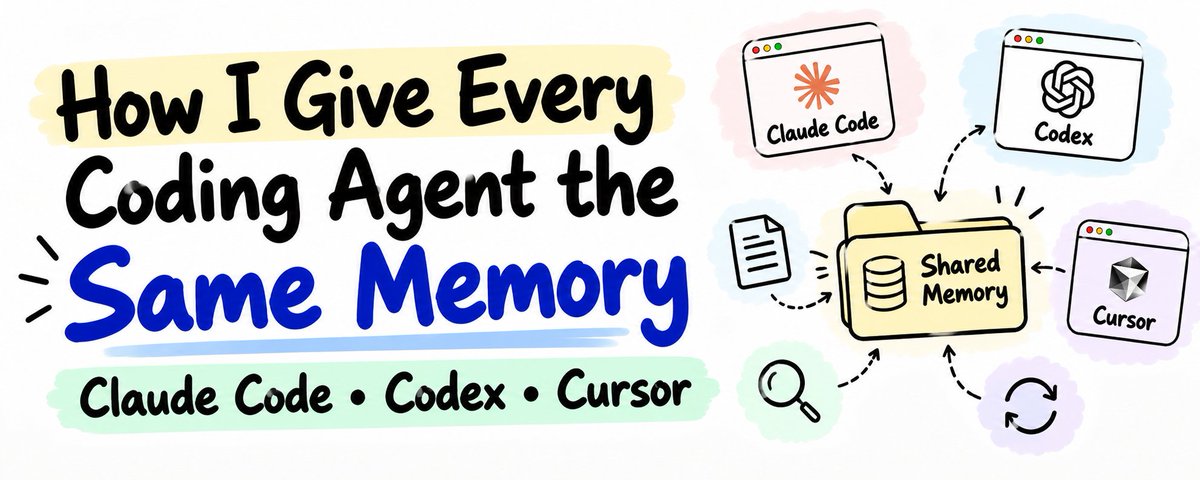
Every coding agent session starts from zero.
AGENTS.md fixed half of it. Claude Code, Codex, Cursor and OpenCode all read the same rules file now.
The other half is knowledge. The retry policy, the API quirk, why a decision got made. A rules file doesn't hold that, and built-in memory stays on one machine with one tool.
The test in this Article is the one I'd steal: ask Claude Code in one repo and Codex in another the same question. If they don't cite the same file, they don't share memory. They share a naming convention.
What I'd take from it:
1. AGENTS.md holds rules only, under 200 lines, plus a pointer to where knowledge lives
2. Write docs for grep, not for browsing. One topic per file, keywords in the first lines
3. One server every agent reads from, instead of copies going stale in each repo
4. Agents get read-only by default and write into an inbox a human reviews
5. Owner and last_reviewed on every doc, so stale ones show up in a query
Boring setup. That's the point. You stop re-explaining your codebase to four agents every morning.


People are using Grok Bot to run whole companies now.
56 ready-made jobs. Sales, marketing, support, recruiting, ops, product, engineering, even life admin.
I run my own content with a team of them. And the bots were never the hard part.
The hard part is everything between them 👇
1/ Don't build workers, install them
-> pick a ready-made job, then tune it. Don't start from a blank prompt
2/ One Bot is the front door
-> a manager that routes work to the rest and never does specialist work itself
3/ Never let the researcher grade its own homework
-> a separate check (accept / verify more / reject) before any claim reaches the writer
4/ No proof, no done
-> before anything is "finished": restate the goal, list every output, show where it lives, list known gaps
5/ Autonomy levels, not "full access"
-> reading and drafting run on their own. Sending, publishing, money and deletes need a human
Same in my setup: every bot is drafts-only. Nothing goes live without me
6/ Don't automate until it works once
-> do it once → make it reliable → save it as a skill → then schedule it. Start with 5 routines, not 40
7/ Measure the boring stuff
-> routing accuracy, false "done"s, how often you had to step in
My take: the next big agent product isn't another agent. It's the handoff layer.
Whoever makes that boring part reliable wins.

Mr. Ånand retweeted
Most security scans are a photo. Your code is a video.
Claude Security just fixed that part. Connect your repos once, it runs a deep baseline scan, then keeps scanning changes based on how risky and complex they are.
Read the launch blog though, and the scanning isn't what I care about. These are:
1. Fixes close themselves. Ship the fix in Claude Code or anywhere else and the finding gets marked fixed. If the bug comes back, it reopens.
2. One project can hold several repos. So it can catch the bug that lives between services, like a backend trusting input the client was supposed to validate.
3. You can tell it what it can't see. Each project gets a knowledge base for how you deploy and which policies apply, plus a threat model Claude writes from your code that your team can edit. That's how it skips risks your setup already handles.
4. Every finding has a severity and an attack path, so you fix what an attacker can actually reach first.
5. It lives in your tools. An API, webhooks for new findings, and an MCP connector in Claude Code. Pull up a finding, ask about it, fix it, resolve it, same session.
Vanta's security lead said the findings only matched how they prioritize after they wrote their own risk policy into the threat model.
That's the real lesson. A scanner is only as good as the context you give it.
public beta, Enterprise only. Eligible orgs get $25K in usage credits a month for two months.


Mr. Ånand retweeted
The internet isn't blocking AI. It's blocking agents that log in with your password.
Read what they actually said.
JPMorgan doesn't let third parties log in with a customer's banking credentials. Read-only data like balances can still flow through open-banking providers like Plaid. Sending money or paying a bill can't.
Schwab's CEO: "We don't want someone just giving their password to Muse… something could go wrong and who's liable?"
Amazon's Conditions of Use now have an Agents section. An agent has to name itself in every request, can't fake human typing, can't solve CAPTCHAs and can't route around a block.
None of that says "no AI". It says "no anonymous agent with your full login".
If you're building agents, that's the real gap: agent identity, scoped permissions, and a human approving anything that moves money 🔑

Mr. Ånand retweeted
I gave an open model a screenshot of a solid black circle.
It read the colour picker (ffec9980, an 8-digit hex), found the change that only adds "#" to 6-digit hex, and landed on a one-word fix: hex8.
Told a user saw a bug and handed the screenshot, it found 8 of 10 visual bugs.
If someone already screenshotted the bug, give your AI reviewer the screenshot 👀

Mr. Ånand retweeted
litellm 1.107.0 on PyPI is backdoored. Again.
The nasty part: it runs on every Python start on the machine, even in processes that never import litellm. It goes after SSH keys, cloud creds and your Claude Code, Cursor and Copilot configs.
If it touched a machine, rotate everything and pin 1.106.2.
Your LLM gateway sits next to every API key you own.

Mr. Ånand retweeted
Your devtool's benchmark chart isn't the pitch anymore.
A 10-point intelligence lead now buys about 20% more developer traffic. In late 2025 it bought nearly 69%.
Cognition says its own data agrees: many coding tasks are now "intelligence saturated". Once any model can do the task well, cost and speed are all that matter.
If developers pick models that way, they'll pick your tool that way too.
What I'd put in front of developers now, as someone who runs DevRel for devtool teams at @Studio1HQ:
→ cost per task on one real workflow, not a leaderboard
→ time to the first thing that actually works
→ where it fails, written down
→ a rerun kit so they can check you
When I published my PR-review benchmark of Muse, the bill sat next to the score: $0.18 per review
Show developers what it costs, not just how it ranks.
Mr. Ånand retweeted
Ask an AI to fix one bug and it usually fixes exactly one bug.
Anthropic's next model reportedly spots the whole class of problems behind it, then asks if it should fix those too.
When I benchmarked an open model as a PR reviewer, it caught 12 of 25 buggy PRs. Running the code confirmed 8.
Wider fixes need wider tests. Would you let it fix the whole class? 👀

Holy Moly. Fable 5.5 may be nearing release.
The Information reports this unreleased Anthropic model is better at reasoning and intuition than Anthropic's current commercial models, according to a person who has used it, and is especially good at inferring a user's underlying intentions even when those goals aren't stated explicitly.
Ask it to fix one bug and it may identify the entire class of problems behind it, then ask whether it should fix them all.

Every coding agent session starts from zero.
AGENTS.md fixed half of it. Claude Code, Codex, Cursor and OpenCode all read the same rules file now.
The other half is knowledge. The retry policy, the API quirk, why a decision got made. A rules file doesn't hold that, and built-in memory stays on one machine with one tool.
The test in this Article is the one I'd steal: ask Claude Code in one repo and Codex in another the same question. If they don't cite the same file, they don't share memory. They share a naming convention.
What I'd take from it:
1. AGENTS.md holds rules only, under 200 lines, plus a pointer to where knowledge lives
2. Write docs for grep, not for browsing. One topic per file, keywords in the first lines
3. One server every agent reads from, instead of copies going stale in each repo
4. Agents get read-only by default and write into an inbox a human reviews
5. Owner and last_reviewed on every doc, so stale ones show up in a query
Boring setup. That's the point. You stop re-explaining your codebase to four agents every morning.