
I like UTXO, RISC-V, RGB++, and Bitcoin. 💥 CKB 💥 ERG 💥
USA
Joined December 2023
- Tweets1.6K
- Following273
- Followers266
- Likes6.1K





Astro++ retweeted

Seven years ago today, CKB's mainnet went live.
Ten months before launch, tucked away in its section on the virtual machine, the whitepaper said being crypto-agnostic "allows CKB users to keep their assets secure even in the post-quantum era."
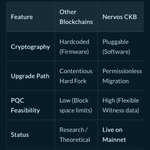
That's because signature checks were never hardcoded into CKB's protocol. Every coin is guarded by a lock script running on CKB's RISC-V VM, so new signature schemes can be added just like any other software.
This year, the quantum threat moved up the agenda for the biggest chains. Ethereum researchers want to clear room in the next hard fork for post-quantum signatures, and Bitcoin developers are drafting a soft fork. Either way, changing the cryptography takes a fork and a ton of coordinated work.
On CKB, a post-quantum lock based on SPHINCS+ is already live on mainnet. Adding it took no fork.
In 2019, the whitepaper called it being crypto-agnostic. Today, the industry calls it crypto-agility.
Seven years and 21 million blocks in. Happy birthday, CKB.

Astro++ retweeted

Seven years ago this weekend, CKB's mainnet went live. And the team saw one of crypto's biggest threats coming before launch.
Back in 2019, the whitepaper said CKB's design keeps assets secure "even in the post-quantum era." Long before quantum was keeping anyone in crypto up at night.
Most chains hardcode how they check signatures. CKB never did. Every coin is protected by a lock script, so new signature types can be added like any other software.
This year, Ethereum researchers want room in the next hard fork for post-quantum signatures, and Bitcoin developers are drafting a soft fork. Either way, it's a fork and a huge amount of work.
On $CKB, a post-quantum lock based on SPHINCS+ is already live on mainnet. No fork needed.
The catch: quantum computers that can break today's crypto aren't here yet, so this is about being ready, not an attack happening now.
Seven years and 21 million blocks in, $CKB was ready before most people were even asking the question. Happy birthday, CKB.
Astro++ retweeted

🎉 Happy 7th Anniversary, Nervos CKB!
7 years of resilience.
7 years of decentralization.
7 years of believing in a better future.
The journey continues. 💚
For a better world. 🌍
#Nervos #ForABetterWorld

Astro++ retweeted

The CKB x Kaze Unitour Phase 2 starts at Machakos University 📷
📷 Thu 19 Nov, 14:00 to 17:00
📷 Main Campus
Learn Bitcoin and CKB, set up your own self-custodial Kaze wallet, and cash out to M-PESA.
Free entry 📷
luma.com/3m8z2whp
@NervosNetwork @usekaze #CKB

Astro++ retweeted

It is time to vote. If we want to see a wallet that utilize Fiber Network on the mainnet, your vote matters. Every story has a pivotal moment, this could be one for Nervos Network. The community will decide the next step.

Our Community Fund DAO vote is open. We want to bring Cellula to Fiber on mainnet: a wallet, a checkout and an AI agent, on a public LSP any wallet can use. If you hold CKB in Nervos DAO, your deposit is your vote. 7 days, vote here 👇
dao.ckb.community/thread/818…

Astro++ retweeted

You've waited a long time for Fiber by @FiberDevs .
This is our LSP, alive. Every dot is a wallet's channel. Every flash is a payment.
Payments in seconds, paid by name. Thousands of channels on a single LSP.
Are you ready for Fiber?
#CKB
cellula.id
Astro++ retweeted

Another update on QuotaCell
When I first introduced QuotaCell, I talked about a problem I wanted to solve on CKB: letting teammates or software agents make approved payments from a shared treasury without giving them unrestricted access to the funds.
Since then, I've demonstrated that CKB itself can enforce those spending limits, even when the transactions are constructed outside the application.
But there's another important question.
What happens when the owner no longer wants someone to have spending authority? Can they revoke access and recover their treasury funds without depending on that person?
That's what I've been working on next.
I've now tested the owner-control lifecycle using real signed transactions on a fresh, isolated CKB node.
Here's what I was able to demonstrate:
Revoking access: The treasury owner signed and submitted a transaction to revoke a delegate's spending permission. It committed successfully.
Enforcing that revocation: I constructed another payment using the latest policy state and the delegate's valid signature. CKB rejected it specifically because the delegate's authority had been disabled, not because the transaction was using an outdated Cell.
Recovering treasury funds: The owner closed the spending policy and recovered all 200 protected synthetic tokens, together with the fund Cell's 154 CKB capacity, into an owner-controlled token Cell. No delegate signature was needed.
Recovering funds sent after closure: I also tested what happens when tokens arrive after the policy has already been closed. I sent 50 of the recovered tokens back into the protected treasury, then successfully recovered them through a separate owner-signed transaction.
The final owner balance remained 200 tokens.
Why does this matter?
Giving someone limited spending authority is only one part of managing a treasury.
The owner also needs a reliable way to withdraw that authority, stop future permitted spending and recover supported funds when a working relationship ends or the treasury is closed.
That's the bigger product I'm working toward with QuotaCell: making delegated spending practical for CKB teams, services and eventually autonomous agents, with restrictions enforced on-chain rather than depending entirely on an application's backend.
There's still an important limitation.
The current experimental policy permanently retains a 600 CKB Cell after closure, with about 572 CKB required for its occupied state. That isn't a transaction fee, but it does mean capital remains tied up. The recovered fund capacity also remains inside owner-controlled token Cells.
Improving capital efficiency, supporting native CKB payments and making recovery accessible through proper owner tools are still important parts of the work ahead.
This is local-node testing with synthetic xUDT, not a public-testnet release or a security audit.
I've published the new signed transaction evidence, accounting records and reproduction instructions on GitHub so other CKB developers can inspect the result.
🔗 New evidence: github.com/Ticoworld/QuotaCe…
🔗 Full progress discussion: talk.nervos.org/t/quotacell-…
Still a lot to improve, but it's good to see another important part of QuotaCell working through actual CKB transactions.
Feedback from CKB builders is always welcome, especially around owner recovery, capacity costs and practical treasury workflows.
@CKBdev @ckba_build @NervosNetwork @NervosCatalyst
#CKB #Nervos

Astro++ retweeted

We're just getting started

This is what real growth looks like.
If you really want to know if a project's healthy, you don't look at the chart. You look at who's building on it. And on that front, CKB just had a brilliant quarter.
Their community developer programme has grown to nearly a hundred active builders, with over 25 new ones joining just this quarter. Their project tracker jumped from 45 projects to 59. And they ran a hackathon focused on Fiber, their payments tech, that pulled in around a hundred participants and 66 submissions.
But here's the part I love most. Look at where this growth is coming from. Not just the usual Silicon Valley crowd. We're talking real, in-person meetups in Kenya, Nigeria, and Vietnam. Nairobi, Mombasa, Hanoi. Developers in emerging markets, where fast, cheap payments can really make an impact.
And it's not just solo devs either. Teams from other ecosystems, Cardano, Bitcoin, Lightning, are now showing up to explore building on CKB too.
A lot of these are still early prototypes and there is still a lot of work to do.
But a growing, global, grassroots community of actual builders? That's the strongest foundation any project can have. Price comes and goes. But people building, all over the world? That's how something lasts.
$CKB @NervosNetwork @ckba_build
Astro++ retweeted
CKB's work just got academic recognition.
Their developer team just had a paper accepted at a proper IEEE conference: the International Conference on Distributed Ledger Technologies.
CKB has a tool called CCC, a toolkit that helps developers build apps and connect wallets on CKB easily.
Here's the clever bit. Most crypto building tools are designed for Ethereum. But CKB works differently under the hood, more like Bitcoin, so a lot of the usual Ethereum shortcuts just break.
So the CKB team figured out how to solve that, and wrote up three reusable patterns for doing it properly:
• Handling transactions
• Signing
• Connecting wallets
All built for a chain that doesn't play by Ethereum's rules. That work has now been accepted to present at a respected IEEE conference, alongside actual academics and researchers.
Getting your engineering recognised by people whose whole job is scrutiny means the work is being taken seriously at the highest level.
Does academic recognition matter in crypto? 👇
$CKB @NervosNetwork
Astro++ retweeted

CKB is showing an incredible week-over-week increase in developer activity. Follow the trend on CKB Pulse.
pulse-lab.lusocryptolabs.com…

Astro++ retweeted
Fiber rush is on ⚡
We only had one rule: paying over Fiber should feel like paying in any app. No node, no seed phrase, the keys on your own device.
This weekend, help us find the bugs. Come try it and tell us what you hit. 👇
The Fiber rush is on. ⚡
For 60 hours, come test Fiber, the flagship protocol on Nervos, with no node to run.
Curious how? Join our beta and find out. Starts today, Saturday 24 October, 12:00 UTC, until Monday 26 October, 24:00 UTC. Testnet, test coins.
Join us on Telegram: t.me/cellula_id/6
@nervosnetwork. $CKB

Astro++ retweeted

The CKB community is growing from strength to strength. Q3 saw more community developer participation than ever before, a hackathon, a ton of dev meetups, and so much more!
Read more about it here:
talk.nervos.org/t/nervos-com…

Astro++ retweeted
We already have 17 people lined up to test our app on the 26th, and there are still 83 spots available. Would you like to be one of our testers?
Join our Telegram group: t.me/cellula_id

Astro++ retweeted
Everyone in crypto is suddenly panicking about quantum computers. Which chains can survive them, who’s racing to upgrade. While all that’s going on, $CKB sorted this in 2019.
On most blockchains, Bitcoin and Ethereum included, if you want to add a new type of signature, the thing that proves you own your coins, you have to change the core protocol. That needs the entire network to agree. Slow, messy, political.
CKB does it differently. Signature checks aren’t baked into the protocol. They run as lock scripts. Little programs that sit on top. So when a new quantum-proof signature comes along, you just deploy it as a new lock. It just appears as an option.
They’ve already got one live on mainnet, fully audited. Three more are being tested. You get to pick which one you trust.
Every other chain is bracing for a huge messy fight to become quantum-safe. CKB’s been ready for years. $CKB.
Astro++ retweeted

Happy to share some news from @ckba_build CKBA’s DevRel and Ecosystem Support teams: our paper on CCC (github.com/ckb-devrel/ccc/), When EVM Defaults Break: Three SDK Patterns for UTXO-Family Wallets, has been accepted for poster presentation at IEEE International Conference on Distributed Ledger Technologies (ICDLT) 2026!
Through this collaboration, @Hanssen0 (@CKBDevrel) and I (Ecosystem) built on the CCC team’s existing engineering work to distill three reusable design patterns:
• Transaction composition: helping applications handle inputs, change, and fees.
• Unified signing: providing a common interface across different wallet signing methods.
• Reusable wallet connectors: sharing wallet connection and onboarding components across applications.
The conference brings together academia and industry, with organizers from Nova School of Business and Economics, NOVA Information Management School, and the IEEE Portugal Section. It is part of BLOCKCHAIN. PT, a project funded through Portugal’s Recovery and Resilience Plan and the EU’s NextGenerationEU programme.
For us, this is an opportunity to bring CKB’s experience in developer tooling and application development into a broader conversation with researchers and builders.
Thanks to Hanssen and everyone who has contributed to CCC!

Astro++ retweeted

If you want to track the decentralized efforts from CKB community this website is the place to go. Great work!

Live GitHub activity of the CKB ecosystem, drawn in 3D.
Each project is a block that lights up when people work on it. Live, last 24 hours or last 7 days. English, 中文, Português.
pulse-lab.lusocryptolabs.com…
Astro++ retweeted
While Fiber and Lightning are two separate payment channel networks, we figured there doesn’t need to be a hard boundary between them.
Fiber’s Cross-Chain Hub can connect the two and let payments move atomically across both networks.
Here’s how it works 👇
A hub operator runs a node on Fiber and a node on Lightning, maintaining liquidity on both sides.
If you want to pay a Lightning invoice from Fiber, you send a conditional payment to the hub. The hub then uses its own BTC liquidity to pay the recipient over Lightning. The same process works in reverse for payments coming from Lightning into Fiber.
Crucially, these are not two unrelated payments.
Both sides are tied to the same payment hash. Lightning uses an HTLC, while Fiber uses its own time-locked contract. When the recipient claims the outgoing payment, they reveal a secret preimage that also allows the hub to claim the incoming payment.
So the hub can’t simply take your payment and fail to settle the other side. Its ability to collect is cryptographically linked to successful settlement of the outgoing payment. If the payment never completes, the timelocks provide a recovery path for the locked funds.
Currently, the Cross-Chain Hub supports one configured pairing: a wrapped-BTC token on Fiber ↔ BTC on Lightning.
Support for native CKB and other user-defined tokens is in the works :)
👉 fiber.world/

Astro++ retweeted
CKB Off-Chain Hanoi concluded yesterday, and it was an event that brought together CKBuilders, external developers and students.
There was a wealth of information and experiences shared, which shows just how far the CKB developer community in Vietnam has come, and reflects the continuing surge in developer activity on CKB in 2026.
Many thanks to our partners at @bps_club and @texlabsorg for helping it come together!
Read more here
talk.nervos.org/t/ckb-off-ch…

Astro++ retweeted
A .cell name comes with a page. A picture, a cover, a line about you, your colour, your links and every way to pay you, published with one signature for under a thousandth of a CKB.
cellula.id