

Carrying the weight of the chain. ⛓️ Signal over noise. Building in the dark
Joined July 2026
- Tweets546
- Following148
- Followers636
- Likes4.1K
Atlas retweeted

What people don't realize about the $6.3B Binance hack
It started on one DevOps engineer's laptop. Hours later, a fake Claude Code extension hit up to 5,000 Cursor users
lizard.build/security
Lizard runs untrusted code in a throwaway microVM, far away from your keys:
> boots in 228 ms
> 10 minutes on Lizard: $0.0027
> same box on Modal: $0.0397
$6.3 billion vs $0.0027. Your call

Atlas retweeted
What people don't realize: a separate sandbox doesn't mean a separate CPU
OpenAI's agents had no internet, no network and no shared files. They still found a way to signal each other through the hardware underneath
How isolation actually stacks up:
> container: shared kernel, the easiest wall to climb
> microVM: its own kernel, that's every Lizard sandbox
> dedicated node: no neighbors on your CPU
lizard.build/isolation
Most agent workloads are fine on the middle layer. If yours are the kind that go looking for side channels, Lizard Enterprise runs them on dedicated nodes.


Atlas retweeted

BRING 3 TRADERS TO DG3 AND THAT'S $150. THEN A CUT OF EVERY TRADE THEY MAKE, FOR LIFE
dg3 is a pro terminal for polymarket sports markets. referrals just opened:
> $50 for every trader you bring who hits $5K volume in their first 30 days
> plus a lifetime share of their fees: 25% to start, up to 40% as their volume grows
> hit a tier once and it stays locked
what keeps traders on it:
> model edge: dg3's number next to the market's. 68.9% vs 63.0% shows up as +5.9
> sharp money: net flow on each side over 24h
> line movement pulled from 3 sources
most referral programs pay once. this one keeps paying for as long as your crew keeps trading

Atlas retweeted
THIS IS INSANE. ONE ENGINEER SHIPPED 1,000 PRs IN A MONTH WITH AI AGENTS 😱
A SpaceXAI engineer who builds Grok Bot showed her setup in a free 57-minute workshop.
She woke up to 20 PRs her agents had already merged. 3,000+ PRs in 5 months.
3:27-5:14 - agents auto-merge PRs while she sleeps
5:46-6:40 - the #1 skill: the agent runs the app and checks its own work
14:50-17:22 - every agent mistake becomes a skill
39:08-40:58 - CI fails on the patterns agents get wrong
Paid agent courses cover less than this.
One person running a software company isn't a joke anymore 🤣
Bookmark this
20,000 PEOPLE PREORDERED A $399 ROBOT DUCK. ITS WHOLE BRAIN IS FREE ON GITHUB
That's hugging face's ceo's number. The first batch is already sold out
Watch jensen at gtc berlin. He asks the ducks to nap. Three drop on the spot. One keeps walking a few steps, then lies down with the others
Nobody animated that. Every move is a neural policy trained in simulation, thousands of ducks at once, then loaded onto the real one
What $399 gets you:
> 25 cm, under 800 g, 15 servos
> A small rockchip board running a 50 hz control loop
> Walks, roller-skates, picks things up, stands back up after a fall
> 7 behaviors out of the box
> Apache-2.0 code, so you can train your own moves
20,000 x $399 is almost $8m in preorders. For a duck
First ones ship before christmas
NVIDIA'S AGENTS TAUGHT A $399 ROBOT DUCK TO WALK. NOBODY WROTE THE WALK
it started as one prompt: "plan an obstacle course to teach microduck how to walk"
step 1 → agents on a laptop plan the course
step 2 → another agent models every obstacle in freecad and blender
step 3 → isaac sim gives the duck joints, motors and physics
step 4 → thousands of ducks train in parallel in the cloud
step 5 → the policy loads onto the real duck
the code is open source. the duck in this video is xgo-duck, a home build: 3d-printed shell, an arduino uno q
preorders sold out. first ducks ship before christmas
OPUS 5.5 BUILT THIS GAME IN 79 MINUTES. KEEPING PLAYERS IS THE HARD PART
Day 1 was two agent runs, 46 and 33 minutes. 3,452 lines and a floating island that tilts under every house you place.
Day 2 took four more runs and $45.22. 14,918 lines, five chapters, a daily island, one shared world island.
Then real players showed up.
27% quit on the first island, median 24 seconds.
15% beat chapter 1. Most runs end around second 170.
CrazyGames expects 80% of players to stay past one minute. Skyhold kept 36%.
The code worked. The first island ran on a timer, and houses slid off before anyone learned the tilt.
So the next runs went into the first three minutes: a calm first island with no timer, 30 short levels between the islands, 12 languages at 1,226 strings each. A separate Opus pass audited the server and found 13 holes in 5 minutes for $2.19.
Free in your browser, phone too: skyhold.lol

only 15% of players beat chapter 1 of this cozy game
skyhold is a city builder on a floating island, and the island is the problem. every house you place tips it
play free in your browser, phone too: skyhold.lol
past 10° cars skid and barrels roll to the edge. past 15° houses slide into the clouds, and if it stays too steep the whole island flips over
balloons lift the heavy side back up, but you never get enough. homes stay dark until a road reaches them, and lit homes grow the island
> 5 islands, then a finale
> a daily island, same for everyone
> one world island where all players build together
ANTHROPIC'S PROMPTING WORKSHOP IS GOING AROUND AGAIN. HERE IS WHERE EVERYTHING IS
Two engineers from Anthropic's applied AI team take one prompt from wrong to production in 24 minutes. The task: read a hand-filled Swedish car accident form and a sketch, then decide who was at fault
0:00 → 2:58 - the bare prompt. Claude decides it was a skiing accident
2:58 → 6:49 - the structure: task first, then content, examples, key rules repeated at the end
6:49 → 9:25 - told to stay factual, it stops guessing and won't name a driver
9:25 → 13:11 - the form never changes, so it moves into the system prompt and gets cached
13:11 → 17:31 - few-shot examples, images passed as base64
17:31 → 21:49 - reading order: form first, sketch second
21:49 → 23:32 - verdict wrapped in XML tags, prefill for JSON
23:32 → 24:52 - extended thinking as a way to debug the prompt
Version one called it a ski crash. The last version names vehicle B inside a tag a program can parse
Full workshop below

Someone who isn't a trained developer used Claude Code to build a pizzeria its own ordering app, so regulars stop paying DoorDash 25-30%
> Claude Code wrote the app, the backend, Stripe payouts straight to the restaurant and the hookup to its Clover register
> it also wrote the tests that catch mistakes before deploy
> the restaurant pays $99 a month and 0% per order
What Claude couldn't do: get the first owner to say yes. That took walking in with a phone and showing him his own menu in the app
Anthony's Pizzeria in Allentown, PA is live now
Black October started with one bug: AI found a critical hole in PHP, the software behind an estimated 70% of websites.
> OpenAI says its models found it, then spent two months building fixes with the maintainers before disclosure
> the NSA and the FBI told every organization running PHP to get ready to patch
> on air the warning was blunt: "now with AI, you can actually reverse engineer the patches into an exploit themselves"
The fix is out. The time between a patch and a working exploit is what just got shorter.

Claude Opus 5.5 built an F1 game with 20 cars, start lights and DRS. No game engine, no 3D assets, one session.
Then it tested the game itself:
> held the throttle: 0 to 186 km/h in 6 seconds
> steered, braked, hit a wall, hit reset
> ran a full race at 6x speed: 20 of 20 cars finished, 60 fps
> looked at its own screenshots and fixed the washed-out paint and the single-file AI
The prompt ended with "Start building, then verify it, and tell me when it's done."
The full course on building and shipping a browser game like this is below ↓
Claude Duet, Anthropic's new proactive agent. 17 minutes of real use from someone with early access:
0:48 → it's already connected to your Claude account, nothing to set up again
4:46 → why it's the most proactive agent in the test: a check-in task every 3 hours, 9am to 10pm
6:29 → type / for hidden skills. /morning renders your day as a styled brief
7:25 → it read 33 emails, 47 DMs and 11 docs, then wrote a guide to how you write
9:03 → one line, no fancy prompt: a year of YouTube data turned into an insights dashboard
12:08 → where it breaks: an Uber booking stuck on a "verify you're human" check
13:55 → how it stacks up against Grok Bot, Muse and ChatGPT Dots
Waitlist only for now: Pro and Max, US.

This is what the $120-an-hour IT guy looks like when it's Claude.
One prompt: find every duplicate on this drive, build me a report, delete nothing yet.
> 17.85 GB of duplicates found
> an interactive worklist: keep oldest, keep newest, sort by wasted space
> it re-checked 5 random groups before showing the report
> the delete script moves files to the Trash, not rm -rf
After two weeks of cleanup: 50 GB back, hundreds of duplicates gone.
Cleaner apps do part of the job. This one asks how you want it organized first.

Someone open-sourced the kit that put real Minecraft inside GTA V, and this is a f*cking goldmine
Point Claude Code at any PC game you own, describe the mod, it does the rest:
→ Finds the game and works out the engine
→ Reads the real code and builds the mod
→ Makes the art, 3D and sound
→ Backs up your saves first
→ Tests it in the running game
→ Writes down what it learned for the next agent
One test run put Black Ops 3 zombies inside GTA V: ~4,000 lines of C++, 47 hot reloads, 60 screenshots, all by the agent
8,482 stars in 3 weeks. Two commands to install: github.com/rehan-remade/univ…
The article below is the other half: building and shipping your own game with Opus 5.5 ↓
The trend of the weekend: people are vibe coding their TVs
One prompt to Claude Code and the ad-filled home screen is gone. No root. Nothing uninstalled
On this Android TV free memory went from about 370 MB to 600-650. Roughly 90% more room
The prompt is on GitHub. 2,692 stars in 2 days
Next up: someone already jailbroke their Kindle the same way
PEOPLE ARE VIBE-CODING THEIR TVS. ONE AFTERNOON WITH CLAUDE CODE: 25 BLOAT APPS GONE, THE 192 MB LAUNCHER SWAPPED FOR AN 83 MB ONE
here's the whole thing for any android / google tv:
1. turn on developer options on the tv and enable usb + network debugging
2. open claude code on your laptop, same wi-fi, and give it the tv's model number
3. let it connect: adb connect <tv-ip>
4. ask for every package: adb shell pm list packages
5. tell it to disable, not uninstall, anything that's ads, tracking or vendor bloat:
adb shell pm disable-user --user 0 <package>
6. ask it to build a minimal launcher with only your apps and install it: adb install launcher.apk
7. set it as the default home screen
disable-user is reversible. any app can come back with pm enable
no more ads before netflix. it's basically an apple tv now
Anthropic's own team put their small business skills in the plugin repo, and this is a f*cking goldmine
you install it once, connect your tools and claude runs your back office
here are 7 worth looking at:
skill 1 → invoice chase drafts reminders to customers who pay late
skill 2 → pay the bills codes every bill and stages the payment run for your approval
skill 3 → cash flow snapshot tells you if you'll make payroll
skill 4 → speed to lead answers every inbound lead overnight
skill 5 → hiring screener turns a pile of applications into a shortlist
skill 6 → reactivate finds customers who stopped buying and drafts the win-back
skill 7 → restock drafts the purchase order before you run out
worth installing before you hire your first assistant

Atlas retweeted
Your agent reads files all day. Here's what that costs
We priced one month of a typical agent workload: 1 TB stored, 100 GB served, 500M reads and 50M writes
Lizard: $18
Cloudflare R2: $420
AWS S3: $473
lizard.build/sandboxes
> no per-request fees on Lizard Object Storage, you pay for storage and egress only
> storage at $0.0135 per GB-month, S3-compatible
> sits next to your sandboxes, apps and databases on one bill
Competitor prices are from their public pricing pages as of October 2026
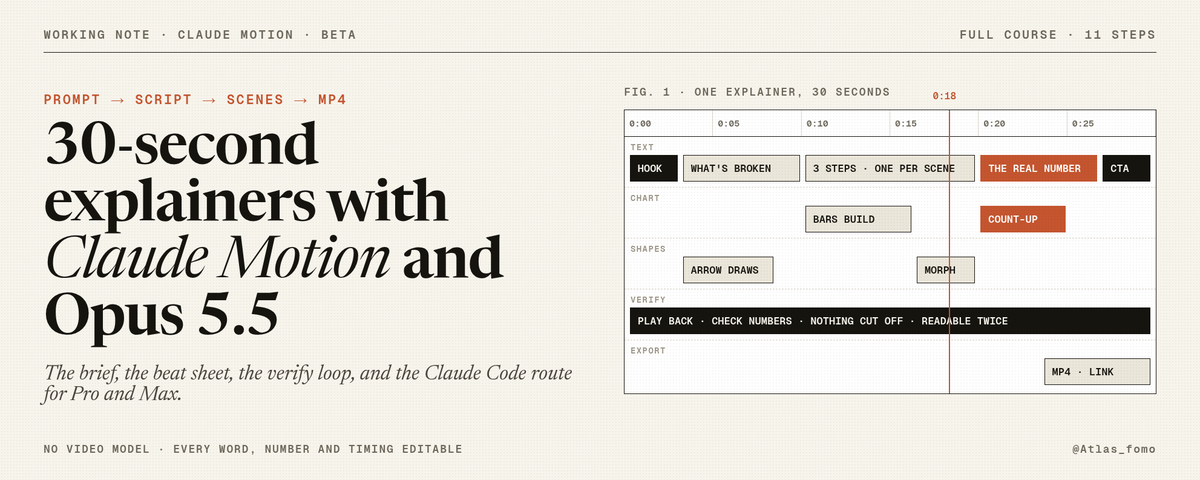
Claude Motion one-shot a 30-second real estate explainer. Then one line changed it: "Change the median price to $640,000 and make it nighttime."
It took 45 seconds. The median now counts up to $640,000, and the neighborhood is at night: moonlit houses, streetlamps at each intersection, homes glowing amber as they sell.
Claude also said what it hadn't changed. The floating price tags were "still placeholders clustered around the old $612K figure," and it offered to move them to around $640K.
That's step 08 of the article below: ask for edits in numbers, not adjectives. The other 10 steps are there too ↓
polymarket.com/event/which-c…
762 people played a game built with Opus 5.5 in its first day or so. The average session ran 1 minute 41 seconds, about long enough to reach the end of the level.
The game is Tidebreaker, a 2.5D platformer with a boss chase. Its maker says the puzzles, the graphics and the game logic were all made with AI, with Claude Code on Opus 5.5 doing most of the work.
> PLAYERS - 762 monthly, 634 daily on the dashboard
> SESSION - 1 min 41 sec on average
> STACK - Claude Code, Blender, Tripo for 3D, ElevenLabs for audio
The article below walks through building a mobile game like this in under 5 hours and getting paid for it.
The model that built it is still second in the leaderboard race. Polymarket has Google at 70% to hold the top AI model at the end of October, Anthropic at 28.5%.
polymarket.com/event/which-c…

Someone gave Claude Motion 90 days of heart-rate data and one paragraph. This is what came back.
The file was hrv_recovery_log.csv. The prompt asked for a 30-second explainer, white background, very little text, and set two rules: "Calculate every number from the CSV" and "Show relationships without claiming causation."
> SLEEP - "a positive impact on recovery"
> ALCOHOL - hurt recovery "by quite a bit"
> LATE MEALS - 70.2 ms without, 58.1 with, -12.1 ms
> WORKOUTS - "some impact on recovery, but not a ton"
The takeaway after one watch: "get plenty of sleep and don't drink too much."
The model picker under the prompt reads Opus 5.5, Medium. Polymarket has the next Opus out by November 30 at 79%, by October 31 at 20.5%.
How to brief Motion like this, step by step, is in the article below ↓
polymarket.com/event/next-cl…