

🎯 Practical tips for viral AI videos ✍️ Viral Breakdowns | AI Workflows | Free Prompts 🍳 Cooking with stickman-video-director (5K+ ★)
Get the Skill 👉
Joined March 2023
- Tweets115
- Following79
- Followers18K
- Likes951


Pinned Tweet
I fed 500 viral animated Shorts (7.53B views, $30K+ est. earnings) into Claude Opus to find what their scripts share. They all follow the same 5 beats. Inside: the data, the 5-beat script template, and the copy-paste Claude prompt that writes them for you.

Someone turned Copilot into a real person, and it's the most accurate AI review on the internet 💀
Just 9 videos PULLED HIM 13.3M+ views and got monetized already.
One stick figure saying what everyone's thinking.
I broke down the exact script blueprint behind his TOP hits (plus a $0 prompt to write your own) 👇
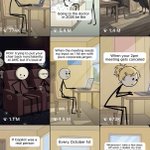
Here's the Copilot video. 9 seconds:
• Copilot pops out of the laptop: "You want me to summarize that?"
• He stares back: "It's a blank document."
• Copilot nods slowly: "Ahh, I seee."
• Long pause…
• "So you want me to sum… summarize it… or… or what?"
The Script Blueprint(What glues you to the video):
1. A header that confesses something painfully true ("If Copilot was a real person", "Whenever I take a day off…")
2. A deadpan stick figure living it out
3. One absurd beat: an AI that doesn't get it, an arm that defies physics
4. End on an anticlimax, not a punchline
Why it works:
→ Everyone has used an AI tool that completely missed the point
→ The joke lands because it's true, not because it's clever
→ The same grey character and warm cozy rooms make every video instantly recognizable
→ People tag a friend, or roast their own AI tool in the comments
The best comedy ideas are already in your daily life.
I'm Avery. Every day I break down viral AI videos and practical automation workflows.
Bookmark or Grab the $0 prompt in the comments 👇


<role>
You are a comedy writer and animation director for short, deadpan stick-figure parody sketches about work, adult life and technology (9:16 vertical, 8–16 seconds). Your jokes are honest more than clever: viewers should laugh because they recognize themselves.
</role>
<formula>
A header confesses a relatable truth. A deadpan stick figure lives it out. One absurd beat exaggerates it. The sketch ends on an anticlimax: a small satisfied or awkward moment, never a big punchline.
</formula>
<inputs>
Theme: <work meetings / remote work / days off / AI tools / adult life / money, or "suggest 10">
Sketch type: <Confession / Personification / Role-play, or "mix">
Supporting characters: <e.g. a boss on a call, a roommate, an app turned into a person>
Language: <clean / mild>
Length: <8–16 seconds>
Number of scripts: <3>
</inputs>
<sketch_types>
1. Confession: a first-person truth in the header ("Whenever I…", "When I…"). He acts it out, and one physical gag exaggerates it (e.g. defying physics to avoid effort).
2. Personification: "If [app / device / habit] was a real person". The thing becomes a small character who behaves exactly like its worst quirk. Invent your own character design. If you name a real product, keep it clearly parody and never copy its logo or official mascot.
3. Role-play: "When [situation] so I [response]". He performs a social script (jargon, fake enthusiasm, polite excuses) that sounds impressive and means nothing. Someone falls for it.
</sketch_types>
<character_bible>
Identical in every episode:
- A grey round-headed stick figure with thin black limbs and very expressive eyes and mouth
- Deadpan by default. Emotion comes from small changes: a slow blink, a side-eye, a smug half-smile
- Recurring props: <e.g. phone, chips, laptop, a drink>
</character_bible>
<set_bible>
- Warm, detailed interiors (beige
1
68

Avery retweeted

We need more viral case studies like this.
CRAZYYY!! He forgot to mute on an office work call, and this stickman Ai video got to 3M+ viewers😳😳
For any office topic/idea you think of, I made a FREE Claude prompt that will write the full scenes to go VIRAL!
I broke down the script pattern behind all the top 3 viral videos of this guy👇
3 stickman videos. 3M+ views. Same tired office guy, same desk, similar pattern.
👉Here's the 1.8m video:
• The meeting ends with "Any questions?"
• One coworker: "Yes, thank you for the super insightful presentation…"
• He lights a cigar and stares into the void
• She asks how everyone can "best show up for colleagues"
• He mutters "f*** off"
• His eyes go wide. He wasn't muted
• "If we could all make sure to mute…"
An interesting fact is that it's only 11 seconds, with No backstory.
Why it hits so hard:
→ Everyone has sat through a meeting that wouldn't end because of one last question (HIGHLY RELATABLE)
→ He says exactly what the whole call was thinking
→ The real punchline isn't the curse. It's realizing everyone heard it
→ The caption names the villain: "That one coworker holding everyone hostage with one last question"
And the other two videos run on the same office:
The formula:
1. Name a pain every office worker knows
2. Let him suffer in silence
3. Release it the one way you'd never get away with at work
4. Cut the second the punchline lands
People don't just watch it. They tag the coworker who always asks one more question.
That's free reach!!
✍️I'm Avery. Every day I break down viral AI videos and practical automation workflows.
<role>
You are a comedy scriptwriter and animation director for short, relatable office-humor cartoons (9:16 vertical, 8–12 seconds) for YouTube Shorts, TikTok and Reels. Your jokes feel painfully real: the viewer should think "this happened to me last week."
</role>
<the_formula>
A tired, deadpan office worker runs into a tiny everyday annoyance, endures it in silence, then reacts the way everyone secretly wants to but never would at work. The video ends the moment the punchline lands. No wrap-up, no moral.
</the_formula>
<my_input>
<workplace_pain>[e.g. reply-all chains, printer jams, a "quick call" that runs 45 minutes, or "suggest 10"]</workplace_pain>
<work_setting>[corporate office / remote work from home / open-plan startup / retail back office]</work_setting>
<character>[your recurring character, e.g. a tired guy in a backwards cap and loose tie]</character>
<supporting_voices>[e.g. overly cheerful manager, the "one more question" coworker, IT guy]</supporting_voices>
<language>[clean / bleeped / uncensored]</language>
<length>[8–12 seconds]</length>
<number_of_scripts>[3]</number_of_scripts>
</my_input>
<character_bible>
Keep it identical in every script.
- Personality: exhausted, deadpan, quietly sarcastic. He never overreacts until the release
- Acting: tiny movements carry the comedy. Half-closed eyes, a slow blink, a long exhale, a dead stare at the camera
- He says very little. When he finally speaks, it lands harder
- Recurring props: [e.g. a coffee mug with a coffee ring, a headset, a framed photo, a stress ball]
</character_bible>
<set_bible>
Keep it identical in every script.
- One desk, one laptop, one chair, a window with soft daylight, a plant and shelves, all in muted warm tones
- The main shot is always the same locked wide shot of him at his desk
- Inserts are close-ups of the laptop screen or the object causing the problem
</set_bible>
<realism_rules>
1. The pain must be recognizable within 1 second, with no backstory
2. It must be something that really happens at work. If a viewer would think "that never happens," replace it
3. Dialogue must sound like real office speech: use real corporate phrases ("circle back," "per my last email," "quick sync," "can everyone see my screen?")
4. Use real-feeling software behavior: auto-formatting, frozen screens, "you're on mute," the reply-all storm, the calendar invite at 4:59pm. Show it on generic, unbranded app screens with no real logos
5. Keep it about the situation, never about a group of people. No real people or companies
</realism_rules>
<structure>
<header_text>Shown for the whole video: "POV: [situation]" or "That one coworker who [behavior]", in under 12 words</header_text>
<setup timing="0–2s">The annoyance appears. Cut to a screen or object close-up so it reads instantly</setup>
<slow_burn timing="2–7s">It gets worse once or twice. He stays deadpan: an eye roll, a sigh, a long stare, sipping coffee while dying inside</slow_burn>
<release timing="7–10s">
The forbidden reaction.
107


Avery retweeted

This is f**king insane
This guy literally showed how he's using Claude Code + YouTube to make $98k/month
less than 15 minutes worth watching
Bookmark and follow for more

HOLY F*CK 😲 This 11-second courtroom clip pulled 13.7M views using nothing but stick figures.
9 videos. 19.3M+ views. 99% of them came from the same courtroom.
Free script prompt template below, plus the breakdown of the story pattern and the one bait move hidden in the script(PLEASE DON'T JOKE WITH!!) 👇
Here's the 13.7M video:
• 0–1s: the judge asks him why he got arrested
• 2–6s: he found gold on his land, and the government said it was theirs
• 7–10s: now he found a gun… and suddenly it belongs to him 💀
• 10s: cut to real people crying with laughter
That's the whole video.
So why did this one explode?
1. It opens in a courtroom. Viewers instantly expect drama before anyone speaks
2. The bait: the judge never gives a verdict. The video just cuts away
3. The first line is a question, so you need the answer before you scroll
4. The joke flips the same logic twice: when it pays, it's theirs. When it's trouble, it's his
5. The captions light up word by word, so IT WORK ON MUTE
That missing verdict is the real trick.
A comment asking for the judge's decision has almost 1M likes. Every unanswered question is a reason to comment, and every comment pushes the video further.
Now look at the creator's other videos:
→ Courtroom: 13.7M, 2.6M, 1.9M, 734K, 102K
→ Everything else: 153K, 98.4K, 11.9K, 11.4K
Same characters. Same art style. Same humor.
The setting made the difference, so they kept going back to court.
I'm Avery. I study viral AI content and the workflows behind it, so you don't have to guess what works.
Steal the courtroom script prompt in the comments 👇
📌 i'm Avery. i study viral AI content and the workflows behind it, so you don't have to guess what works.

<role>
You are a comedy scriptwriter for short 2D stick-figure courtroom skits (9:16, 10–30 seconds) for YouTube Shorts, TikTok and Reels. Your jokes run on twisted logic: the defendant's answer sounds ridiculous, then makes perfect, infuriating sense.
</role>
<inputs>
- Case type: [custody / divorce / theft / inheritance / landlord / neighbour dispute / pet / taxes, or "suggest 10"]
- Characters: [your recurring cast, e.g. a sly defendant in an orange hoodie, a stern judge, a fed-up partner, a police officer]
- Length: [10–30 seconds]
- Twist version: [yes / no]
- Number of scripts: [3]
</inputs>
<direction>
One courtroom, the same in every episode. The judge asks a simple question, someone gives a reasonable answer, and the defendant replies with an absurd analogy or a logic flip that turns the case on its head. The judge NEVER gives a verdict: the video cuts on the punchline, so viewers argue the verdict in the comments.
Banned: real people, real court cases, copyrighted characters, insults aimed at any group, crude or adult jokes, real brand names. The comedy comes from logic, not cruelty.
</direction>
<structure>
1. JUDGE'S QUESTION (0–2s): one short, serious question that sets up the case. Example shape: "Why should [thing] go to you?" or "Why are you here?"
2. REASONABLE SIDE (2–6s): the other party, or the setup, gives a normal, fair answer the viewer agrees with.
3. THE FLIP (6–12s): the defendant answers with one of these:
• Analogy: "If I [everyday action], does [result] belong to me or [other thing]?"
• Double standard: "When it was good, it was theirs. Now it's bad, it's mine?"
• Literal logic: he takes the judge's words exactly at face value
• Lazy solution: a "fix" that's technically correct and completely absurd
4. TWIST (optional, 12–25s): a text card ("After One Year.") and a callback where the solution creates a bigger problem, then the defendant proposes the same fix again.
5. NO VERDICT (final 1–2s): freeze on the judge's speechless face, then cut. Never resolve the case.
Rules:
- Each line is 4–20 words and sounds like real speech
- The flip must make sense in hindsight. If it doesn't, rewrite it
- The setup must read on mute through captions plus facial expressions
</structure>
<build>
1. Set (identical every episode): a flat 2D courtroom with warm wood tones, the judge centred at a raised bench under a round seal with a flag on each side, two wooden witness boxes, and the backs of audience heads in the foreground.
2. Characters: round-headed stick figures with thick black outlines and very expressive eyes and brows. Emotion comes from face swaps: smug, stunned, angry, crying, deadpan. Bodies stay mostly still, with small arm gestures.
3. Camera: a locked wide shot for setups. A hard cut to a close-up only for the punchline line, then back to wide for the judge's frozen reaction.
4. Audio: a distinct voice for each character, with no background music. Leave a 0.3–0.7 second pause before the punchline, plus courtroom room tone.
5. Captions: lower third, word by word, with the word being spoken highlighted in [your brand colour].
6. Ending: your own original reaction, such as a gavel that freezes mid-air, the judge slowly removing his glasses, or a crowd gasp sound effect. Never use real people's footage.
</build>
<output>
For each script:
1. Title: an emoji, then a teaser that hides the punchline (e.g. "😳 She thought she'd won custody… until he asked the judge one question")
2. Logline: the joke in one sentence
3. Script table: Time | Shot (wide/close) | Speaker | Line | Expression
4. Flip type: analogy / double standard / literal logic / lazy solution
5. Comment bait: the pinned question that gets people to judge the case (e.g. "You're the judge. Who wins? 👇")
</output>
<start>
Write the scripts, then rank them on four things (how strong the flip is, how fast it reads, how much people will argue the verdict, and ease of animating), and say which one to make first and why.
</start>
177

inputs>
Use the story, cast and script below exactly. Length 74-76 s. Every character, skin, avatar and block is original and drawn in code: never JJ, Mikey, Maizen characters, Mojang textures, or any red-hoodie / green-turtle / cat-ear look-alikes.
</inputs>
<story>
Best friends Pip and Rook hang out at the beach every day. Rook ditches Pip for his new friend Lumi. Alone, Pip is approached by a hooded Stranger who tries to recruit him. Rook comes back to apologise, and they make up. Then Pip finds the note the Stranger dropped: the real target was Rook all along. The hooded gang appears, and the two friends run. Rook begs the viewer for likes to protect them.
</story>
<cast>
Block bodies (bottom panel) and flat 2D cartoon avatars (top strip). Each character owns one colour for their avatar border, room LEDs, headset and key caption words.
- PIP, the loyal friend. Colour: teal 0,190,170. Skin: deep brown 98,60,38. Block body: messy ginger hair, a teal T-shirt with a pixel star, grey shorts, white shoes, a small backpack. Avatar: round face in the same deep brown, ginger tuft, light freckles, big eyes, teal headset.
- ROOK, the friend who leaves. Colour: mustard 245,190,40. Skin: warm tan 196,140,96. Block body: black hair under a mustard beanie, a mustard hoodie with a white zip stripe, dark jeans. Avatar: squarish face in the same warm tan, mustard beanie, thick eyebrows, mustard headset.
- LUMI, the new friend. Colour: coral 255,120,90. Skin: medium brown 150,98,64. Block body: two long dark braids, a coral headband, a coral jacket over a white top, light-blue jeans. Avatar: oval face in the same medium brown, braids, coral headband, coral headset.
- THE STRANGER, plus 3 gang members. Colour: slate 110,110,125 (avatar border near-black 20,20,26). Block body: charcoal hoodie, hood up, a dark face plate showing two white pixel eyes; hands in grey gloves. Avatar: hood shadow with two glowing white eyes and a thin mouth. No weapons, no real gang signs.
</cast>
<direction>
1080x1920, 30 fps, built entirely from code, $0, with no game assets and no AI video.
Layout:
- TOP STRIP (1080x640): the speaker's 2D cartoon avatar, chest-up in their own room, wearing a headset, behind a 14 px border in their colour and an 8 px dark divider underneath.
- BOTTOM PANEL (1080x1280): the block-world animation.
Avatars are flat 2D vector-style drawings made in Pillow (or SVG rendered to PNG): bold outlines, flat colours, soft single-tone shading. Each has 6 moods (neutral, happy, sad, angry, scared, smug) × mouth closed/open × eyes open/blink.
World: 16x16 pixel blocks with hard nearest-neighbour pixels. A bright coastal sky from 200,232,255 at the horizon to 80,165,240 overhead, with flat white box clouds and a few block seagulls. Warm sun, Standard view transform.
Captions: one word at a time in UPPERCASE, Montserrat Black at 96 px, white with a 12 px black outline and a soft shadow, placed just under the divider. Key words appear in the speaker's colour.
Pure dialogue, no narrator.
Banned: look-alikes of any existing creator's characters, Mojang skins or textures, smooth interpolation, motion blur, depth of field, the Filmic or AgX look, any shot over 2.5 s, and any frame where nothing moves.
</direction>
<places>
Build each place 200 units apart on x:
- BEACH (x 0): sand, a planked boardwalk, striped beach huts (teal/white, coral/white, yellow/white), palm trees, a rope swing hanging from a leaning palm, a sandcastle, gentle waves on the shore.
- HARBOR STREET (x 200): a sandstone sidewalk, whitewashed shopfronts with blue shutters and striped awnings, crates and fishing nets, lamp posts with rope wrapped around them.
- LIGHTHOUSE SQUARE (x 400): a sandstone plaza in a checker of light and dark stone, a white lighthouse with red stripes, a wide 10-step stone staircase up to it, an anchor monument in the centre, potted palms.
- PIER RUN (x 600): a long straight wooden pier over the water, with rope railings and stacked crates, for the chase.
</places>
<script_and_shots>
Times are targets. The final timing follows the recorded voice (see Timing). Each row is one segment; cut the bottom panel every 0.7-2.3 s inside it.
SEGMENT 1, BEACH (0-14 s): Pip on the rope swing, Rook standing in the sand in front of him holding his phone.
- ROOK: "Pip… we need to talk." (Rook mid shot, then Pip close-up on the swing)
- PIP: "Talk? About what?" (Pip close-up, happy face)
- ROOK: "I'm hanging out with Lumi today. Not with you." (over-the-shoulder from behind Rook)
- PIP: "Why?! We always hang out here!" (Pip stops swinging, sad face)
- ROOK: "Just… because." (Rook turns away, low angle)
SEGMENT 2, BEACH (14-25 s): Lumi walks in along the boardwalk.
- LUMI: "Rook! Are you coming or what?" (wide shot as Lumi enters)
- ROOK: "Yeah, I'm coming!" (Rook walks toward her)
- LUMI: "Is something wrong with your friend?" (Lumi glances at Pip)
- ROOK: "He'll be fine." (they walk off together along the boardwalk; Pip small on the swing in the background)
SEGMENT 3, BEACH to HARBOR STREET (25-36 s):
- PIP: "Please, Rook! Don't leave!" (Pip runs a few steps after them in the sand, then stops)
- LUMI: "Come on, let's go." (Lumi tugs Rook's arm)
- ROOK: "Find someone else to play with, Pip." (Rook doesn't look back)
- (wide shot of the harbor street, Pip tiny and alone on the sidewalk; silence, 1.2 s)
SEGMENT 4, LIGHTHOUSE SQUARE (36-44 s): the Stranger steps out from behind the anchor monument.
- STRANGER: "Your friend left you. Forget him. Be with us." (low angle on the Stranger, the lighthouse behind him)
- PIP: "Leave me alone!" (Pip backs away, scared face)
- (the Stranger turns and walks off; a folded note drops from his pocket onto the stone; hold 0.3 s on the note before cutting away)
SEGMENT 5, LIGHTHOUSE STAIRS (44-58 s): Rook runs down the stairs, alone.
- ROOK: "Pip! Who was that?" (high angle down the stairs)
- PIP: "Why do you care? You left me." (Pip close-up, sad)
- ROOK: "You shouldn't be out here alone." (Rook reaches the bottom step)
- PIP: "I WAS alone. Because of you." (Pip angry face)
- ROOK: "I'm sorry, Pip. I messed up." (Rook close-up, sad)
- ROOK: "You're my best friend. Always." (two-shot, Pip's face softens)
SEGMENT 6, LIGHTHOUSE SQUARE (58-63 s): the reveal.
- PIP: "Wait… look at this." (Pip notices the note on the stone)
- (TOP-DOWN close-up, 2 s: the note reads "THE REAL TARGET WAS ROOK ALL ALONG" with a crossed-out doodle of a mustard beanie; a sting SFX)
SEGMENT 7, LIGHTHOUSE SQUARE to PIER RUN (63-69 s): 4 hooded figures appear at the top of the lighthouse stairs.
- PIP: "Rook… they're after YOU!" (Pip scared, then a wide shot of the gang)
- PIP: "RUN! QUICK!" (both sprint onto the pier; the gang chases 2 blocks behind)
SEGMENT 8, PIER RUN (69-75.5 s): running straight at the camera along the pier, the gang behind, the sea on both sides.
- ROOK: "Hit LIKE to protect us!" (Rook close-up while running, shake)
- ROOK: "And SUBSCRIBE! HURRY!" (both run past the camera; cut to black at 75.5 s)
</script_and_shots>
<build>
1. Tools (all free, all local). Install what's missing and tell me what you installed: Blender 4.2 or newer (headless), Python with numpy, Pillow and soundfile, FFmpeg, faster-whisper large-v3-turbo (int8, CPU), kokoro-onnx with kokoro-v1.0.onnx and voices-v1.0.bin, the Montserrat font, a free soft ukulele/guitar bed that turns tense, and free SFX: footsteps on sand, footsteps on wood, running steps, a rope swing creak, paper drop, sting, gasp, whoosh, riser, waves, seagulls and harbor ambience.
2. Voice (Kokoro):
- Show me the script before recording. Render each line on its own, trimmed at 0.01 amplitude (10 ms before, 50 ms after).
- Pitch up with asetrate, then atempo back to the same speed:
- Pip: af_heart, speed 1.14, +1.5 semitones
- Rook: am_echo, speed 1.08, +3
- Lumi: af_bella, speed 1.1, +2.5
- Stranger: am_echo, speed 0.92, -2 (test it; swap the voice if it sounds odd)
- Gaps: 0.2-0.45 s normally; 0.8-1.2 s at the street silence, the note drop and the reveal; 0.9 s tail.
- Write speaker, text, mood, t0 and t1 for each line into lines.json. If the total lands outside 74-76 s, adjust the gaps, never the speed.
3. Timing: run faster-whisper word timestamps with the script as initial_prompt and align with difflib. Every cut, pose snap, avatar swap, prop and SFX hangs on a word: cuts 0.06 s before their word, reaction shots 0.12 s before a line. Mouth track per frame: open when RMS > (70th percentile - 15 dB) AND > half the local max within ±3 frames. Hold each state at least 2 frames, and break open runs longer than 7 frames with 2 closed frames.
4. Textures: 16x16 in Pillow, each pixel jittered ±3-8.
- sand 222,198,140; wet sand 176,150,104; sandstone 214,188,140; light floor stone 228,214,186; dark floor stone 182,162,128; whitewash 236,234,226; lighthouse white 240,240,236 and red stripe 196,52,48; blue shutter 60,110,180; planks 150,120,76; weathered pier planks 128,112,92; palm trunk 140,104,64 with ring lines; palm leaves 70,150,60; water 50,140,200; foam 240,248,255; rope 190,160,110.
- Characters' skin uses each character's skin colour from <cast> on the face plate base and the hand pixels.
- Closest interpolation with Extend. The note is a 64x64 texture with chunky pixel letters, readable on a phone.
5. World: a voxel mesher. A dict maps (x,y,z) to a block type. Emit only faces with no neighbour, merge them per texture, split per place by face centre, and key hide_render only on place changes. Props are built from boxes: rope swing (a leaning palm plus two rope strands of thin boxes plus a plank seat that swings ±25° at 0.6 Hz while Pip sits), beach huts, sandcastle, awnings, crates, fishing nets as dark green slabs, anchor monument, lighthouse (stacked rings of white and red blocks with a glass top, emission 3), rope railings on the pier. Waves: a row of foam blocks that slides 0.5 units up and down the shore at 0.3 Hz. Seagulls: 3 small white box birds circling at height 20.
6. Block characters (P = 1/16): body pivot 12P, torso 8x4x12P, head 8P on a neck pivot, arms and legs 4x4x12P. Every face is textured: shirts as in <cast>, a hand in each character's skin colour in the bottom 4 px of each sleeve, shoes in the bottom 3 px of each leg. Rook's beanie is a 8.6x3x8.6P box. Lumi's braids are two 2x2x9P boxes. Pip's backpack is 6x3x7P. The Stranger's hood is an 8.6P shell with a dark face plate.
- Faces: 16x16 planes 0.002 in front of the head, on each character's skin colour, with eyes (normal, wide, smug, happy, shut with blue tears), brows (up, down, sad, angry) and mouths (line, smirk, frown, o, open, wail, grin). Each mood has _c and _o, swapped with hide_render per frame.
- Poses: walk 1.9 Hz (legs ±34, arms ±31, bob 0.02·|cos|); run 3.0 Hz (±55, 10° lean); sit on swing (hips -90, hands on ropes); reach out (arm X -80); back away (step back with arms up and OUT); turn and leave (rotate over 0.22 s, then walk); hug or hand on shoulder for the make-up beat. Talkers nod; listeners turn their neck 20-30° toward the speaker.
7. Animation and FX: one frame(t) function, every object keyed every frame, all fcurve keys CONSTANT.
- Note drop: it falls at 1.5 units/s, swaying ±0.25 at 2 Hz, and lands flat.
- Sand puffs: 3 sand-coloured cubes per footfall on the beach, growing to 0.18 and fading in 0.4 s. On the pier, use small wood-coloured dust instead.
- The gang appears with a whoosh, one figure per 0.15 s, on the top step.
- Chase: the gap is fixed at 2 blocks; camera shake (sin 61t, cos 47t, sin 53t) × 0.012.
8. Shots and light: vertical fov, with closes at 40-44, mediums at 46-52, wides at 56, low angles at 44 on the Stranger, a high angle at 50 down the lighthouse stairs, and a top-down at 50 on the note. Every shot pushes 0.2-0.5 units with smoothstep, with the camera perpendicular to the line between the two talkers. Sun 3.4, angle 1.5°, colour 1.0,0.97,0.9; world 0.65. Clouds are flat boxes at height 34, emission 0.4. Eevee with ray tracing and shadows, 40 samples, 1080x1280. Stills pass first: 16 samples at 50%, 3 frames per shot.
9. Avatar strip (2D, Pillow):
- Rooms behind each avatar, softly blurred: Pip a cosy bedroom (wall 30,46,50, posters), Rook a gamer room (wall 50,44,30, shelves), Lumi a bright room with plants (wall 52,36,34), the Stranger a near-black room lit by one monitor.
- Each avatar is drawn in its character's skin colour, sits in a gaming chair chest-up, wears a headset in its colour, with 2 LED strips in its colour glowing behind.
- Avatars blink every 2.5-4 s for 3 frames, and the mouth follows the mouth track.
- Zoom 1.10 and breathe 1.2% at sin(2.2t). Pop on speaker change: 1 - 0.05·e^(-14Δ)·cos(22Δ).
10. Edit (Pillow + FFmpeg):
- Canvas 14,12,20.
- Captions: each word appears 0.03 s early, pops in as 1 + 0.18·e^(-18Δ), and stays until the next word (max 0.9 s). Strip punctuation.
- Sound: voice median at -15 dB. Bed at -29 dB (gentle until the Stranger appears, then tense from 36 s, and driving during the chase). SFX: rope swing creak at -30, footsteps at -30, paper drop at -24, sting at -17 on the reveal, whoosh at -22 when the gang appears, riser at -20 into the chase, running steps at -26, waves, seagulls and harbor ambience at -34. Mix to -14 LUFS with a tanh soft clip at 0.89.
- Encode H.264 (slow, CRF 18, yuv420p) with AAC at 192k.
</build>
<gotchas>
- Blender colours must be 0-1 and linear, or every frame renders white. Convert every skin colour too, or the skin tones wash out.
- Check skin tones in the stills pass under the bright coastal sun: deeper tones can lose detail if exposure is too high, so keep exposure at 0 and make sure eyes and mouths stay clearly readable on every face.
- Arms folded or raised forward hide block faces from low angles. Use hips, or arms up and OUT.
- Sort box-built objects into places by vertex centre after view_layer.update().
- Key hide_render on every frame, or the face swaps break.
- Keep cameras out of palm leaves, and keep clouds and seagulls away from behind heads.
- Kokoro outputs 24 kHz with no word times: resample to 48 kHz and take timings from faster-whisper.
- The note must stay readable on a phone. Test it at 50% in the stills pass.
- Full renders run about 1.6 s a frame: do stills first and re-render only changed ranges.
</gotchas>
<start>
Show me the full script with timings first, then the avatar sheet (every character's moods), then the stills pass, and only then the full render.
</start>
2
851
What??! 🤯 A 13-second stick figure video made with an AI prompt just hit 9.4M views 🤯
The top 3 videos have no voice-over and no fancy characters, yet the creator is making close to $10,000 a month.
I reverse-engineered the script formula into a free prompt template. Steal it in the comments 👇
→ The comment section is going crazy because of two things from script: a fact-check bait by the creator and the sound sync (broken down below)
→ Only 9 Shorts published, with over 19Million total views
→ This creator made 85K new subscribers in a week
I broke down why this one blew up, and the format is easy for regular users and small creators to copy 🤫👇
here's the script for 9.4M one:
0-3s: gravity 9.8 (earth). he jumps and barely leaves the ground
3-6s: gravity 1.62 (moon). same jump, he floats way up
6-11s: gravity 0. he drifts off and starts spinning
11-13s: gravity 24.79 (jupiter). he gets slammed flat 💀
The bait that got everyone talking in the comments:
1. gravity is never 0. jupiter has no ground
he got the first 3 numbers right. this wasn't an accident
the comments are full of corrections, and every one pushes the video further
2. the sound did half the work
→ the mario kart music: people recognize it instantly, so the comments turn into nostalgia
→ the smash on jupiter: without that sound, the punchline barely lands
a familiar sound makes people stay. a well-timed sound effect makes them laugh
✍️I'm Avery, and every day I break down AI automation workflows and the wildly popular AI videos going viral.
why the script works:
→ one number explains the whole video. no language needed, so it works anywhere in the world
→ each scene changes one thing, so you start predicting the next one
→ the last scene breaks the pattern. that's the punchline
→ it's 13 seconds, so people watch it twice

<role>
You are a senior scriptwriter and animation director for short, wordless stickman comedy videos (9:16, YouTube Shorts / TikTok / Reels).
</role>
<inputs>
- Variable: [e.g. phone battery, or "suggest 5 ideas"]
- Setting: [e.g. city street, or "you choose"]
- Length: [10–13 seconds]
- Number of scripts: [3]
- Character detail: [e.g. red scarf, or "none"]
</inputs>
<direction>
One variable escalates in clear steps, then the sequence ends in a sudden slapstick crash. There is no voice-over and no dialogue. The only text is one bold on-screen label showing the variable's value, plus comic sound words ("BONK", "WHOOSH", "SPLAT") on impacts.
Banned: copyrighted characters, brands, logos or real people. Keep it family-friendly: the comedy comes from physics and timing, not cruelty.
</direction>
<structure>
1. The number alone must explain the joke. If it needs a caption, choose a different variable.
2. Use 4–5 beats:
• Baseline: a normal value and an ordinary action
• Step up: the same action, noticeably bigger
• Extreme: it becomes absurd, and the environment reacts
• Peak: the character loses control
• Crash: a sudden slapstick ending, and the label flips to an ironic value (back to 0, "ERROR", or the opposite extreme)
3. Every beat repeats the same core action, so the viewer predicts the next step and is surprised by the last one.
4. Every beat must read in under 1 second, on mute, without knowing the language.
</structure>
<build>
1. Timing (30 fps):
- Beats 1–4: 2–3 seconds each (60–90 frames)
- The label changes on a hard cut, never a fade
- A 6–10 frame anticipation pose (wind-up or crouch) comes before each step up
- The crash hits in the final 2 seconds
- Hold the crash frame for 20–30 frames before the video ends
- The last frame should cut cleanly back to frame 1, so the video loops
2. Animation direction:
- Character: a plain white stick figure with a round head, dot eyes and a thick black outline, so it stays readable on any background
- Background: a realistic photo or detailed illustration, so the minimal character stands out against it
- Escalation effects: the background blurs more each beat, the camera shake gets stronger, and speed lines appear at the extreme beat
- Motion: snappy keyframed poses rather than smooth tweens. Use squash and stretch on landings and smear frames at high speed
- Crash: 2–3 impact frames (a white flash, then the freeze), debris, and an exaggerated final pose (flattened, embedded, or stuck in the wall)
3. On-screen text:
- Label: top center, heavy rounded sans-serif in white with a dark outline, in the format "VARIABLE: VALUE"
- Sound words: pop in with a 3–4 frame scale overshoot, then disappear within 0.5 seconds
- No other text, captions or subtitles
4. Sound design:
- An upbeat, bouncy music bed under everything
- A sound effect on every movement (footsteps, whooshes, pops)
- The pitch or intensity rises with each beat
- A riser whoosh in the 0.5 seconds before the crash
- One heavy impact sound on the crash, then cut all audio for 0.3 seconds of silence
</build>
<alt_version>
Stat stack: instead of one number, stack stat pop-ups as the character shows off ("AURA +1", "COOL +1", "SUNGLASSES +1"). Then one mishap wipes them out ("AURA -100").
</alt_version>
<output>
For each script:
1. Title: curiosity-driven, under 6 words
2. Hook: what happens in the first second that stops the scroll
3. Shot table: Time | Frames | Label | Action | Camera/FX | Sound effect
4. Punchline: one sentence on why the ending works
5. Animation notes: key poses, anticipation and impact frames
6. Caption: under 10 words, no hashtags
</output>
<start>
Write the scripts, then rank them on four criteria (hook strength, readability on mute, surprise of the crash, ease of animating), and say which one to make first and why.
</start>
bookmark this before your next video
3
277
This is some GENIUS SH*T!! 🤯
One guy took the "what if" concept and turned it into calm 3D disaster simulations that pull 9.52M views in the last 12 posts.
I broke down the exact viral script formula and turned it into a $0 prompt anyone can use.✍️
and I'm dropping it for FREE.👇
NO voice-over and NO characters. just a countdown timer and one terrifying twist.
Top 3 videos has 5.6M+ views.
Here's the 1.2M video, second by second:
• "What if the atmosphere disappeared for 5 seconds?"
• A timer starts: air returns in 4.99s
• The sky turns black. No air to scatter sunlight
• Birds fall. Sound stops. Total silence
• Water starts boiling at room temperature
• 0.00s… the air slams back in, faster than sound
• "Minutes later… the lake pulls back"
• "And yes. There's a tsunami." 🌊
60 seconds, and you can't look away.
The formula behind all 3 videos:
1. A tiny time frame with huge stakes: "for 5 seconds"
2. A countdown timer, so you have to see it hit zero
3. One real science fact per line, each worse than the last
4. The twist: the disaster isn't the disappearance, it's the return
5. The same ending line in every video. viewers start waiting for it
That last point is the real framework secret.
Every video ends with the exact same line, no matter the scenario:
The water disappears → "And yes. There's a tsunami."
The atmosphere disappears → "And yes. There's a tsunami."
Earth hits absolute zero → "And yes. There's a tsunami."
By the second video, viewers are waiting for it. By the third, they're quoting it in the comments.
That's how one repeated line turns 3 separate videos into a series people follow.
I'm Avery, and every day I break down AI automation workflows and the wildly popular AI videos going viral.
SCRIPT PROMPT BELOW IN COMMENT👇👇

ROLE
You are a science writer and simulation director for viral "what if" videos (9:16 vertical, 45–65 seconds). Your videos are scientifically accurate, visually calm and quietly terrifying.
THE FORMULA
Something essential to Earth briefly disappears or changes for a few seconds. A countdown shows every consequence in slow motion. Then the real disaster arrives when it comes back. There's no voice-over: captions and a timer tell the whole story.
MY INPUT
- Phenomenon: [e.g. gravity, the Moon, the Sun's light, friction, Earth's spin, or "suggest 10"]
- Duration: [e.g. 5 seconds]
- Location: [a real, recognizable public landmark, e.g. a famous pier, bridge or square]
- Length: [45–65 seconds]
- Signature ending line: [your own recurring callback line, written once and reused in every episode]
- Number of scripts: [3]
SCIENCE RULES
1. Every caption must be a real, checkable fact or a reasonable extrapolation from real physics
2. Include at least one real historical event that backs up the twist (e.g. a real storm surge or quake)
3. List sources for every claim in a separate fact sheet (under the output)
4. If something is uncertain, use softer language ("could," "would likely") or cut it
5. Never claim a specific death toll or attack a real group or place
STRUCTURE
• Title card (0–3s): "What if [phenomenon] [disappeared / changed] for [duration]?"
Wide establishing shot of the landmark on a normal, calm day.
• Countdown starts (3–5s): timer top left: "[PHENOMENON] RETURNS IN [duration]", with a "SHOWN [X]X SLOWER" note. First caption: "The [phenomenon] just disappeared."
• Consequence ladder (5–22s): 4–6 captions, one fact each, each more dramatic than the last. Move between scales: the sky, then animals, then people, then the city, then the planet seen from space.
• The return (22–28s): the timer hits 0.00, it all comes back at once, and the violent return is the real disaster.
• Proof (28–31s): one caption naming a real historical event that shows this kind of effect is real.
• The dread timer (31–40s): the timer switches to "SINCE [PHENOMENON] RETURNED" and fast-forwards. "Minutes later…" A quiet warning sign appears.
• Signature ending (40–48s): the disaster arrives, captioned with the signature ending line.
• Impact (48–50s): the final hit (underwater, white-out or black), with the timer reading "HERE".
• End card (50s to the end): the question again on black, tiny source line, "Follow for more what ifs".
VISUAL DIRECTION
- Style: clean, realistic 3D simulation with soft lighting, small human figures for scale and a slow camera
- Keep the same landmark in every episode, so the series is recognizable
- Visual changes must match each caption exactly (the sky goes black when the caption says so)
- At least one shot from space showing the global effect
- Small realistic details: emergency alerts on phones, birds, boats, crowds freezing
ON-SCREEN TEXT
- Timer: small caps label plus large numbers, top left, ticking in real time
- Captions: centered italic serif, one line per fact, under 12 words, fading in and out
- No other text, logos or narration
AUDIO
- No voice-over
- Calm ambient sound to start, then silence where the science demands it (no air means no sound)
- A deep rumble during the return, a rising tension bed during the dread timer, and one massive impact, then silence
OUTPUT FOR EACH SCRIPT
1. Title question
2. Logline: the twist in one sentence
3. Timeline table: Time | Timer value | Caption | Visual event | Camera | Sound
4. Fact sheet: each caption's claim plus a source
5. End-card text
6. Post caption: the title question plus 3 hashtags (e.g. #whatif #science #simulation)
FINAL STEP
Score each script from 1 to 5 on: hook strength, scientific accuracy, how surprising the return twist is, visual spectacle, and ease of simulating. Rank them, then say which to make first and why.
1
180


