

Founder Merk Investments. USD ~2.5bn in precious metals. Weekend rancher. tweets ≠ advice
USA
Joined June 2012
- Tweets41.5K
- Following1.1K
- Followers21.9K
- Likes1K




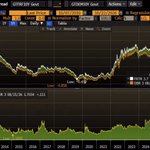




Always a challenge to muse real time as to *why* the price of gold moves. Part of it is because drivers are changing. Late in the week it felt like a classic initial risk off burst — bonds rallying, risk assets declining, dragging gold along.

1/
Some loose thoughts on the current macro setup and what it means for #gold 🧵
Gold is under real pressure. Silver and the miners are underperforming and show no signs of strength yet.
My take: we’ll see a capitulation low over the next few days.
WSJ's @RichardRubinDC lists social security reform proposals:
* increase retirement age: still bust, long-range gap shrinks
* end tax cap: delays insolvency by 24 years
* raise tax cap: shrinks gap, delays insolvency by 2 years
* lower benefit adjustment: still bust, shrinks gap a bit
* lower benefits to each successive cohort: still bust in the short-term, but long turn turns deficit into surplus
* not mentioned: means testing as to whether you get benefits
@karadapena wsj.com/politics/policy/how-…

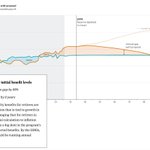
Read the full analysis of Social Security's trajectory to go beyond the headline. I was trying to wrap my head around the last option, dubbed "change initial benefit levels."
Think of Social Security benefits as an income tax in reverse: based on your highest 35 years of earnings (adjusted for wage growth), you currently get 90% of the first tier of average monthly earnings, 32% of the second tier, and 15% of what's above that. There's a cap on annual earnings that count toward benefits, just as earnings above that cap are exempt from Social Security payroll taxes.
The proposal apparently reduces those percentages for each successive cohort becoming eligible for retirement, using a formula that offsets wage growth above inflation. The idea is that starting benefits should rise with inflation, rather than—as is currently the case—with average wage growth across the population.
The net of it is that each successive cohort will receive less than it would under today's rules, even though benefits may still rise in dollar terms. And once eligible, benefits would continue to receive annual inflation adjustments.
It's complicated enough that few will understand what's actually changing.
wsj.com/politics/policy/how-…


Adam’s post yesterday recalls Thomas Sowell’s A Conflict of Visions: in politics, some prioritize outcomes, others principles. The former may micromanage, risking unintended consequences; the latter tolerate 'loopholes' for more freedom and fewer rules.
amazon.com/Conflict-Visions-…


Controversial take:
As those who follow me know, I'm no socialist
But I'm not a fan of accelerating wealth concentration either (see below stats)
I'm of the mindset that if you invent the next Google/SpaceX/etc you should reap the full rewards in your lifetime
Work your way to billionaire status? Go ahead, live like a king.
But should you be able to set up your family for dynastic dominance for generations to come? There's something about that that doesn't sit well with me
Absolutely you should be able to leave your heirs "plenty" ($20 million per heir?) so that they'll be well off. But not so much that they can influence society's orbit with their inherited mega-riches (e.g., Alex Soros)
How best to achieve this? And if your heirs don't get your excess wealth (beyond my "plenty" allotment), who does?
I don't have a great solution to propose (yet)
On theory my preference would be for the wealth to literally vaporize. No one gets it. Your excess assets would be liquidated and the proceeds would go to money heaven. That way, the purchasing power of every other dollar in circulation would slightly increase -- benefitting all. And the govt wouldn't amass a massive estate tax surplus that would surely get abused and wasted.
But the practicalities of implicating such an idea are probably so complex as to not be realistic (what to do with illiquid assets?, for one)
Maybe your excess wealth goes towards paying down the national debt? Or funds critical infrastructure? The problem is, this would actually incentivize Congress to be even more fiscally profligate as they would come to count on your estate proceeds to subsidize their spending.
Like I said, I don't have a neat solution to propose (yet). But I do noodle on this frequently and would appreciate any constructive ideas any of you may have to share.
Or, we just accept that the aristocrat class will continue to invest its compounding wealth over the generations towards furthering its own advantage. That's largely how the world has worked so far. The danger, of course, is that when the concentration of wealth becomes too lopsided, class warfare erupts and the guillotines come out. I've toured the catacombs under Paris -- they are gruesome.
"European countries have seen a sharp uptick in so-called gray-zone assaults" "if the... attack had resulted in large numbers of casualties, they would have considered invoking [NATO's] Article 5"
WSJ dives into Putin's sabotage campaign in Europe. 👇
wsj.com/world/europe/airfiel…

This morning, @jc_econ suggested to @BloombergRadio that Warsh signed on to a hiking cycle due to peer pressure on the FOMC. With due respect, that's a misunderstanding of Warsh's framework.
Not only is Warsh a hawk at heart, he has clearly articulated both his plan to tackle inflation and his reform ideas to improve the context of how monetary policy is conducted.
You point out good old forward guidance is responsible for the lack of a rate hike being priced in next week. Almost. It is correct that bad habits die hard (FWIW, the Minutes also suggest that a forward guidance mind is still present in several FOMC members), but eliminating forward guidance doesn't mean there should not be a reaction function. And while Warsh cannot publish a reaction function without the rest of the FOMC on board, he was very clear in his September post rate decision presser when he said he "removed a dose of accommodation" - it implies a tightening bias, it implies a hiking cycle, but it also implies that there is no urgency - the rational market reaction should have been what we now see: low odds of a October hike, high odds of a December hike. All of this of course in a context of data dependency.
Differently said: yes, there's still too much forward guidance, but don't let that distract from Warsh's efforts to reform the Fed a step at a time. Implying that Warsh is hostage of an FOMC that pressured him to hike rates mistakes the horse and the cart.