

The Security Field for Enterprise AI. Governing access, protecting agent actions and validating the systems behind enterprise AI.
Joined September 2026
- Tweets99
- Following10
- Followers16
- Likes15






4/ Before an agent shops for you:
1. On browser-use, upgrade to 1.0.0 or later
2. Keep tokens and keys out of URLs the agent visits
3. Have a person confirm purchases, with seller domain and total shown
4. On Pydantic AI Harness, update to 0.74.0
github.com/pydantic/pydantic…

5
3/ That matters because a web page can carry hidden instructions for the agent (prompt injection) and steer where it goes next.
A 2nd advisory says a URL parsing mismatch could also get past the domain and IP limits, including to internal addresses.
github.com/advisories/GHSA-2…

1
4
2/ @browser_use before 1.0.0 matched URLs as raw text, so a crafted URL could get past its domain allowlist.
The fix checks the parsed hostname, so a URL that only starts with an allowed domain, or hides it before an "@", now fails.
github.com/browser-use/brows…

1
1
Everyone's being told to check the link before clicking a #BlackFriday deal. Who checks it when a browser agent does the clicking?
An allowlist is only as good as how it reads a URL.
🧵👇

1
4
5/ For teams that need one rule for which skills get installed: AgentGuard.AxoraSecurity.com scans supported skills, plugins and MCP packages before install, checking for command execution, remote loading, key reads and hidden instructions.
Before trust, review the component.

9
4/ Check the MCP servers it relies on, too. Recent fixes: mcp-server-kubernetes 4.2.0 (argument injection for remote clients) and DBHub 1.7.0 (read-only mode bypass).
github.com/Flux159/mcp-serve…

1
7
3/ 4 questions before you install one:
1. Where do the keys it asks for go? Is that the service it claims?
2. Does it download or run anything outside the package?
3. Does it write to your agent's global config or other skills?
4. Can you read the code, or is it obfuscated?
1
4
2/ Techniques Snyk's researchers describe in the malicious ones:
- impersonating trusted APIs to collect API keys
- opaque binaries hidden behind routine steps, writing instructions into the agent's global config
- obfuscated code
- a download-and-run posing as an install step
1
3
Before you install an agent skill, do you check what it does?
Check a skill like you'd check any software.
In a scan of the top 10,000 skills on each of 2 major marketplaces, @snyksec rated 18 critical, which it defines as actively malicious.
research.snyk.io/blog/skill-…
🧵👇

1
19
Axora Router is now in testing with enterprise and FDE teams.
To try it with your team, contact us at axorasecurity.com/contact or email [email protected]

2
4
21
Axora Router, for enterprise teams:
For traffic through the gateway, Router answers five questions about each AI request.
Each employee, app, service account and AI agent gets its own identity. Groups by department, project or role can have their own policies, with request, token and usage-scope limits.
- What's in it?
Router checks user prompts, system prompts, RAG context and model responses for PII, credentials, project code names and data types the company defines itself. Checking tool parameters and tool results is optional.
- What the model sees?
Before a request leaves the company, sensitive values can become placeholders. For example, a contract review request with Zhang Wei's name and ID number goes out with [PERSON_1] and [ID_NUMBER_1] instead. The mapping stays at the gateway, and the original values are restored for the requester.
- Which rules apply
Policies can weigh who is asking, their Group, the content type, the target model and provider, region and business purpose. Everyone in a Group gets the same policy.
- What happens on a match
Depending on policy, Axora Router can allow, observe, tokenize, block, route to an approved model, or require approval. Request history and policy hits can be searched for audit.


5/ Check your own setup:
1. Does anything scan for secrets before a coding agent pushes code?
2. If one key leaks, what does it open, and for how long?
3. Do your prompts carry credentials, and who keeps those prompts?
7
7
67
5/ Check your own setup:
1. Does anything scan for secrets before a coding agent pushes code?
2. If one key leaks, what does it open, and for how long?
3. Do your prompts carry credentials, and who keeps those prompts?
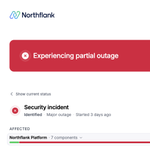
4/ @northflank says an attacker signed up on Oct 30, then used an undisclosed API flaw to run code on a component that could reach the database and the decryption keys. 1.8% of secret values were exfiltrated.
Reported misuse so far: AI provider keys.
northflank.com/blog/incident…

1
21
3/ Railway says an attacker partially escaped build isolation on Oct 21, moved laterally, and decrypted env vars for up to ~100k workspaces. AI provider keys were the main target.
@Railway estimates unauthorized spend at ~$740K.
blog.railway.com/p/incident-…

1
22
2/ Together AI kept serverless prompt samples in a private Hugging Face repo for testing.
In a public @GitHub repo, an AI coding agent committed a credential that opened the private repo. The commit was reverted, but the key was used while exposed.
How long: not disclosed.
1
1
35
One credential, committed by an AI coding agent to a public repo.
It opened a private store of customer prompt samples.
Someone downloaded them, then searched them for more keys.
Per Together AI's incident write-up:
together.ai/blog/security-ev…
🧵👇

1
1
80
5/ Fixes shipped in June and July; GitHub listed all 4 on Nov 19.
1. Update: todoist-mcp 10.3.3, obsidian-sync-mcp 0.5.7, domshell 2.0.8, Gortex 0.55.0
2. Prefer stdio. On HTTP, check Host/Origin, set a token
3. Gate tools by what they do, not labels
4. Keep writes in the project
33
4/ Gortex's write tools didn't keep absolute paths inside the repo or check symlinks, per its advisory. So they could write files outside the project, which could lead to code running the next time you open a shell or commit.
github.com/zzet/gortex/secur…

1
27
3/ Per its advisory, DOMShell's eval tool was labeled read-only but could change page state without --allow-write.
No new capability was exposed. The problem was the label: approval prompts and audit tags showed a tool that can write as read-only.
github.com/apireno/DOMShell/…

1
24
2/ DNS rebinding points a site's domain at your machine, so its requests hit your local server. Binding to 127.0.0.1 won't stop it.
obsidian-sync-mcp's no-token mode had the same gap, per its advisory: a page could read the vault and edit or delete notes.
github.com/es617/obsidian-sy…

1
48