

Astrologer @RenayOshop; I reflect on #astrology investigations, particularly those inflected by Eastern philosophy. #Panchanga transits in English @AAstro_Tr.
Boulder, CO
Joined February 2012
- Tweets1.9K
- Following657
- Followers666
- Likes1.4K





Pinned Tweet
Vāgbhaṭa's Aṣṭāṅgahṛdayam: A Full English Translation youtube.com/playlist?list=PL… via @YouTube

1
382
AyurAstro® retweeted

A farmer digging in a ruined place near Peshawar in 1881 found 70 fragile leaves of birch bark. They carried mathematics that still surprises us.
One leaf holds a rule for the square root of a non square number. Subtract the nearest square. Divide the remainder by twice that root. Apply one correction. That is all.
How good is it?
The manuscript itself computes the square root of 339009. Its answer is correct to 11 decimal places.
In another problem it checks its own answer using a fraction whose numerator has 23 digits. No decimals. No calculator. Just digits in a row, and dots for zeroes.
The bark reached Oxford's Bodleian Library in 1902, and the rule sat there, admired but shelved. Then in 1976, M.N. Channabasappa, a mathematics prof. at Karnataka Regional Engineering College, Surathkal, re-deciphered the sutra and turned the rule into an iteration.
In 1979 he reported that, iterated, the Bakhshali rule reaches the square root of 41 to ten decimal places 38% faster than Newton's method.
A rule from a birch bark, beating Newton at his own game.
In 2012, David Bailey and Jonathan Borwein proved why. One Bakhshali step is secretly 2 Newton steps rolled into one, so every step multiplies the correct digits by about 4.
They wrote that the Western tradition knew no square root method this powerful until well after the Enlightenment.
How old is the bark?
Oxford's 2017 carbon dating says its leaves come from at least 3 different periods, the oldest from the 3rd or 4th century. The rule itself cannot be dated. It may be older than the bark it sits on.
We do not know the scribe's name. We do know the professor's. Why is it not in our maths textbooks?
Sources: Indian Journal of History of Science, Ganita Bharati, American Mathematical Monthly, MacTutor, Bodleian Libraries
Photo: A folio of the Bakhshali manuscript on birch bark. The dots are its zeroes. Credit: National Geographic / Bodleian Libraries

Personal Jyotisha 12 Month Anytime Printed Astrology Almanac devata.pro/samvatsara
Your next twelve months, day by day, as a book.
Saṃvatsara is a personal Vedic almanac: printed, bound and mailed to you.
A saṃvatsara is a full turning of the year. This one is calculated around one person: you.
Every day is worked out from your birth chart and the town you actually live in. Sunrise, tithi, nakṣatra and festival dates are set for your location, not only for India. And each day is coloured by how the Moon meets your birth Moon: Radiant, Bright, Steady, Mixed or Inward.
Inside, about 60 full-colour pages:
→ Month spreads: calendar on the left, daily pañcāṅga on the right, then a page for reflection
→ Your Viṃśottarī daśā periods
→ Jupiter, Saturn, Rāhu and Ketu transits, Sāḍe-sātī, retrogrades
→ Rāśi and navāṃśa charts, your birth star, your birth pañcāṅga
→ The year's festivals and Ekādaśīs
→ Your tithi birthday, birth-star birthday and solar return, marked
→ A saṅkalpa page to set the year's intention
The cover is your own birth chart as a painted image. No two are alike.
Sidereal zodiac, Lahiri ayanāṃśa, Swiss Ephemeris precision. Start it on any date you choose: 1 January, your birthday, the Vedic new year.
It isn't a prediction. It's a calendar for reflection, devotion and planning: a way to keep your chart in your hands all year instead of in a drawer.
$29 → devata.pro/samvatsara
18

ayurastro.com/writings/sutra… To see is to forget the name of what one sees. #astrology #consciousness #linguistics #words #reality #perception

22
Tell me this isn't #astrology.

Chomsky was wrong.
Researchers from UC Berkeley and Google DeepMind cracked one of the biggest mysteries in AI.
For years, scientists have been finding impossible geometric shapes hidden inside the brains of LLMs.
Calendar months arrange themselves into literal circles.
Historical years bend into smooth, rippled timelines.
Cities organize themselves into actual 2D maps of latitude and longitude.
Everyone assumed this proved massive transformers were spontaneously inventing complex "world models" out of thin air.
They were wrong.
This paper proves you don't need a massive LLM for any of this to happen.
Even basic, decade-old word embeddings like word2vec produce the exact same circles, timelines, and maps.
The geometry isn't coming from the AI's architecture.
It’s coming from a hidden mathematical property inside human language itself.
Researchers call it translation symmetry.
In natural text, how often any two months appear near each other depends almost entirely on the time gap between them.
January and February share the same statistical relationship as July and August.
When a neural network trains on data with that kind of symmetry, the math forces it to learn Fourier representations, literal sine and cosine waves.
The circles? Those are the long waves.
The strange "ripples" researchers found on AI timelines? Just higher harmonics.
Here is the craziest part.
Rresearchers tried to break it.
They deleted every single sentence in the training data where two months appeared together. No "January" next to "February." No "March" next to "April."
And the circle formed anyway.
Why? Because the geometry is a collective phenomenon across the entire language.
Even if two months never touch in a sentence, they are both pulled into orbit by thousands of other words tied to the same seasons, weather, and events.
The rest of human language forces the shape into existence.

32
New and free on AyurAstro: #Astrocartography, read through Jyotiṣa.
Every chart is cast for one place. But the moment you were born happened everywhere at once. Somewhere on Earth, at that instant, Guru was rising. Somewhere else Śani stood at the zenith. Somewhere the Moon was directly underfoot.
Astrocartography draws those places as lines on the globe. I have built a tool that does it, and then reads the result the way a Jyotiṣī would.
What it does:
✦ Enter a birth or event — date, time, place — and the whole Earth is drawn for that moment on a globe you can turn, zoom and spin. A flat world map is one click away.
✦ Twelve bodies: Sūrya, Candra, Maṅgala, Budha, Guru, Śukra, Śani, Rāhu and Ketu, plus Uranus, Neptune and Pluto for those who use them. Each gets four lines: rising (ASC), setting (DSC), culminating (MC) and under the earth (IC).
✦ Sextile, square and trine lines to those four angles, switched on or off as you like.
✦ Name any place — a city you might move to, a country that keeps calling you — or simply click the map. Some 15,000 cities appear as you zoom in.
✦ Save exactly what is on screen as a PDF.
The reading is where it becomes Jyotiṣa. Astrocartography itself is a twentieth-century technique. Its foundation is much older: a graha on a kendra is strong and visible in a life. So for the place you choose, the tool recasts the chart and tells you:
— which grahas stand on the angles there, and how closely
— whether each has dig-bala on that angle (Guru and Budha at the lagna, Sūrya and Maṅgala at the 10th, Śani at the 7th, Candra and Śukra at the 4th)
— its sidereal sign, nakṣatra and dignity, under the Lahiri ayanāṁśa
— what it rules for the lagna of that place: lagneśa, yogakāraka, or a harder lord
— the relocated chart itself, with its lagna lord and the dṛṣṭi falling on the lagna
A line shows where a graha is loud. It does not show whether it is kind. That takes the whole chart, the daśā and the transits, and the tool says so.
It runs entirely in your browser. No account, no fee, and your birth data stays on your device.
Try it with your own birth, then with the place you live now. Then with the place you have always wondered about.
ayurastro.com/tool-astrocart…
#Jyotish #VedicAstrology #Astrocartography #Relocation

97


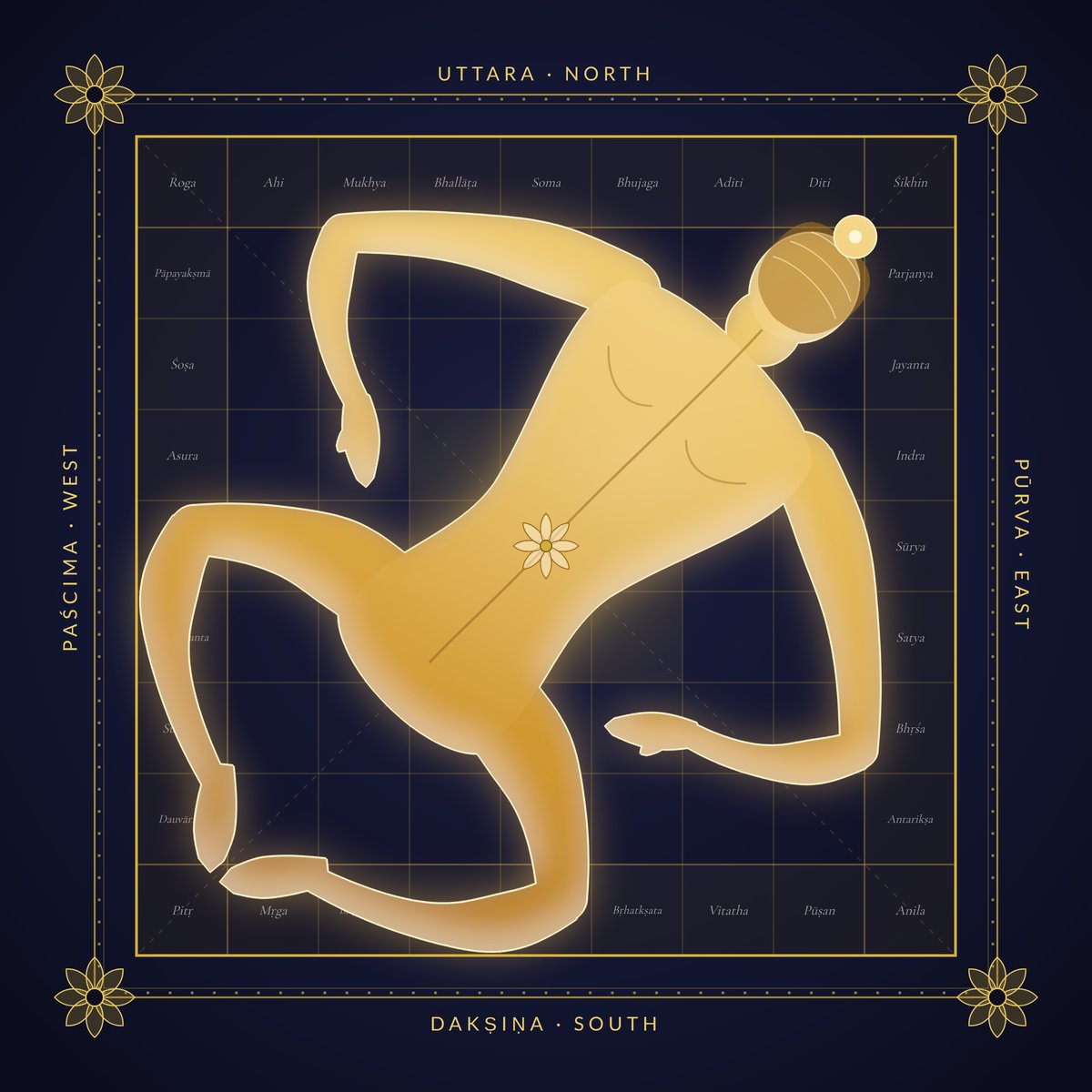
Vāstu Maṇḍala
Lay the vāstu-puruṣa on your own home. Draw Varāhamihira’s maṇḍala over your plot, flat or floor plan; place the door, kitchen, shrine, beds, water and stairs; and see how each one reads in the Bṛhat Saṁhitā — then get a plain list of what to do, and a report to print.
Get access — $12 #vastu #calculator
49


I am excited to share that we are once again making three-metal rings: 24 kt gold, fine silver, and copper woven together and sealed. #Ayurveda #Astrology #jewelry ayurastro.com/store.html
1
53
The Devata Project just had its biggest upgrade since launch, and I want to tell you what actually changed under the hood.
Devata has always drawn its readings from sixteen classical Jyotiṣa texts, with every insight tied to a cited verse. But until this week, the engine could only consult the handful of verses it happened to find by searching for a topic — a few hundred out of a library of more than twenty thousand.
Now every verse of all sixteen texts has been read into the engine, one by one, as a rule it can test against a chart: the condition the verse states, and the result it promises. Bṛhat Parāśara Horā Śāstra, Bṛhat Jātaka, Sārāvalī, Phaladīpikā, Jātaka Pārijāta, Horā Sāra, Bhṛgu Sūtras, Garga Horā, Uttara Kālāmṛta, the Jaimini Sūtras — and then the texts for the year and the question: Tājika Nīlakaṇṭhī, Hāyanaratna, Praśna Mārga, Saptarṣi Nāḍī, Bṛhat Saṃhitā's birth-star chapters, Naṣṭa Jātaka. 20,735 verses and sections. 19,262 rules.
What that means in practice:
- Your chart asks the questions. Instead of searching "career," the engine starts from where YOUR tenth lord has gone, which sign rises, who shares a house — and asks the texts about exactly that, across twelve areas of life. On one test chart the old engine found 12 applicable rules. The new one finds more than five thousand that hold, and ranks the ones most specifically about your placements first.
- Nothing is written that wasn't verified. A verse enters your reading only after the engine has confirmed, step by step, that its condition is met in your chart. When a text asks for something the engine can't compute, it abstains rather than guessing. When a verse is written for a woman's chart or a man's, the reading says so — and if you tell it which, it applies the right ones. (The order form now asks, optionally.)
- The divisional charts, at last. Navāṃśa, drekkāṇa, horā — all sixteen vargas. "The tenth lord in the navāṃśa of Jupiter," "a planet in its own drekkāṇa," vargottama — these were the largest class of rules the engine couldn't express. It can now. Also: the nakṣatra and pañcāṅga of birth (tithi, weekday, nitya yoga, karaṇa), and the degree a planet sits at within its sign.
- The year and the question get their own texts. The annual (Varṣaphala) reading now reads Tājika Nīlakaṇṭhī and Hāyanaratna against your annual chart itself — the Muntha, sixty-three sahamas (forty-six of them taken straight from Balabhadra's formulas), the year-lord, the sixteen Tājika yogas, the mudda daśā with real dates. The horary (Praśna) reading reads Praśna Mārga against the chart of the moment you asked.
- The yogas, named and defined. The thirty-two Nābhasa yogas, the twelve Mālikā garlands, the pravrajya yogas, and dozens more whose definitions the engine learned from the texts themselves.
- Longer readings — about half again as long — because each section now draws on up to eighteen verified rules instead of a dozen, and the appendix lists the verses it was written from.
Devata remains what it has always been: an academic exploration of the classical texts, drawn faithfully from the verses and delivered as a typeset PDF — a companion to a personal consultation, not a substitute for one. What's changed is how much of the tradition it can bring to bear on a single chart, and how carefully it checks each verse before it speaks.
devata.pro
68
