

Call report data made useful.
Joined January 2025
- Tweets486
- Following49
- Followers399
- Likes95







bankviewUSA retweeted
Explore the Basel III endgame comments...
bankviewusa.com/b3eg/index.h…


@BankviewUSA was happy to contribute.
New Bank Regulations Could Favor Loans To Private Credit
@telis nails it here
wsj.com/finance/regulation/n…


bankviewUSA retweeted
$AROW picks up 14.2% of Utica-Rome for 1.4x TCE


Adirondack Bank of Utica, NY to merge into Arrow Financial $AROW (bank B in the $NCXS $BSPA merger)
hovdegroup.com/wp-content/up…
bankviewUSA retweeted
The biggest story in banking rn...
Favorable capital treatment from securitization rules have pushed bank lending into private credit.
#SSFA

A regional bank makes a $100 NDFI loan to a BDC.
The loan is collateralized by $133 of middle-market loans placed in a bankruptcy-remote SPV, and the BDC takes the first loss. The lawyers structure it so it qualifies as a securitization.
Question: How much capital must the bank set aside for this loan?
a) $8 - same as direct loan (100% RW)
b) $12 - slightly riskier (150% RW)
c) $100 - BDCs are super-risky... dollar for dollar (1250% RW)
d) $1.60 - safer because of overcollateralization (20% RW)

bankviewUSA retweeted
Find the loan portfolio of any bank in 45 seconds @BankviewUSA


bankviewUSA retweeted
Looks like Metropolitan Capital was wrestling some bad C&I loans for over a year along with AOCI issues.
Provisions brought total capital sub 8% in 2024, so supervisors should have been watching these guys.


Metropolitan Capital Bank & Trust, Chicago, IL was closed today by @IDFPR, which appointed the FDIC as receiver. First Independence Bank, Detroit, MI will assume substantially all deposits and certain assets of the failed institution.
fdic.gov/news/press-releases…

ALT Blue background with FDIC logo. Text states: "First Independence Bank, Detroit, Michigan assumes all deposits of Metropolitan Capital Bank & Trust, Chicago, Illinois.
bankviewUSA retweeted
For all the bank nerds wondering how private credit issues could affect banks, here's an SSFA model you can play with...
bankviewusa.com/ssfa/
It uses the Simplified Supervisory Formula Approach (SSFA) formula that banks use to lower the risk weight of an underlying pool of loans. Banks can take advantage of the lower risk weights for NDFI and SRT transactions if they structure the loan as an on-BS securitization and keep the more senior tranche(s). The RW calculation is reassessed continuously through the course of the securitization.
Inputs like p-factor and floor are set by the regulators. (B3EG did try to make the p-factor more conservative, but those changes are likely dead at this point.) You'll find the model to be most sensitive to attachment/detachment points and delinquencies (W).
SRTs of 100%RW loans will tend to attach at 12.5% and detach at 100% because it's the widest tranche a bank can have at 20% rw, but W stays near 0% because defaults are reimbursed immediately by investors on the other side.
In the case of NDFI loans, we (including regulators maybe?) just don't have a handle on where avg. attachment points sit or how reliable collateral valuations might be. In other words, we don't know how much cushion banks really have until DQs start pushing SSFA risk weights higher than the 20% floor. (See Chart 2.)
Obviously doesn't settle the private credit question, but it could help frame the discussion better. If you're an expert in the area and think I'm missing something, please comment or DM.
bankviewusa.com/ssfa/


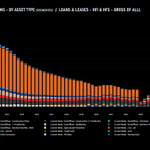
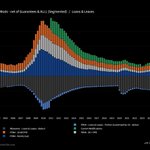
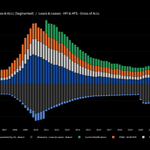
Bank loans ex. NFDI grew slightly in Q3.
Growth was offset by QoQ declines in C&I and non-residential construction & development.

1
2
252