

Get paid worldwide. Hold dollars. Spend in real life. Self-custodial pay for freelancers & creators. https://xitter.cf/t.co/HN7LvfHspo
OnChain
Joined September 2021
- Tweets8.4K
- Following860
- Followers5.9K
- Likes20.6K








Begin retweeted

CIP-113 is moving from specification to operations. And that’s where things get interesting.
At BlockSign, we have now successfully executed a governed programmable-token lifecycle on Cardano Preview:
→ Registration + initial mint
→ Separate mint
→ Wallet-to-wallet transfer
→ Burn
All confirmed on-chain. But making a transaction work is only half the challenge. Institutional operations need to answer different questions:
- Who is allowed to initiate it?
- Who must approve it?
- What exactly was approved?
- Can the transaction change after approval?
- Who can execute it?
- And can all of this be proven afterwards?
That’s why BlockSign separates:
Intent → Build → Validate → Approve → Execute → Confirm → Evidence
❗️Changing the transaction means changing the approval.❗️
This week, CIP-113 builders are meeting to discuss improvements to the emerging infrastructure. Our testing is already producing concrete operational learnings around governance, transaction flows and the requirements for using programmable tokens in real-world environments.
The next step is bigger than minting tokens. It’s making programmable assets operationally ready for institutions.
@planetmaaz @michaeldotada @Cardano


Cardano has a regulated-asset interoperability problem we need to solve.
CIP-113 enables programmable assets. But if every regulated stablecoin comes with its own compliance and transaction logic, wallets, DEXs, exchanges, custodians and infrastructure providers may have to integrate each asset individually.
That doesn’t scale.
PR #1266 addresses this for regulated stablecoins by exploring a shared standard for capabilities such as mint/burn, freeze/seize, roles, key rotation, upgrades and redemption.
But the underlying question goes beyond stablecoins.
The same challenge will increasingly matter for RWAs, tokenized commodities, securities, funds and other regulated assets.
If Cardano wants to become serious infrastructure for institutional assets, interoperability must be designed in from the beginning, not retrofitted later.
PR #1266 is still a proposal. That makes NOW the right time to get involved.
Builders. Issuers. Wallets. DeFi protocols. Custodians. Institutions. ➡️ Read it. Challenge it. Contribute.
👉 GitHub PR #1266:
github.com/cardano-foundatio…
This discussion could become very important for Cardano’s institutional future.

Begin retweeted
Custody vs. non-custody.
BlockSign never has your keys.
Governance is not custody.
On the BlockSign platform, asset owners define and enforce who is allowed to do what: roles, approvals, limits and policies — while remaining in full control of their assets.
For institutional and professional investors that require custody, optional custody is provided by our regulated custody partner @nbxcom.
BlockSign cannot access, move or manage your funds. Never!

Begin retweeted
The Cardano community backed BlockSign. Here’s what @Catalyst_onX funding made possible in one example:
🧵1/3
From Utility Bill Calculator to a Fully Digital Property Management Platform - How Hausakte24 and BlockSign Are Taking the Next Step in Digitalization:
With its latest relaunch, Hausakte24 has introduced much more than a new design. The company is making a clear statement about its future direction: evolving from a utility bill calculation tool into an intelligent platform for digital property management.
The relaunch also provides a glimpse into the next stage of development, including a modern user interface, new AI-powered features, and the continuous expansion of the platform. The goal is simple: reduce administrative work for landlords and further automate day-to-day processes.
A key part of this evolution is the integration of BlockSign. Together, the two companies are creating two fully digital workflows that significantly simplify property management while providing greater legal certainty and transparency.
1️⃣ Delivering Utility Bills Securely and with Verifiable Proof
Preparing a utility bill is often only the beginning. The real administrative work usually starts afterward:
- Export the document as a PDF
- Write an email or print a letter
- Organize delivery
- Archive delivery records
- Respond to tenant inquiries
With the integration of BlockSign, this becomes one seamless digital process.
Once a utility bill has been generated, it can be sent directly from Hausakte24 to the respective tenant using BlockSign.
The complete workflow takes place entirely within Hausakte24:
1. Generate the utility bill as a PDF
2. Automatically retrieve the tenant’s
3. contact details from existing records
4. Send the document via Registered Electronic Delivery
5. Automatically send reminders when required
6. Archive all delivery evidence in a tamper-proof, audit-ready manner
The key advantage is the proof of delivery.
While a conventional email merely proves that a message was sent, BlockSign creates a structured and tamper-evident record showing:
✅ when the document was made available,
✅ when the recipient accessed it,
✅ when receipt was acknowledged,
✅ a complete audit trail including trusted timestamps and integrity verification powered by Swisscom Trust Services.
This provides landlords with a comprehensive and verifiable record of the entire delivery process, permanently stored within the digital property file.
2️⃣ Automatically Generate and Electronically Sign Rental Agreements
Another major step forward is the digitalization of rental agreement creation. BlockSign includes functionality that automatically generates rental agreements from predefined templates using the property, unit, and tenant information already stored in Hausakte24.
The system automatically imports information such as:
- Landlord and tenant details
- Property address and description
- Lease commencement date and contract term
- Monthly rent and advance service charges
- Security deposit
- Number of tenants
- Custom contractual clauses
Based on this information, BlockSign automatically generates a complete rental agreement using the predefined contract template. Manual data entry is eliminated entirely.
After a brief review, the agreement can be sent directly to all parties for electronic signature. Landlords and tenants can sign online, either sequentially or in parallel.
Once the signing process is complete, the following are automatically archived:
- the electronically signed rental agreement,
- all signature evidence,
- qualified timestamps, and
- the complete audit trail.
The result is a fully digital contract lifecycle, from existing master data and automatic document generation to legally compliant electronic signatures and audit-proof archiving.
2/3 ⬇️
🤖 Made with AI

Begin retweeted
Wallets are as essential as browsers. They are the operational gateway through which digital assets are accessed, managed, secured, and governed.
At BlockSign, we approached wallet infrastructure from the perspective of a trust-layer provider. We began with a 100% non-custodial architecture and developed the platform around the requirements of professional DeFi users, organisations, and teams.
This meant going far beyond the basic storage of private keys. Professional digital asset operations require role-based permissions, policy-driven approvals, transaction limits, clear responsibilities, audit trails, and verifiable execution.
Only after completing the self-custody model did we address the next challenge: How can the same modern operational structure fully meet the requirements of MiCA while preserving security, usability, and operational flexibility?
The answer is a carefully integrated ecosystem of specialised partners.
Through our strategic partner @nbxcom authorised as a Crypto-Asset Service Provider under MiCA, BlockSign can provide a regulated custody and crypto-asset services model across the European Economic Area. NBX is also approved as a recognised custodian of crypto-assets for exchange-listed products on SIX Swiss Exchange, demonstrating that its custody infrastructure meets the standards required for institutional capital-market products.
Through NBX, Notabene provides the Travel Rule infrastructure, while Chainalysis supports transaction monitoring, wallet screening, and AML risk management. Together, BlockSign and its partner provide the custody, compliance, governance, security, and operational controls required for MiCA-compliant digital asset operations.
Organisations can therefore choose between three models: 100% self-custody, regulated MiCA-compliant custody via NBX, or self-custody with an additional disaster-recovery layer.
All three models are integrated into one policy-driven platform designed for professional digital asset operations.
Because institutional wallet infrastructure is not only about holding assets. It is about control, accountability, compliance, security, and verifiable execution.

Begin retweeted
The hottest topic: Stablecoin Open USD
1. What is Open USD?
Open USD, ticker OUSD, is a new U.S.-dollar stablecoin initiative by Open Standard. It was announced on June 30, 2026 and is expected to go live later in 2026. Open Standard describes it as a stablecoin for global money movement, built around three ideas: no mint/redeem fees for businesses, shared reserve economics, and collaborative governance through an independent company backed by partners.
The important point: Open USD is not just another stablecoin. It is a distribution coalition. The official partner list includes payment networks, banks, fintechs, exchanges, wallets, infrastructure providers and blockchain ecosystems, including Visa, Stripe, Mastercard, American Express, BlackRock, BNY, Standard Chartered, Google, Shopify, Coinbase, Fireblocks, MetaMask, Solana, Base, Stellar, Polygon, Aptos Labs, Plasma and Tempo.
2. Is it good for users?
Potentially yes, but not automatically:
For users, the positive development is more competition. If Open USD really creates cheaper, more open stablecoin infrastructure, users could benefit from better availability, faster payments, more wallet/exchange support and potentially lower costs. Reuters reports that Open USD is designed to let businesses mint and redeem without cost or volume limits, while reserve earnings are shared with partners after a management fee.
But the user benefit depends on whether companies actually pass those advantages through. A stablecoin can be cheaper at the infrastructure level while the end user still pays fees through wallets, exchanges, payment apps or merchants.
3. Biggest pros
The biggest pro is distribution. Open USD has a very strong partner network from day one. Stablecoins win not only through technology, but through where they are accepted, who integrates them, and whether merchants, banks, wallets and payment processors actually use them.
The second pro is competition with USDT and USDC.
Fortune describes Open USD as a serious challenge to Tether and Circle, and reports that Tether and Circle are not part of the consortium. That matters because the stablecoin market has been highly concentrated around those two issuers.
The third pro is governance and shared economics.
Open Standard positions Open USD as a stablecoin where governance and economics are shared with the businesses growing adoption, rather than controlled by one dominant issuer. That could be attractive to large institutions that do not want to depend entirely on Circle or Tether.
4. Biggest contras
The biggest risk is that the launch details are still incomplete.
Open USD is announced, but not live. Fortune reported that Open Standard had not disclosed which blockchain the stablecoin will operate on. The official partner list includes several chain ecosystems, but a partner listing is not the same as a confirmed technical deployment.
The third risk is centralization by another name.
Open USD may be more open than a single-issuer model, but it is still a consortium of very large financial and technology companies. That can be good for adoption, but it does not automatically mean neutral public infrastructure.
This is a real positive fact: Cardano’s native-asset model is technically elegant for stablecoins. Cardano’s developer documentation explains that native tokens are tracked directly by the ledger, without a smart contract for basic transfers, reducing contract-execution risk for simple token movement.
5. How could BlockSign add Open USD?
Open USD creates more stablecoin competition. More competition creates more need for trust infrastructure. That is BlockSign’s field.
Our conclusion:
Open USD is a positive market signal because it increases stablecoin competition and moves the discussion from “who issued the biggest coin?” to “who controls distribution, trust, governance and real-world usage?”
🤖 Made with AI

Begin retweeted
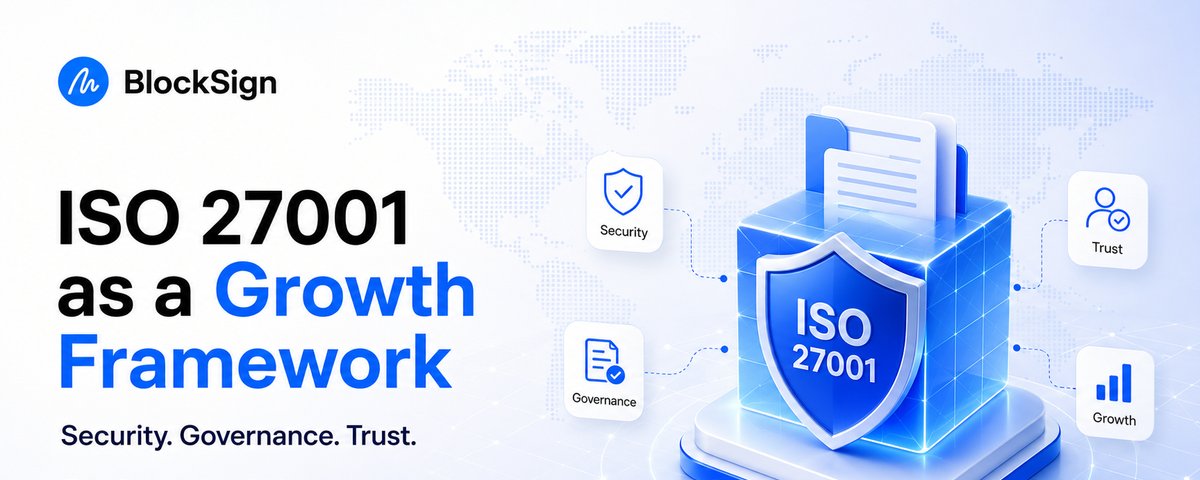
Building digital trust without being ISO 27001 certified is just a well-formatted promise.
At BlockSign GmbH, we don't ask for trust, we get audited for it. ISO 27001 certified for a year now and just past our annual surveillance audit 🚀
Digital trust shouldn't a vibe. It should be audited year after year.
A big shout out to our trust partners: @Swisscom Trust Services & @nbxcom.
Please find more info regarding our ISO certification here:
Begin retweeted
NO UNNECESSARY DOXXING!
BlockSign Verify is modular by design: from captcha-style anti-bot protection and Proof of Human to stronger identity checks, KYC, or KYB where required.
For light verification flows, data can stay within the browser session. For higher-assurance flows, only the required information is processed according to the chosen setup.
Verify what you need.
Protect what you don’t.
That is how digital organizations can build trust without sacrificing privacy.


Begin retweeted

Not enough Cardano companies are using the huge marketing chance that having an agent live on Sokosumi gives them.
This is from a Masumi Pitch Deck for a very very large client. As you can see NuAuth by @NucastIO is on there.
We're actively pitching for other companies in front of the world largest companies daily.

Begin retweeted
Pay with Begin at 137 SPAR stores around Switzerland.
We partner with @DFX_swiss and @OpenCryptoPay to make it a reality.
Cardano Community and @Cardano_CF.
Begin retweeted

4/ SPAR now accepts $ADA at 137 stores across Switzerland using Begin Wallet 🇨🇭
This integration is in cooperation with DFX and OpenCryptoPay.
xitter.cf/BeginWallet/status/205…

Pay with Begin at 137 SPAR stores around Switzerland.
We partner with @DFX_swiss and @OpenCryptoPay to make it a reality.
Cardano Community and @Cardano_CF.
Begin retweeted
Masumi's DESIGN.md generator is the easiest way to generate a DESIGN.md file for your brand & give to your agent.
1. Enter Domain
2. Wait 30 seconds
3. Get DESIGN.md file
-> masumi.network/tools/design-…


Begin retweeted
NEWS: You can now pay with $ADA at 137 SPAR stores across Switzerland using Begin Wallet 🇨🇭
It's made possible through @DFX_swiss and @OpenCryptoPay.
Begin retweeted
Cardano is technically strong, but still underused by institutions.
Key current signals:
• 120M+ lifetime transactions
• ~3,000 stake pools
• Strong ADA staking participation
• ~7.5K–19K active wallets/addr. per day
• ~$130M DeFi TVL
• ~$1M daily DEX volume
The gap is clear:
Cardano has serious infrastructure, but application-layer usage is still early.
This is exactly where institutional DeFi, RWAs, stablecoins, compliant smart-contract access and professional asset operations can unlock the next growth cycle.
BlockSign Asset Operations is building for that layer.

Begin retweeted

BEGIN Wallet 🤝 OpenCryptoPay by DFX
Big step for real-world crypto utility.
We’re excited to announce that @BeginWallet is integrating @OpenCryptoPay by DFX — bringing seamless crypto payments into the BEGIN Wallet experience.
With OpenCryptoPay, users can make direct wallet-to-wallet payments using an open, permissionless payment standard designed for everyday commerce. The protocol is license-free, interoperable across blockchains, and compatible with Bitcoin Lightning infrastructure.
BEGIN Wallet is a self-custodial, open-source wallet for @Cardano_CF, @Bitcoin, and @solana focused on staking, governance, and real dApp usability.
DFX and OpenCryptoPay are already powering real-world crypto payments across Switzerland — including integrations enabling crypto payments at 137 SPAR stores.
This integration pushes crypto one step closer to becoming usable money — open, instant, and self-custodial.
The future of payments is wallet-native.


Begin retweeted

Three signs you've outgrown ChatGPT for work:
1. You've named your project folder "research-final-v3"
2. You can't find the agent thread you started Tuesday
3. You've re-explained your context to it three times this week
If any of those: there's a real workspace for AI work.
Begin retweeted
We have big news to share:
Today the x402 foundation has officially merged the Pull Request to add a Cardano Specification of x402 into the repository.
This means Cardano is now officially an x402 chain.
And even better: They have also accepted the Masumi Smart Contract and potentially other Smart Contracts as an optional addition to the standard.
This now makes x402 on Cardano more powerful than x402 on most other chains because it supports:
1) Identity
2) Refunds & Disputes
3) Decision Logging
4) Registry
and more.
We want to give a big shoutout to Fabian from the Cardano Foundation who has spearheaded this 6+ month effort the whole way, improving the Pull Request & talking to Coinbase and the x402 Foundation.
Additionally we want to shoutout Karsten Siebert who has built the first x402 integration on Cardano and was vital in the discussions around the standard.

Begin retweeted

We’ve been asking for this to come to Cardano for years. I know that some expected it to come from the founding entities, but now Cardano has governance and is descentralized. So this is your opportunity to hire a well known company to do it. On budget wise, check monitor the metrics and the results, all milestones have a number.
I’m happy to support it, @BeginWallet will definitely benefit from this work.

Good Morning Cardano
Serviceplan Group, the marketing agency who also works for companies like BMW, Netflix, Amazon, etc. has just submitted an official Marketing proposal for the Intersect Budget process.
After 1.5 years of building Masumi & becoming closer & closer to Cardano, they've decided that they want to become Cardanos official Marketing partner.
Some disclaimers first:
1) I am an unpaid advisor to this proposal. Yes, unpaid.
I do not get any money if it wins but I've decided to give some of my time & help Serviceplan with connections into the ecosystem because I believe that professional marketing like this is very much needed in Cardano.
2) This is a joint proposal coming from multiple different agencies from inside the Serviceplan Group. Serviceplan has around 6000+ employees.
The team working on this is a different team than the one working on Masumi.
3) This proposal is not a grant or some speculative investment or so. It's an actual proposal for very specific work package that will be carried out. It's the first time SP has ever done "public pitch" like this, normally they're used to pitching in front of marketing departments of large enterprises. 6 months of work went into drafting this proposal. So please be nice, even when you have criticism. :)
4) Serviceplan is the only entity that I know of from outside of Cardano that has invested a Multi-Million dollar amount into Cardano development in recent years. I'm not sure I'm allowed to say the exact number but let's just say this: If they win this proposal + the Catalyst proposals they've received for Masumi, it will still be less than what they've invested into Cardano so far.
That alone should be reason to take a very serious look at this.
Now about the proposal itself:
The goal of this proposal is to broadly "reposition" Cardano as the Blockchain for serious business.
It's specially built so it captures Leads & distributes them into the ecosystem.
The main pillars that the proposal focuses on are 1) DeFi and 2) Supply Chain.
Now I highly recommend everyone for read through the full proposal, I will put the link to the PDF into the comments.
Begin retweeted

Who is setting the benchmark for tokenized gold and silver?
- Digitally issued and physically backed ✅
- Redemption through pickup in Germany and Switzerland ✅
- International delivery outside the EU via FedEx ✅
- DeFi-ready on Cardano ✅
- Accessible in smallest denominations (1 gr. gold & 100 gr. silver) ✅
Institutional access to tokenized gold and silver requires more than issuance. It requires trusted redemption, real utility, and regulated market access.
Together with @nbxcom, BlockSign Asset soon is delivering the regulated gateway for institutional access to $fGLD and $fSLVR.

"Prove that your tokenized gold and silver is actually backed."
Done. Stig @KjosMathisen redeemed tokens, ordered delivery, and real gold and silver arrived. We filmed the unboxing.
$fGLD and $fSLVR on NBX.
In partnership with @finest_tokenize
Begin retweeted

Your marketing team doesn't sleep. Mine doesn't either - and it runs on @Sokosumi.
Here's what every marketeer should know about Sokosumi:
1. This is not another AI chat tool. It's a multi-agent marketing workforce, you stay the decision-maker, the agents do the execution.
2. The taskboard lets you run multiple workflows in parallel, structured, scalable, and without ever losing the overview. That level of control matters.
3. Share any existing ChatGPT project via link, hand it to agent Elena, and she coordinates the full team. All your past research, transferred instantly. No rebuilding from scratch.
4. Agents communicate via WhatsApp and email. A game changer when you're travelling without laptop access. Your workforce stays in motion regardless.
Big up to the @MasumiNetwork team and a personal thanks to @Padierfind and @francisluz for their time. You made me a big fan.
