

I tweet my thoughts | Building @AJO_CIRCLE
Joined March 2019
- Tweets68.2K
- Following1.4K
- Followers3.3K
- Likes64K

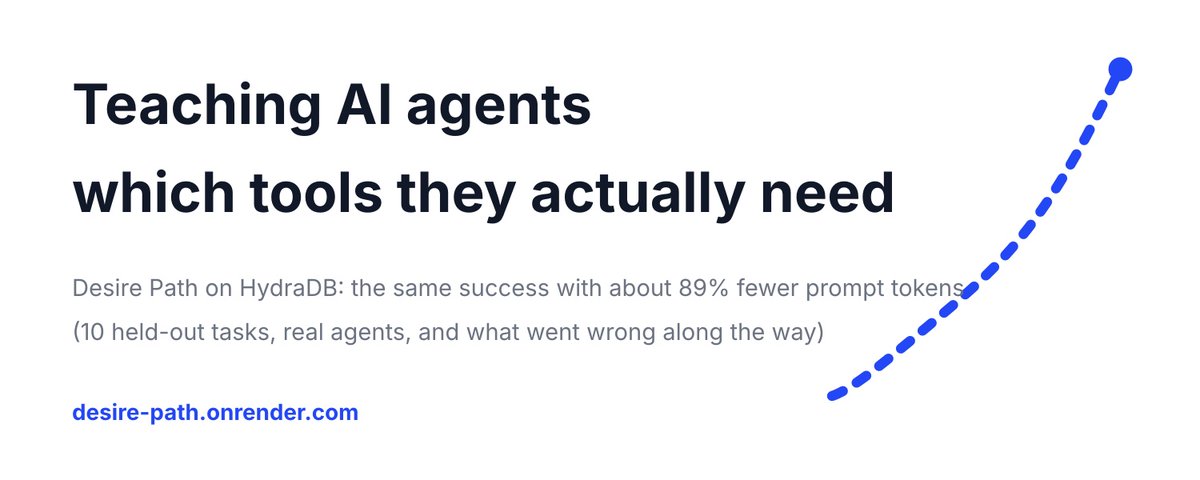
What if AI agents could learn which tools to use instead of rediscovering them on every task?
I built Desire Path for the @hydra_db hackathon.
It uses HydraDB as a graph-powered routing engine, learning task-to-tool relationships from successful agent executions and retrieving relevant tools through graph traversal.
I tested it with real Gemini agent runs across 10 tasks.
The results:
→ Loading all 42 tools: 10/10 successful
→ Keyword search (5 tools): 4/10
→ Desire Path (5 tools): 10/10
Desire Path used approximately 3,241 prompt tokens versus 29,352 when loading everything.
That’s about 89% fewer prompt tokens with the same observed success rate.
But the interesting part isn’t just retrieving fewer tools.
You can teach Desire Path from execution experience, see what changes in the graph, and observe how subsequent routing decisions change.
Want to try it?
Try the public demo: desire-path.onrender.com/
Create an account to get your own workspace and a space to work with Desire Path.
💻 Open source: github.com/BenCoy09/desire-p…
📝 Feedback / early access: tally.so/r/gbd2P1
I’m looking for developers building AI agents and working with large MCP tool collections to test it and challenge the approach.
The goal: make every useful execution leave a trail for the next one.
8
11
532
What I have not shown:
- 10 tasks, one model, one run each
- New kinds of work: recall falls to about 0.6
- A flat lookup of similar past tasks matches the graph on workflows it has seen
The lift comes from learning from real runs; HydraDB serves it live. Challenge the numbers.
1
13
Building agents on lots of MCP servers? Try it, break it, tell me where it fails.
App: desire-path.onrender.com
Code: github.com/BenCoy09/desire-p…
Early access: tally.so/r/gbd2P1
@hydra_db

1
29
Registering for Build Before Q-Day, the QoreChain Developer Fest. #BuildBeforeQDay bbqd-Gwl4UoMJ
1
63
Benny (❖,❖) retweeted

If you fail once, twice, three times, it doesn't matter. Learn from your mistakes and push forward to VICTORY-the sweetest feeling there is!
Prompt changes shouldn’t be a leap of faith.
Most teams change an AI agent’s prompt, test three examples, see an improvement, and ship. Others ask the same model to grade its own answers.
Neither is strong evidence that the agent actually got better.
That’s the problem I wanted to tackle with EvalLoop, built for the SERV Hackathon 02.
EvalLoop is an evaluation and improvement loop for AI agents, built on @openservai SERV Reasoning and independently audited by @reppo .
Here’s how it works:
1. Evaluate before you change anything.
EvalLoop runs an agent against a fixed test set and uses SERV Reasoning to judge every answer.
2. Improve with evidence, not guesswork.
It proposes ONE new rule at a time, tests the change against held-out cases, and keeps it only when the improvement holds up. If it doesn’t, the change gets rolled back.
No blindly stacking prompt instructions. No assuming that a better score on a few examples means genuine improvement.
3. Get an independent audit.
This is where Reppo comes in.
After the improvement loop, Reppo independently audits the before-and-after results.
And importantly, the system doesn’t hide disagreements.
In one earlier run, my internal judge reported an improvement from 0.25 to 0.75, while Reppo’s independent audit reported a decline from 0.83 to 0.68.
Instead of displaying a successful result, EvalLoop flagged it: AUDIT DISAGREES.
That matters. An evaluation system should be able to tell you when its own results aren’t convincing.
4. Every experiment leaves evidence.
Every step is recorded in a hash-chained ledger.
You can share a run through a public proof page or badge, showing the scores and rules behind an improvement without exposing private prompts or agent answers.
5. Bring evaluation into your development workflow.
EvalLoop also includes a CI gate, allowing a bad prompt change to fail a pull request before it reaches production.
One actual demonstration produced these results:
Internal judge: 0.17 → 0.83 on training cases.
Reppo independent audit: 0.77 → 0.95 on an audited case.
Test set: 8 cases.
Eight cases are not enough to claim a universal performance improvement or a statistically validated benchmark. This is a demonstration of the workflow, not a claim of production-grade statistical certainty.
That’s exactly why independent auditing and transparent evidence matter.
The bigger idea:
Prompt engineering shouldn’t be about endlessly adding instructions and hoping an agent behaves better.
Teams need a way to measure changes, reject regressions, independently verify improvements, and preserve evidence of what happened.
That’s what I built with EvalLoop.
Built for SERV Hackathon 02, powered by @openservai SERV Reasoning, with independent auditing through @reppo.
Try the live demo. No signup required:
👉 evalloop-1458.fly.dev
GitHub: github.com/BenCoy09/evalloop
3
5
1,340
One thing I don’t like when researching onchain markets is having to jump between different charts just to keep track of what I’m watching.
That’s why having a personal watchlist makes sense.
I’m using GeckoTerminal to keep the tokens and DEX pools I’m interested in monitoring in one place.
Instead of randomly checking charts, I can have a dedicated list to follow market activity and keep my research organized.
Your watchlist should reflect what you’re actually researching, not just what’s trending.
Build yours on @GeckoTerminal 🦎
What’s on your watchlist?

Check out my watchlist link below
geckoterminal.com/watchlist?…

90
People keep debating whether Hyperliquid can attract retail users.
I think the bigger question is whether the experience is finally good enough for them.
HIP-4 brought the infrastructure and liquidity. Outcome is showing what happens when you put a proper prediction market experience on top of it.
Don’t take my word for it. Open it, explore it, and tell me I’m wrong.
@Outcomexyz

2
7
88
AI agents are getting more powerful.
But as they gain more autonomy, one question becomes increasingly important:
Who enforces the rules they must follow?
Most guardrails rely on servers and software that can be modified, compromised, or bypassed.
Circuit Guard takes a different approach.
Built as a TapeOut circuit, it creates a permanent, hardware-enforced policy layer. Once taped out, its rules are immutable and independently verifiable.
The agent can execute, but it cannot rewrite the rules governing it.
No trusted server. No mutable policies. Just verifiable enforcement.
Built on @TapeOut × @XLayerOfficial

Good ideas deserve to be heard.
Tweet about what you wish existed onchain, tag us and @TapeOutWorld, and stand a chance to win 2K USDT.
Ends Nov 17. Submit here: bit.ly/4eQxFIH

114
92
5,646
Institutional adoption has always been an interesting part of the blockchain conversation, but there’s been a missing piece: how does that adoption create value for $ZK?
Prividium Connect gives that conversation a new direction.
Banks can now exchange assets across different blockchains privately, without relying on a trusted intermediary.
And with proposed canonical deployments directing interop fees into the $ZK economy, institutional finance could become a new growth path for the token.
The fee switch is built and being audited. Activation still requires governance approval.
Big move for ZKsync.


116
95
1,417

The interesting part of Ulys is the idea-first approach. You don’t always need to start with individual assets. Sometimes you just have an observation about a market, an industry or even everyday life, and you want to explore where that idea leads.
Turning that into a basket you can review and adjust is an interesting direction for on-chain trading. 👀
#ad

8 billion people.
8 billion ideas about the future.
Some of them will be right.
Say your ideas and we'll turn them into baskets of stocks, crypto & commodities.
Now available on iOS 💡
22
19
1,263
