

mathematics Thief & Chef "through the window of differential equations, mathematics sees the light in the real world" / "通过微分方程的窗子,数学家看到现实世界的光" (Jiang Zehan)
Seattle
Joined June 2008
- Tweets14.9K
- Following646
- Followers4.4K
- Likes6.7K







Pinned Tweet
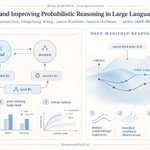
“This Is Not How Mathematicians Are Trained”
数学家不是这样训练的
1, "Solving the forward problem (positive time) and the inverse problem (negative time) together has always been a desire of mathematicians, but they’ve never known where to begin. Neural networks, however, tackle this problem naturally" (将正时间的正问题与负时间的反问题同时求解,一直是数学家的梦想,但他们始终不知道从何入手。而神经网络却能自然地处理这个问题)
2. “Variables, coefficients, even coordinates, are changing. Everything is in flux. This is not how mathematicians are trained. It would be impossible for mathematicians to come up with such a design” (变量、系数,甚至坐标都在变化,一切都处于变动之中。数学家不是这样的训练。这样的设计,不可能出自数学家之手)
3. “Mathematicians tread carefully around composite functions with more than two layers, wary of the many pitfalls, yet neural networks solve them effortlessly, almost nonchalantly.” (数学家在处理超过两层的复合函数时格外谨慎,警惕其中诸多陷阱, 而神经网络却几乎漫不经心地轻松应对)
4. “Neural networks have stacked covers, mathematically speaking, whereas the Numerical Manifold Method typically uses only 3 to 4. In contrast, neural networks stack hundreds or even thousands of such covers. I never imagined anyone would take it that far”. (神经网络在数学上拥有堆叠的覆盖层,而数值流形通常只有三到四层覆盖。相比之下,神经网络则堆叠了上百乃至上千层。我从未想过有人会将其推进到这种程度).
That was what Gen-Hua Shi (石根华) told me after returning from a two-week vacation in early June 2024..
see rest of the story, click the link
open.substack.com/pub/deepma…


#DeepManifoldInterpretation
We need more such papers and research on blue-collar AI for the enterprise, with high precision, like accuracy over 98%.


📢 Introducing WorkForge: a scalable framework that constructs verifiable training environments for long-horizon work agents from real-world resources.
Starting from expert workflows, it builds authentic workspaces, extracts checkable facts, and derives tasks plus dual (programmatic + semantic) verifiers grounded in observable evidence.
🚀 We scale to 16.7K environments across 40 professional domains covering 60 file types, enabling consistent gains on long-horizon work benchmarks as data volume and interaction horizon increase.
📚Paper: arxiv.org/pdf/2610.04906 @zhang_leo54389 @ZoeyyyZhououou @Be1ong1
#Tencent Hy#AIAgents #WorkAgents #AgentTraining


Theory-of-mind lets agents coordinate by modeling others’ thoughts/beliefs, but requires the agent to hold many hypotheses at once. ToM2Vec teaches agents to produce continuous ToM thought vectors which capture multiple hypotheses, improving across 5 multi-agent tasks and transferring to unseen partners, including frontier-model partners.
LLM agents often focus on their own plans without accounting for their partners’ next steps, leading to redundant or conflicting actions. ToM2Vec addresses this by improving agents’ theories-of-mind, training agents to predict a continuous, abstract representation of a partner’s reasoning. These continuous ToM tokens then guide the agent’s own reasoning and actions.
At test-time, the main agent generates a series of latent thought vectors representing its estimate of another agent’s reasoning/thoughts.
ToM2Vec improves coordination without any task rewards, across cooperative, competitive, and mixed-motive settings, including Overcooked, negotiation, Decrypto, Hanabi, and Collab Escape/Capture.
Crucially, agents trained with ToM2Vec generalize to unseen partner model families, including GPT-5.4 and Gemma-4.
🧵👇


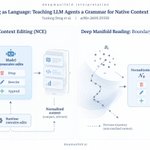
Can LLMs manage their own context natively without any external harness? We are teaching LLMs the ability of Native Context Editing. Our method achieves considerable performance gain on popular long-horizon agentic benchmarks (Terminal-Bench, SWE-bench) while reducing token usage significantly.
🤔 This can be viewed as a form of verbalized context management, which leverages LLMs' inherent capabilities to optimize context. Our prior work, Verbalized Machine Learning (arxiv.org/abs/2406.04344), similarly explores context optimization to enhance downstream task performance.
Project: dengyl20.github.io/native-co…
Paper: arxiv.org/pdf/2610.25550
Code: github.com/dengyl20/native-c…

#DeepManifoldInterpretation
An agent navigates the landscape of the neural fixed-point field. Its trajectory is an iterated integral process, guided by the boundary conditions imposed by the harness.
** Neural Fixed-Point Field **
xitter.cf/BetaTomorrow/status/20…
@jackyk02, @Mao_Yuzhen, @talaei_shayan, @Azaliamirh
🤖 Made with AI


We used an agent to help train a stronger successor. Then we used that successor to help train the next.
Our new paper, Terminal-RSI, studies this recursive self-improvement loop: learn from verified successes, improve through practice, and repeat.
Across two cycles, a 27B model’s Terminal-Bench 2.1 success rises from 51.7% to 86.5%, and Terminal-Bench 4.0 success rises from 0.0% to 19.8%, a new SOTA.
We’re interested in how far this kind of hill climbing can go, and what makes it stall.
Paper: arxiv.org/abs/2610.22192


How can LLMs learn new skills from offline data without losing what they already know?
Introducing Subspace Tuning (SST): a simple approach that improves the learning–forgetting trade-off by controlling where weight updates happen.
Paper: arxiv.org/abs/2610.22293
Blog: app.notion.com/p/ac-notes/To…
🧵 1/8


Build specialized harnesses, folks.
This is a banger paper from Google Cloud AI Research on self-evolving agent harnesses.
(bookmark it)
They introduce OO-Harness, which raises AutomationBench from 61.6% to 77.4% with the same Gemini 3.5 Flash executor.
It also beats Meta-Harness on all three benchmarks they test.
More details below.
Instead of evolving one global harness for every task, an evolution agent builds a class hierarchy of specialized harnesses from execution records.
The design has three parts.
> Subclasses inherit the base harness and override only the methods a task cluster needs
> Design lessons record which changes helped and which ones failed
> A router reads the task and the base run, then picks a subclass or keeps the base result
On Workspace-Bench, the score goes from 25.5% to 39.5%, and on Toolathlon-GYM strict pass goes from 31.2% to 37.5%. Spending extra inference on best-of-K sampling or self-refinement does not reliably help.
Inheritance also improves results. On Workspace-Bench, harnesses built as subclasses score 4.96 points higher than the same evolved code copied into flat classes.
arxiv.org/abs/2610.28380
Chat with Paper: academy.dair.ai/papers/objec…


Solid mathematical ideas almost always outperform contrived engineering tricks.
For years deep learning has been dominated by increasingly complex architectural hacks: CNN blocks, attention layers, channel mixers, residual pathways, normalization stacks.
Every few years a new architecture is announced as if it were a revolution.
One of the most famous examples was Kaiming He and Residual Networks (ResNet). At the time he was paraded around the AI world like a celebrity because residual connections supposedly “solved” deep learning.
But these were largely engineering patches.
Now something much more interesting appeared.
A new architecture called CliffordNet returns to mathematics — specifically Clifford Algebra, developed in the 19th century by William Kingdon Clifford.
Instead of stacking arbitrary modules, the model is built around the geometric product
uv = u·v + u∧v
A single algebraic operation that simultaneously captures inner product structure and geometric interactions.
In other words: the math already contains the interaction mechanism.
No attention blocks.
No mixer layers.
No architectural spaghetti.
The result:
• 77.82% accuracy on CIFAR-100 with only 1.4M parameters
• roughly 8× fewer parameters than ResNet-18
And with strict O(N) complexity.
The paper even suggests that once geometric interactions are modeled correctly, feed-forward networks become largely redundant.
A good reminder for the AI community.
Engineering tricks can dominate for years.
But eventually mathematics shows up and deletes half the architecture.
Paper:
arxiv.org/pdf/2601.06793?utm…
19th century geometry just walked into computer vision.


1/8 New paper with Ivan Ilin: "Local Work, Global Progress: A Convergence Theory of AI Agent Collaboration".
We all know that teams of LLM agents can tackle big tasks. However, their collaboration protocols lack guarantees. We model collaboration as block optimization and, under suitable assumptions, prove convergence.
arxiv.org/abs/2610.28286

#DeepManifoldInterpretation
Misalignment is a model or computational error, and its root causes are inherited by design, mathematically:
1. Inverse learning
2. Propertyless and full-rank relational structure
3. Data complexity and numerical approximation
The difficulty is that these are also what make AI extraordinarily powerful.
We therefore face a double-edged problem: the mathematical sources of capability are also inherited sources of misalignment.


Our new paper led by Ida Mattsson on the game-theoretic limits that an assistant faces when trying to be both helpful and not harmful, when it doesn't know who it is talking to.
arxiv.org/abs/2610.27373


An immediate benefit of context isolation: each agent uses a small local context, while the full trajectory can be much longer. This enables long-horizon reasoning beyond a single context window.
See our earlier paper:
arxiv.org/abs/2603.02112
🧵3/18

Harnesses let agents work together on a task, each in its own context.
Beyond context limits, what does this way of organizing agents change about learning?
Our new paper shows how it can help models generalize out of domain.
🧵1/18
arxiv.org/abs/2609.20831


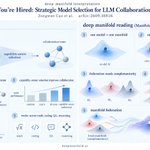
What should a student ask to learn the most from its teacher?
We train a model to ask better questions—without reference answers, correctness rewards, or per-question student updates.
Meet Ask-to-Distill (A2D). 👇
arxiv.org/abs/2610.27450


SAEs have become the dominant approach in mechanistic interpretability. But what if a good old statistical method from decades ago could do just as well, at a fraction of the cost?
In our latest work, we revisited Independent Component Analysis (ICA) and discovered something surprising: a bug in the evaluation code of an influential early SAE paper had significantly underestimated ICA's interpretability! After correcting it, we found ICA to be remarkably competitive with SAEs.
Many of my academic friends from the good old days probably remember me as the tensor decomposition and spectral methods person. So this feels a little like going back to my roots. :) Sometimes, old mathematical tools still have surprises in store!
But there's another motivation behind this work that I care about even more.
I've always wished mechanistic interpretability could be more actionable. Understanding what happens inside a neural network is fascinating, but what comes next? Can we use that understanding to actually intervene, steer behavior, and improve the model?
With ICA Lens, we take steps in that direction, from discovering and annotating interpretable features to using them to understand new hidden states and steer model behavior.
Interpretability shouldn't end with understanding. It should empower us to act.
And we'd love for the community to try it! ICA Lens is open-source, lightweight, and requires no training of another sparse dictionary.
🌹 Try it yourself:
pip install icalens
pypi.org/project/icalens/
Curious to hear what the mechanistic interpretability community thinks!


Is this machine playing? 🏀🪁🛝
We left Eko, an embodied coding agent, on an island for 30 hours with no task or goal, studying it like ethologists study a new species
Eko explored, built, climbed, made games, and learned completely new techniques (1/9)
machineplaying.org


Thanks @dair_ai for sharing our work! Check out our thread for more details: xitter.cf/weizhepei/status/21122…