

Ancient Egypt through original museum photography, remarkable artifacts, hidden details, and archaeological discoveries. Based in Cairo, Egypt.
Cairo, Egypt
Joined June 2026
- Tweets179
- Following1
- Followers79
- Likes105
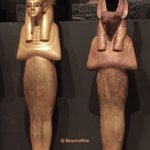




Why did Anubis appear in both the preparation of the dead and the judgment of their fate in the afterlife?

Ancient Egyptians actually grew barley inside the shape of a dead god.
Found in Tutankhamun's tomb, this Osiris Bed was filled with Nile mud and seeds that were watered until they sprouted.
A remarkable ritual that made the idea of rebirth visible.
1
7
173
Why were birds carved on the back of Tutankhamun's golden throne?
In ancient Egyptian art, marsh landscapes could evoke creation, fertility, and renewal.
What looks like decoration may carry a much deeper meaning.
Gold wasn't the only thing that survived inside Tutankhamun's tomb.
These funerary bouquets were found near the entrance to his burial chamber.
Even the flowers left a trace.
Two statues stood face to face outside Tutankhamun's sealed burial chamber.
One inscription wished the king eternal life, renewed every day like the sun god Re.

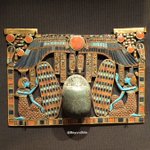
The most powerful detail isn't the gold.
It's the scarab.
At the center of Tutankhamun's pectoral, it symbolizes rebirth, flanked by Isis and Nephthys.
A piece of jewelry carrying the hope of life after death.

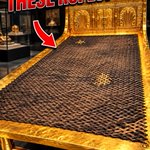
Gold on the outside. Woven linen underneath.
Tutankhamun's royal bed used an intricate network of cords to support the sleeper, rather than a solid wooden platform.
A remarkable detail of ancient Egyptian furniture design.
Photographed at the Grand Egyptian Museum.
Look at the claws.
This gold pectoral was found on Tutankhamun's mummy. The vulture goddess Nekhbet holds two shen symbols of eternity and protection.
Even the claws carried a message.

This tiny blue faience cup was found in 1906, sixteen years before Tutankhamun's tomb.
It carried the king's name and became an early clue in the search.
Theodore Davis thought the tomb had already been found. Howard Carter disagreed.
Tutankhamun had a chair that promised millions of years.
Carved into its back is Heh, the Egyptian god associated with eternity, holding symbols of endless time.
Even royal furniture carried a message about immortality.

1
5
81
These black marks helped guide the assembly of Tutankhamun's golden burial shrines.
Howard Carter believed their orientation contradicted the markings.
A construction mistake, or something more complicated?
1
1
68