

State policy nerd @MultiStateAssoc. AI policy at https://teapaw.org/t.co/5CGyz0zJaO and elections at https://teapaw.org/t.co/WxzDZXeUZw. Views are mine.
Washington, DC
Joined February 2011
- Tweets5.7K
- Following676
- Followers544
- Likes225






Bill Kramer retweeted

There are now 24 states that have comprehensive consumer privacy laws. I wrote about the big trends we saw from states with privacy legislation in 2026: multistate.us/insider/2026/1…

Bill Kramer retweeted

CRYSTAL BALL: 4 rating changes today in statewide contests, with the most significant being that both the AK Senate & Gov. races move from Toss-up to Leans D.
SC Senate moves from Safe R to Likely R, while OR Gov. moves from Likely D to Leans D.
centerforpolitics.org/crysta…


Bill Kramer retweeted

Lots of fascinating stuff on statewide ballots this year, @loujacobson runs through the highlights

NEW @LarrySabato's Crystal Ball -- @loujacobson with his annual tour of this year's ballot issues, including the wealth tax fight in CA, redistricting in MD/MO, and a ton more: centerforpolitics.org/crysta…
Requiring third party safety checks for AI developer has been debated for years but is now center stage after 2026 laws in Illinois and California along with the labs themselves recently asking for such measures.

Here, I walk through the history and the current debate for third party AI auditing: mailchi.mp/ccac29b727ee/vol-…
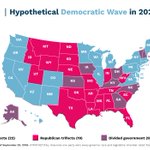
Electoral hypothetical: Let's say that Democrats have a "wave" election in 2026. Assuming they win every competitive governor race and state leg chamber, Democrats could potentially gain 6 new trifectas in 2027 with a map like this:

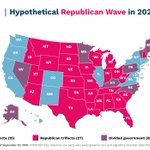
Of course, if the polls are way off base and Republicans actually have a great election, the state trifecta map could look like this in 2027:

Bill Kramer retweeted
CRYSTAL BALL: As the environment remains tough for Republicans, 11 House races shift to Dems. Notably, the 3 competitive R-held seats in VA each shift a column leftward.
In NE & VT, Govs. Pillen (R) & Scott (R) both go from Safe R to Likely R.
centerforpolitics.org/crysta…


Bill Kramer retweeted

This was the expected outcome, given the terrible luck Anthropic had with the panel draw. Anthropic seems to be doing fine despite the SCR designation (although they've certainly lost some business from government and defense contractor clients) so it remains to be seen whether they'll appeal.
I would expect Anthropic to win before an en banc DC Circuit and likely even before SCOTUS, but they're not guaranteed any appeal at all.

JUST IN: D.C. Circuit upholds the Trump administraiton's decision to ice out Anthropic/Claude, finding the government's claim of security risks to have "ample support." documentcloud.org/documents/…


Bill Kramer retweeted

Can Democrats win a trifecta in Pennsylvania?
They need to flip 3 GOP-held seats total, and basically have 4 targets to do that. New polls show them in contention in 2 of those 4. (The other two are Trump +5-6, so within the range of these.)

🚨NEW PENNSYLVANIA LEGE POLLS🚨
SD-16 (Trump +9) | 🔵DEM +1 (FLIP)
SD-24 (Trump +2) | 🔵DEM +2 (FLIP)
HD-131 (Trump +10) | 🟡Tie
HD-143 (Trump +6) | 🔵DEM +5 (FLIP)
HD-147 (Trump +10) | 🔴GOP +1
HD-187 (Trump +9) | 🔵DEM +3 (FLIP)
articles.statenavigate.com/p…

Bill Kramer retweeted

We need to be precise in discussing RSI.
A lot of recent takes make it sound like automation of AI R&D inevitably leads to RSI, and fast! But that’s only true if automated improvements accelerate subsequent research + obviate other limits (like limited compute).
If the returns diminish too quickly, we could hit a ceiling—or, at the very least, a plateau for a period of time (maybe even a long period of time). It only become recursive if the feedback loop is strong enough.
Even if we get RSI, that doesn’t necessarily cause transformational takeoff. For that to be the case, RSI would need to solve many other bottlenecks, including in robotics and physical manufacturing. That seems possible, but far from guaranteed.
None of this gives me comfort in hearing vague company promises that “fully autonomous RSI is not happening today, and we should not pursue it unless and until it can be done safely.”
There’s a real chance we get RSI and transformative change, and we don’t want to be caught flat-footed in that world. The incentives to pursue RSI are overwhelmingly strong and perverse. And we can’t blindly trust companies to be angels and hope for the best.
But we should also be clear-eyed about the many other assumptions of RSI. I think a lot of smart people are already factoring this in, but it’s getting lost online. I worry people new to this discourse will sense the unspoken assumptions and take this whole conversation less seriously, or will look back at this moment and say “you sure sounded confident this was going to happen right away, but it didn’t.”

I appreciate Anthropic’s transparency in sharing this chart but unsurprisingly it has led to speculative interpretations about intelligence explosion and superintelligence. I don’t think the chart implies we’re anywhere close to either.
In short, task delegation ≠ task automation ≠ process automation ≠ faster progress ≠ recursive self-improvement ≠ intelligence explosion.
Source: anthropic.com/institute/meas…
1) The software engineering precedent: a year ago there were widespread hopes / fears that once AI can write ~100% of the code, software engineering output would explode (SaaSpocalypse! Everyone would create their own SaaS and dump their vendors) and that this would make software engineers obsolete. Since then, many companies and teams have basically hit that milestone, but neither of the assumptions proved true. Turns out we still need humans, and while shipping velocity has increased moderately, improvements in terms of actual outcomes for software users remain unclear. Besides, we’re still getting a better grasp on the negatives: code quality, long-term maintainability issues, and burnout. While the precedent is no guarantee, this should be our default expectation for what happens as the “Automation Level 4” line trends towards 100% — it won’t be a phase change. normaltech.ai/p/why-ai-hasnt…
2) The “production-progress paradox” is the fact that individual researchers’ productivity has been increasing while the rate of collective scientific progress has been slowing by most measures. AI exacerbates this because everyone uses the same or similar AI models, and ideas become homogenous over time. I suspect it’s too early to tell if this is going to bite companies that are plunging into AI-led research. normaltech.ai/p/could-ai-slo…
Note: our own research on AI agents doing open-ended research shows limitations in creativity, judgment, and other areas. cruxevals.com/crux/can-ai-ag…. But it is possible that these could be overcome in the near future, so I’m discounting those limitations here. The production-progress paradox is a deeper issue that’s not AI-specific, though particularly applicable to AI-driven research. It’s about the fact that productivity increases are self-evident but true progress is not measurable as it happens (and only becomes clear in retrospect), so we end up optimizing for the wrong thing.
3) Let’s talk about automation level 5, which is still at 0% in Anthropic’s graph. It’s a bit unclear what Level 5 would look like, but it seems to be about full autonomy at the task level, and not the “AI builds its own successor” vision. My prediction for a while has been that even 100% task automation in most cognitive jobs won’t lead to any kind of discontinuity. youtube.com/watch?v=uiTwQG1Z…
What I expect will happen: if anything is understood well enough to be specifiable as a task, it can be handed off to AI, whereas the role of humans is entirely in the interstitial tasks — hard to formalize but still essential. So there will still be a human bottleneck.
4) This human bottleneck is a good thing and is essential for remaining in control. Humans don’t have to be in the loop on every task, but as long as there are enough touch points for oversight in the overall process, and adequate investment in improving human understanding and AI control, increasing AI capabilities doesn’t have to be bad for safety and, more broadly, collective human agency over AI. But “full RSI” is where this balance of agency can break. This kind of closed-loop process is arguably a much more important and tractable target for regulation than compute thresholds, superintelligence, or harm thresholds.
I’m glad that OpenAI agrees that fully autonomous RSI may not be a good idea, in a just-released post: openai.com/index/building-st…
“Fully autonomous RSI is not happening today, and we should not pursue it unless and until it can be done safely. Whether and how to proceed must depend on our ability to preserve human control and on informed democratic choices about the benefits and risks. Done without appropriate care and caution, RSI could result in humans losing practical control over AI development, unable to provide oversight on research processes they no longer understand.”
5) Finally, many people have written about why Recursive Self Improvement, even if achieved, won’t necessarily lead to superintelligence. Here’s my argument: normaltech.ai/p/what-will-be… The bottlenecks are external.

ALT Claude now leads 26% of model R&D work
Bill Kramer retweeted
CRYSTAL BALL: 10 rating changes today, across multiple race categories. All moves are in Democrats' direction as the environment remains poor for Republicans, especially in the Midwest.
@kkondik with details on the changes:
centerforpolitics.org/crysta…


Bill Kramer retweeted

New: For @SpotlightPA, I run down the key Pennsylvania state legislative races to watch where control of the state House and Senate will be on the line.


Bill Kramer retweeted

🚨NEW PA STATE LEGE POLLS🚨
PA SD-36 (Trump +15) | 🔴Jones +3
PA SD-40 (Trump +7) | 🔴Brown +3
PA HD-41 (Trump +5) | 🔵Chambers +1
articles.statenavigate.com/p…

Bill Kramer retweeted

Maybe you have recently become aware of the AI safety debate and the arguments swirling around it.
If you want to understand them, you need to understand a couple things that almost everyone gets wrong:
There are TWO distinct classes of AI dangers, and it's VERY important to think about them separately, and not let one confuse you about the other.
Many many people (including many quite intelligent, clear-thinking people) do not effectively understand the fundamental differences between these two classes of dangers.
The first one has to do with the theory that an AI far superior to human intelligence (Artificial SuperIntelligence, or ASI) will inevitably wipe out the human race.
The second one has to do with the idea that powerful AI will result in very harmful things happening to many human beings, possibly all human beings.
Those two sound VERY similar, don't they?
They are DIFFERENT. Understanding how they are different is crucial if you want to think about or contribute usefully to any conversation about AI safety or AI harm. You might feel like you are Making Very Good Points or Asking Incisive Questions, but if you aren't clear on the differences between the two, you aren't.
So, I'm going to tell you what the difference is so that you can talk more usefully.
The first one concerns itself with a very specific thing, which is ASI (Artificial Superintelligence) that is more intelligent than any human being. When I say that, I am not referring to a thing like how Einstein is smarter than you, we are talking more about something like how a human being is more intelligent than any mouse.
In our regular lives, we meet other people who we can tell are smarter than us, vs some who are less smart. The line is fuzzy, because intelligence has a lot of dimensions. I'm better at a "rotating shapes" kind of intelligence than my wife, and she is better at "words-making" kind of intelligence than I am.
But every human is better in almost every dimension of intelligence than every single mouse.
That's the level we're talking about: an artificial superintelligence - made up of a computer or a network of computers - that is more intelligent than any human. And more intelligent by a long shot, by a wide margin, in an indisputable way like how humans are above mice.
That is the first thing.
The theory says that if you have an AI that is vastly smarter than all humans - in the way that a human is smarter than mice - that superintelligent AI will inevitably, eventually, sooner or later, wipe out every human on the planet.
We will refer to this as "existential risk."
The common follow-up question "well, how exactly is it going to do that?" is NOT the important question, and one of the most important elements of understanding this theory is first getting why that particular question is not important. A couple analogies:
Analogy 1: You are playing chess against a grandmaster. My theory predicts the grandmaster is going to beat you. You can ask "Well, how exactly is he going to do that?" I don't know, because I'm not a grandmaster, I just know that a chess grandmaster is almost always going to beat a normal player like you. And I'd be right. So the question "how is he going to do that" is not important, and doesn't affect the final outcome. He's going to figure out a way because he's way better than you.
Analogy 2: Humans are smarter than all other animals, comprehensively, by a wide margin. We have driven numerous species to extinction, not because we hated them or hunted them. Many of them have died out without most humans even ever thinking about them. All we did was expand our civilization, use up resources, encroach on habitats, and pretty soon the resources needed by those species went away and they died out. We figured out a way to get what we wanted because we're way smarter than them, and often we didn't even notice they died as a result.
A lesser animal asking, "how are the humans going to wipe us out?" is not asking a relevant question. We don't know, but we do know that any time humans and lesser species compete for any kind of resources, the humans will win. The fact that we know who is going to win beforehand - and that it is due to the vastly different levels of intelligence - is the key concept here.
A vastly more intelligent AI is likely to care about things that are incomprehensible to us, the way animals can't understand human goals. It's going to need resources to pursue those goals and it's going to be far more effective at gaining control of them and excluding us from them - in the same way that we are far more effective than other lower species.
A much more intelligent AI will not care about our interests, it will care about its interests, and to whatever small degree we happen to escape total annihilation from losing access to all our resources, any remaining humans will likely be enslaved into a system that serves the AI's own purposes.
That is the first thing. (Remember how I said at the beginning of this post that there was a first thing, and then a second thing?)
The first thing is the most difficult to understand, because you have to extrapolate how a vastly superior intelligence would act, and you can only use analogies like "how do humans treat lesser creatures," and the analogies are messy.
But now let's move on to the second thing.
The second thing is "everything else you've ever heard that AI might do that's harmful."
That's a little inaccurate. It's actually "everything else you've ever heard that humans might use AI to do that's harmful."
This is the critical difference. The first one talks about the inevitable outcome of what happens when two vastly different levels of intelligence collide, e.g. ASI vs humans, or human vs mice.
The second one has to do with what happens when humans possess AI as a powerful tool. This second thing is much easier to understand, because we have many more concrete notions:
Like:
- the military uses AI to make hyper-efficient killer drones and missiles
- your capitalist overlords use AI to replace you and everyone loses their jobs
- authoritarian government uses AI to surveil everybody and control the entire population
- hackers use AI to break into secure networks and hold companies and governments hostage
- students use AI to cheat on homework and show up to college knowing nothing
- AI slop saturates the internet and makes it impossible for artists and writers to make a living
- terrorists use AI to make biological or nuclear weapons
or even things like
- the military hands control to an AI and it misinterprets something and launches nuclear attacks and kills millions
All of those sound pretty familiar, right? Yeah, you've heard them before. We call this second thing "risks from misuse."
These problems are not the first class of problem! This second class of problems exists while AI is a tool that can be controlled by humans, and humans use it to do evil or careless things to each other. The problems may sound exotic or dystopian or novel, but they are fundamentally problems having to do with flawed human nature.
Given a powerful tool, some humans will likely use it to control or otherwise harm others. This is a very familiar problem.
I am not condemning or condoning this. I'm just describing it.
That is a fundamentally different danger from the first thing, which is that when a human is far superior to a mouse, the mouse is likely to come to harm because the human cares about doing human things, and the mouse is not gonna make it once the humans get going.
=====
Hopefully from the above, you have understood the difference between the first thing and the second thing. I will list them again - see if you now understand how they are different:
The first one has to do with the idea that an AI superior to human intelligence (Artificial SuperIntelligence, or ASI) will inevitably wipe out the human race.
The second one has to do with the idea that powerful AI will result in very harmful things happening to many human beings, possibly all human beings.
Can you tell how they are different now?
If not, re-read the stuff from earlier until you understand.
We call the first one "existential risk" and we call the second one "risks from misuse."
Once you understand, here is the CRUX of the problem:
SOLUTIONS TO THE SECOND THING DO NOT HAVE ANYTHING TO DO WITH SOLUTIONS TO THE FIRST THING.
In fact, it's worse:
Solutions to the second thing (misuse) look roughly like "give powerful AI to as many people as you can, so they can fight the other people using powerful AI."
But the general solution to the first one (existential risk) is basically "don't let anyone have powerful AI, no one can control super-intelligent AI."
Throughout history, harms from technological misuse typically arise because a small group has control of it and can use it to dominate or harm others. Once everyone has it, things tend to stabilize: you can hurt me, I can hurt you, maybe we test each other (ouch 💥), and then we agree not to hurt each other.
But the first one (existential risk) pretty much just arises if anyone (good or bad!) creates a superintelligence. Because they aren't going to be able to control it, the superintelligence will decide it has other priorities, and then we will be at great risk of being wiped out.
And the solutions that generally work to solve problems like the second thing are EXACTLY THE OPPOSITE of the ones likely to solve the first thing.
THIS is why lots of arguments about "AI risk" or "AI safety" go nowhere. Because someone will be thinking about the risk from the first thing, and another person will be thinking about the risk from the second thing. Both are plausible risks but fundamentally they arise from different things - and so the solutions are not just "bad" or "flawed" - they are likely to be very nearly exact opposites.

As 2026 began, the once high enthusiasm for state-level AI regulation had sowed, but I argue the momentum has swung back in the state's favor today. A _lot_ has happened this year. Hell, a lot has happened this MONTH.

Third, enter the HF-incident and policymakers finally waking up the rogue agentic AI. And combine that with anti-data center, Flock camera backlash, and other populist movements on the local level. AI was already a big issue in the states and it's about to get bigger.