

Bitcoin Hardware for India
Bangalore
Joined April 2026
- Tweets263
- Following71
- Followers323
- Likes171




Pinned Tweet
This is what a real Bitaxe setup looks like — no warehouse, no rack of machines. Just this, plugged in, running. $BTC
Screen shows your live hashrate the second it boots. That's the whole point: you're not trusting a dashboard somewhere else, you're watching it work in your hand.
Bitaxe — ₹18,000. DM "MINE"
OneKey Classic 1S is a dedicated hardware wallet with a secure element carrying an EAL6+ certification and an on-device screen for checking each transaction before you sign.
A mid-range pick if you want certified hardware without moving up to the premium end of the lineup.
@OneKeyHQ 11999

Happy Dussehra from all of us at Bitasha.
The festival is about the victory of good over evil, and about starting new things on a day seen as auspicious. For many people in Bitcoin, one good start is taking real custody of your own keys.
Whatever you’re beginning this season, we hope it goes well. Wishing you and your family a safe, prosperous Vijayadashami.

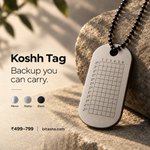
Koshh keeps your backup safe at home. Koshh Tag is the same idea in a form you can carry.
Same steel, so it handles water, heat and time the way the plate does. The difference is portability: it can travel with you, sit in a bag or a safe deposit box, or live somewhere other than your main backup.
One thing doesn’t change. A punched backup holds your actual seed, so treat the Tag with the same care as the plate. Keep it out of sight, and don’t wear it where it invites questions.
Mirror, Matte or Black · ₹499-799 $BTC

Most hardware wallets talk to your computer over USB or Bluetooth. SeedSigner talks through a camera and QR codes.
You scan a transaction into it, check the details on its screen, sign, and it shows a QR code for your wallet app to scan back. There’s no data cable and no wireless link for anything to travel through.
It also doesn’t keep your seed after it’s switched off. You load it when you need it, and when the power goes, so does the key.
Unchained’s report points out that QR and microSD transfers reduce exposure to attacks aimed at always-connected interfaces. One catch it also stresses: you still have to verify the transaction details on the device’s screen. The air gap protects the channel, not your attention.
@SeedSigner · ₹8,499

Steel solves one specific problem: your seed phrase surviving damage.
Fire, water, fading ink and time are what paper loses to. A punched steel plate handles all of them.
What steel doesn’t solve: someone finding it. Anyone who gets hold of your plate and knows the format can read it, so where you keep it matters as much as what it’s made of.
A decent setup is simple. Punch it, check it against your wallet screen, then store it out of sight and away from the device it backs up. A backup stored with your wallet can be lost in the same accident.
Koshh covers the durability part. ₹3,750 $BTC

A 12-word seed phrase isn’t 12 words of pure randomness.
Each word is picked from a list of 2,048, so each one carries 11 bits. Twelve words would be 132 bits, but Bitcoin keys use 128 bits of entropy. The extra 4 bits are a checksum, a built-in error check calculated from the rest.
That’s why a mistyped or misordered phrase gets rejected by a wallet instead of quietly opening an empty wallet. A 24-word phrase works the same way: 256 bits of entropy plus an 8-bit checksum.
It also means the last word isn’t fully free. Part of it is the checksum.

Setting up a Bitaxe is simpler than most people expect. Here’s the whole process, start to finish.
1. Plug in the power supply and the screen lights up
2. Connect it to your Wi-Fi from your phone or laptop
3. Open its web interface and enter your pool address and your Bitcoin address
4. Save, and it starts hashing
From then on the screen shows your live hashrate, so you can see it working without opening anything.
No terminal, no rack, no special hardware. Watch the full setup in the video below, and if you get stuck at any step, DM us and we’ll walk you through it.
#bitaxe $BTC
Thinking about multisig? One thing worth checking is which chip makers your wallets share.
Per Unchained’s report: Trezor Safe 3, 5 and 7 and the BitBox02 Nova all use Infineon’s OPTIGA Trust M V3 secure element. Jade uses Espressif chips. Passport Prime uses Microchip parts plus its own avalanche noise circuit.
If a flaw turned up in one maker’s silicon, a multisig built from wallets that all share it would be exposed together. Mixing makers spreads that risk.
We carry all of these, so if you’re planning a setup, DM us and we’ll help you pick a combination.

Most wallets get their randomness from a chip whose inner workings you can’t inspect. Even the maker usually can’t show you the full design, because it’s proprietary silicon.
Foundation’s Passport Prime does something unusual: alongside its processor and secure element, it includes a diode avalanche noise circuit. A diode is pushed into a controlled breakdown, which produces unpredictable bursts of current, and the device reads that noise as randomness.
What sets it apart, per Unchained’s report, is that the circuit is built from ordinary discrete components with an open-source schematic. Anyone can look at how it works, which isn’t possible with the random number generator inside a typical chip.
Unchained is clear that this is only one of the device’s sources and the chips around it are still proprietary. But a part of the randomness you can actually inspect is rare.
@FoundationHQ · ₹57,499

The Gamma 601 runs at about 1.2 TH/s on 17W, which is less than a phone charger. Plug it in, point it at a pool, and watch your hashrate on the screen.
Solo mining income is small and uneven, so don’t buy one expecting a paycheck. You’re buying a real, independent entry into the block-finding lottery that costs almost nothing to keep running.
₹18,000
#bitaxe $BTC

Most hardware wallets lean on the random number generator inside one chip and ask you to trust it. BitBox takes a different route: it mixes five separate sources of randomness when it generates your key.
Per Unchained’s research, those are:
• A hardware random number generator in the main microcontroller
• A second one in the secure element
• A hash of your own password
• A secret number generated at the factory, unique to your device
• Randomness from the BitBox app on your phone or computer
The point of mixing them is redundancy. When sources are combined properly, the result is at least as strong as the strongest one. If a chip turns out to have a flaw, the other sources still protect your key. An attacker would have to break all five to rebuild it.
Unchained adds a fair caveat: this holds assuming the design is implemented correctly, and the chips themselves are proprietary, so no one outside the manufacturers can fully audit them. Mixing sources doesn’t remove trust. It spreads it across more places.
BitBox02 and BitBox02 Nova are both in our collection.
@BitBoxSwiss
