

PhD (Math & CS) ⁞ Dad³ • Zero Sleep • Infinite Grind • Web3 guy by choice ⁞ ✦ Dev + Content Creator ✦ Research: https://xitter.cf/t.co/sxWLNVRy7q ✦ ✦ @WireNetwork ✦
⌬ /mnt/oracle/core
Joined August 2020
- Tweets42.4K
- Following6.9K
- Followers14.6K
- Likes51.2K







Pinned Tweet
Ask 2 chains to cooperate today and you quickly find out they don't, really.
They don't share a clock. They don't agree on when something is final. They don't speak the same transaction language. Each one is a sealed room with its own rules.
So cooperation gets faked from the outside. Someone runs a relayer. Someone writes a wrapper. Someone mints a stand-in asset on the far side and hopes the 2 versions stay in sync.
Every one of those pieces is plumbing a person or an app has to trust, maintain or work around. Most users never see it until it breaks.
The cleaner idea is to stop asking chains to talk to each other directly. Give them a shared settlement layer they can both rely on.
That's the design choice @WireNetwork is making. Assets stay on their native chain. What moves is ownership, settled on the Universal Transaction Layer. Nothing wrapped. Nothing duplicated that has to be kept honest.
🤝 Paid partnership

Quantum + Classical becomes much more concrete when you measure the time between them.
Qblox has integrated NVIDIA GPU systems into its quantum-control stack through NVQLink.
Reported round-trip latency:
• Below 4.0 microseconds on RTX PRO 6000 Blackwell
• Below 7.2 microseconds on DGX Spark
Those are different measurements, not a sub-4-microsecond result for both systems.
The significance is where the classical computation sits.
GPU processing can participate inside the active control loop, supporting tasks such as live calibration and error-correction decoding rather than only analysing results afterwards.
This is different from routing jobs across a distributed marketplace.
For anyone following @quipnetwork, it is a useful distinction: hybrid computing needs coordination both between machines and within the hardware’s real-time feedback loop.

BlockClaimed retweeted

An important update for the Wire community.
The $WIRE TGE will now take place in the second half of November.
We know many of you have been looking forward to October 27, and we want to share the reasoning behind this decision.
As we prepare to launch the Universal Transaction Layer, we're finalizing some of the most significant relationships in Wire Network's history, including top-tier exchanges, market makers, strategic partnerships, and millions of dollars in liquidity to support our launch.
At the request of key ecosystem partners, we've made the strategic decision to adjust our launch timeline to allow additional time for their integrations and preparations.
Many of these opportunities emerged from our recent participation in Korea Blockchain Week and TOKEN2049 Singapore, where we made substantial progress on relationships that could play an important role in Wire's future.
After nearly six years of development, our priority is ensuring Wire launches with the strongest possible foundation and maximum momentum.
This is not a technical delay. It's a strategic decision to bring the right partners, infrastructure, and liquidity together for one of the most important milestones in our history.
And we won't be slowing down between now and launch day.
Over the coming weeks, we'll be sharing more announcements around financing, ecosystem partnerships, and the teams helping bring Wire to market.
To everyone who has supported us, purchased a node, built alongside us, or helped introduce Wire to the right people: thank you. You've helped us reach this moment.
Now it's time to put that foundation to work.
BlockClaimed retweeted

If Satoshi's coins moved tomorrow, would the market believe Satoshi was back, or that someone used a quantum computer to crack his keys?
@cadillion and @rcarback walk through what a quantum attack could look like.
Thanks @cyphertalkmedia for having us on.

Worried quantum is coming for your bags?
@cadillion of @quipnetwork walks us through a quantum hack: ~26 days of compute for one shot at a key, roughly 50/50 odds. On average, 52 days to crack a single one.
Which means the first targets are the big holders.
Quantum computers need more than better qubits. They need less manual intervention.
QuantrolOx announced €12 million in funding on October 22 for software that automates quantum-device tuning and control.
The company points to research in which machine learning tuned devices in under 70 minutes, outperforming the best human benchmark.
That is a specific reported result, not a promise that every processor can be calibrated in 70 minutes.
But it highlights an important operational problem:
How much expert time does a machine require before it can do useful work?
For compute networks such as @quipnetwork, reliable hardware availability will matter alongside theoretical capability.
A processor that needs constant specialist attention is harder to operate as a service.
Automation is part of turning a laboratory instrument into dependable compute capacity.

ALT QuantrolOx
BlockClaimed retweeted
New chains keep launching for a reason. Each one makes a different trade-off.
Some optimize for speed. Some for low cost. Some for privacy. Some attract a particular kind of developer and build their whole culture around them.
Think of a hospital. Cardiology. Radiology. Pediatrics. Nobody suggests merging them into one giant department to make things simpler. The specialists are the whole point.
What makes a good hospital work is the shared patient record. Every department reads from the same file, so nobody has to re-explain your history at every door.
Crypto has the specialists. What it's missing is the shared record.
That's how I read @WireNetwork's approach. Leave each chain good at what it's good at. Coordinate ownership on one layer across supported chains, so moving between them doesn't mean starting from scratch.
🤝 Paid partnership

A quantum-safe wallet does not make the rest of your phone quantum-safe.
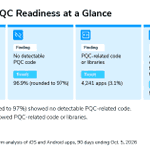
NowSecure assessed 136,711 iOS and Android apps and found that 96.9% showed no detectable post-quantum cryptography code or libraries.
That is a measurement of detectable code, not proof that every app is insecure and not proof that the remaining 3.1% deploy PQC correctly.
Still, it exposes a practical migration gap.
Users interact with financial systems through apps, authentication services, recovery flows and network connections. Improving one signing mechanism does not upgrade all those dependencies.
For anyone following @quipnetwork account-security work, this is the adjacent question worth asking:
What protects the application around the account?
Post-quantum readiness needs to reach the software people actually use, not stop at the protocol diagram.

BlockClaimed retweeted
Most token launches follow the same script. Sell tokens. Send the money to operations. Leave liquidity for the market to sort out later.
That's how tokens end up trading thin for months after launch, with nobody really owning the depth underneath.
The LCO from @WireNetwork flips the order. The offering exists to build the liquidity pool, full stop. 100% of proceeds go into protocol-owned liquidity. None of it funds the business.
Launch is gated on that too. The network goes live once the combined liquidity target across the Outposts is reached. Then every WIRE pre-token converts 1:1 to WIRE at TGE.
Proof of liquidity instead of proof of hype.
It doesn't make anything risk-free. Nothing in crypto is. It does change what the launch actually rests on.
🤝 Paid partnership

Get access to $WIRE before TGE.
Wire's Liquidity Creation Offering (LCO) lets eligible participants acquire $WIRE Pre-Tokens ahead of launch.
Earlier stages come with lower purchase prices, with prices increasing as the offering progresses.
Early access to $WIRE, with a pricing structure that favors earlier participation.

BlockClaimed retweeted
Available on 12 chains shows up in a lot of token announcements as if it's purely good news.
Reach is real. More chains means more places a token can be used.
But it also means 12 separate ledgers. 12 sets of balances. 12 places a user can end up holding the right asset somewhere they didn't intend. 12 sources of truth an app has to reconcile.
Nobody puts that half on the banner.
The question isn't how many chains a token is on. It's whether anything keeps a single consistent record of who owns it across all of them.
That's the angle @WireNetwork takes. Keep each asset on its native chain. Settle ownership on one layer. Let supported chains multiply without multiplying the bookkeeping.
🤝 Paid partnership

New chains keep launching for a reason. Each one makes a different trade-off.
Some optimize for speed. Some for low cost. Some for privacy. Some attract a particular kind of developer and build their whole culture around them.
Think of a hospital. Cardiology. Radiology. Pediatrics. Nobody suggests merging them into one giant department to make things simpler. The specialists are the whole point.
What makes a good hospital work is the shared patient record. Every department reads from the same file, so nobody has to re-explain your history at every door.
Crypto has the specialists. What it's missing is the shared record.
That's how I read @WireNetwork's approach. Leave each chain good at what it's good at. Coordinate ownership on one layer across supported chains, so moving between them doesn't mean starting from scratch.
🤝 Paid partnership
One practical question for quantum adoption:
How much time must a student spend learning the machine before they can investigate the problem?
The QVM launch coverage says researchers at Monash University, Notre Dame and Purdue are evaluating the platform.
A Monash researcher highlights the teaching challenge: learning a quantum programming paradigm can consume a substantial part of a semester.
A higher-level interface could let students spend more time formulating problems, comparing solvers and examining results.
That is a teaching hypothesis, not a demonstrated educational outcome yet.
Evaluation is also not the same as a university-wide deployment or endorsement.
Still, it is a useful adoption test for @quipnetwork:
Can the tooling help a new researcher reach a meaningful experiment faster - without hiding the limitations they need to understand?

BlockClaimed retweeted
Picture a small business paying suppliers in stablecoins across 4 chains.
Paying is the quick part. Month end is where the real work starts.
Every chain is its own ledger. Every ledger has its own balances, its own transaction format, its own explorer. The finance person has to pull records from each one, match them to invoices, then figure out why the totals are off by a transfer still sitting on the wrong network.
Multiply that across 12 months and it stops being an accounting chore. It becomes a reason not to use crypto for payments at all.
What that business needs is one place where ownership is recorded consistently, regardless of which chain each payment touched.
That's the problem @WireNetwork Universal Transaction Layer is designed around. Assets stay native. Ownership settles in one place. One record to reconcile instead of 4.
🤝 Paid partnership

Italy is putting quantum computing into real infrastructure. Blockchain security needs to plan on the same timescale.
Volta B1, Italy’s first quantum annealing computer, was inaugurated in Como on October 16. That does not mean blockchain cryptography suddenly became breakable. It does show why treating quantum computing as a distant research topic is no longer a useful strategy.
@dac_chain used this milestone to call for quantum-resistant blockchain infrastructure. Davide Costa, DAC’s Head of Innovation, highlighted the need to prepare for future cryptographic threats, with DAC developing an EVM-compatible Layer 1 built around Proof of Quantum Work and quantum entropy.
The reason to prepare now is not that an attack is guaranteed tomorrow. It is that changing the security underneath wallets, applications, assets and business systems takes time. Waiting until the threat becomes practical leaves less room to test, coordinate and migrate safely.
Today’s users are building systems they expect to trust for years. Their security needs to look further ahead than the next release.
Quantum progress is worth celebrating. Preparing for its consequences should be part of that progress too.

ALT watcher.guru
Most token launches follow the same script. Sell tokens. Send the money to operations. Leave liquidity for the market to sort out later.
That's how tokens end up trading thin for months after launch, with nobody really owning the depth underneath.
The LCO from @WireNetwork flips the order. The offering exists to build the liquidity pool, full stop. 100% of proceeds go into protocol-owned liquidity. None of it funds the business.
Launch is gated on that too. The network goes live once the combined liquidity target across the Outposts is reached. Then every WIRE pre-token converts 1:1 to WIRE at TGE.
Proof of liquidity instead of proof of hype.
It doesn't make anything risk-free. Nothing in crypto is. It does change what the launch actually rests on.
🤝 Paid partnership
Get access to $WIRE before TGE.
Wire's Liquidity Creation Offering (LCO) lets eligible participants acquire $WIRE Pre-Tokens ahead of launch.
Earlier stages come with lower purchase prices, with prices increasing as the offering progresses.
Early access to $WIRE, with a pricing structure that favors earlier participation.
Available on 12 chains shows up in a lot of token announcements as if it's purely good news.
Reach is real. More chains means more places a token can be used.
But it also means 12 separate ledgers. 12 sets of balances. 12 places a user can end up holding the right asset somewhere they didn't intend. 12 sources of truth an app has to reconcile.
Nobody puts that half on the banner.
The question isn't how many chains a token is on. It's whether anything keeps a single consistent record of who owns it across all of them.
That's the angle @WireNetwork takes. Keep each asset on its native chain. Settle ownership on one layer. Let supported chains multiply without multiplying the bookkeeping.
🤝 Paid partnership
BlockClaimed retweeted
ICYMI: @cadillion on @AGTPinsights this week at @money2020 in Las Vegas
Full interview: youtube.com/watch?v=xUClT8R8…
BlockClaimed retweeted
For six years, we've been building around one belief:
The future isn't one chain.
It's an economy spanning many ecosystems, applications, assets, and eventually autonomous agents.
That future needs infrastructure capable of coordinating what happens between them.
So we built it.
The Universal Transaction Layer.
Different ecosystems remain independent.
Assets remain native.
Coordination becomes shared.
Soon, Wire enters its next chapter.

Quip’s reported 1,930 portfolio-optimization races deserve attention and careful interpretation.
The published summary says the quantum solver matched or beat the classical comparator in every race.
Results within 0.5% counted as ties. Where the difference exceeded that threshold, the reported median improvement was 2.56%.
Those qualifications belong beside the headline.
This is a result for a particular workload, comparator, and experimental setup - not proof that quantum computers outperform classical computing generally.
The next questions are:
- How strong was the classical baseline?
- Were resource budgets comparable?
- Does the result hold on larger, unseen instances?
@quipnetwork has a technical-report page pointing to the method and all 1,930 results.
That is where a productive discussion starts: with the benchmark design, not just the win count.

BlockClaimed retweeted
Right token. Wrong network.
It might be the most common mistake in crypto. The name matches. The ticker matches. The logo matches. The balance just never shows up where you expected it.
That happens because a token deployed on several chains is really several separate ledgers wearing the same name. Each one tracks its own balances. None of them knows the others exist.
Getting funds back usually means support tickets. Sometimes it means hunting for a wallet that supports the other network. Sometimes the funds are just gone.
The fix isn't more warning popups. It's one consistent record of who owns what.
That's the model @WireNetwork is building toward. Assets stay on their native chain while ownership settles on the Universal Transaction Layer, so one record answers the question no matter how many supported chains an asset lives on.
🤝 Paid partnership

BlockClaimed retweeted
Putting our money where our mission is 🦋

Happy to share that @quipnetwork will be pledging 10,000 USD for @thedaofund PQ Wallet Security Initiative. If you run a project that works with Ethereum and care about quantum readiness, I hope you will join us:
initiatives.thedao.fund/init…