

Ideas about computational thinking to chew on with kids over breakfast (or lunch, or in the car) from the K-12 education team @cornell_tech
New York, NY
Joined March 2020
- Tweets197
- Following221
- Followers376
- Likes229
Back to school means back to computational thinking and computing! No better way to begin than to celebrate human rights hero Felicitas Mendez, who stood up for the rights of all children to go to good schools together. This is awesome, @GoogleDoodles! youtube.com/watch?v=8Ky0sDXI…

2
When you take on a challenge, talk with your family about which computational thinking skills help you get it solved. Here's the @BarefootComp CT chart to help remind you! #CSforALL

1
2
Hello computational thinkers! Computational thinking can be handy in math. Now that our kitchens are also math classrooms, here's a fun set of family challenges from @MrSTEmurray using Legos. No Legos? Use blocks, or coins, chips, or draw pictures to solve the challenges.

How about this one? NOT A SET! Why? Let's test: shape, there are 2 cards with ovals and 1 with diamonds. To be a set, they would have to all be the same, or all different. Shading, 2 cards are empty while 1 is striped. Again, they must either be all the same or all different. 3/4

1
2
Here's another set. Here's how we know: shape, all different; shading, all different; color, all different; number, all different! PATTERN RECOGNITION on fire! 2/4

1
1
A SET is made of three cards in which EACH of the 4 variables are either all the same, or all different. For instance, the set below has three different shapes, three different colors, but the same shading (solid) and the same number (1).

1
1
From our @cornell_tech team to yours. We know that for students and parents, every week is #TeacherAppreciationWeek. Teachers, thank you for your enthusiasm for #computerscience! And for all you do, big & small, to keep learning alive all year long. #CSforALL @csteachersorg

Remember details like turning water off after you wet your hands (running the water for 20 seconds costs 2 gallons of wasted water!) then turning it on & off to rinse. Get your algorithm ready in words or pictures & teach it to friends or family in person or online! Safe weekend!
Feliz Friday, computational thinkers! One of the best ways to check on your knowledge is to teach someone else. I know you've heard plenty about handwashing. But today, kids, create an ALGORITHM (a series of steps) for washing hands and teach it to an adult, in person or remotely

Finally Friday, Computational Thinkers! Let's do something fun this morning. When technologists get together to solve a problem or create a product, they often us a strategy called design thinking. Design thinking starts with problem, and the person the solution is for.

Thinking Thursday! I think it's time for a PATTERN hunt. Our homes are full of patterns if you look closely. Walk around your home and see what patterns you can find. They may not be made up of identical pieces, like this quilt or shelf. Find the pattern & describe it!


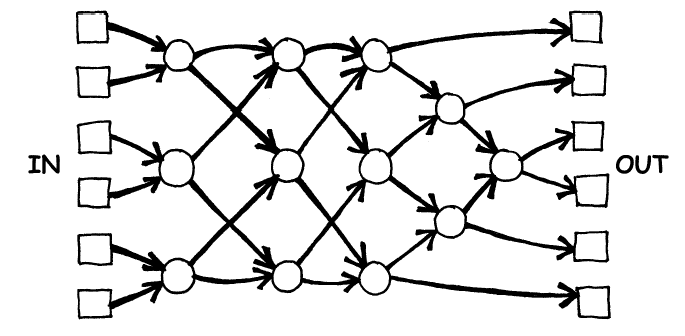
Bring the three pairs of numbers to the first circles & compare them. The higher number moves along the path to the right, & the lower number, the left. Move them step by step, always sending bigger numbers to the right. As if by magic, your numbers will be sorted at the end! 3/4

1
1
Copy or print this drawing. Create 6 counters numbered 1-6 (use chips, paper, pebbles, toothpicks-anything is fine). This sorting network will sort 6 numbers from low to high. Put the counters in random order on the squares on the IN side, on the left. 2/4
1
Create a poem using the haiku algorithm, abstracting out essential details that describe something your are thinking or feeling about spring, or friends, or anything that's happening right now. Let us see! 3/3 #CSforALL

2
With such spare use of words and images, haiku is a good example of ABSTRACTION (filtering out unimportant details). Now that you know that haiku is 17 syllables total, written in 3 lines of 5, 7, and 5 syllables, can you create an algorithm for writing haiku? 2/3

Computer scientists have to give computers precise instructions, because the computer only does exactly what it's told. That's why we teach students to create clear, detailed algorithms. It gets them ready to write their own programs someday soon. More tomorrow! 4/4 #CSforALL


