

Researcher at the Natural History Museum London. Building & using phylogenies of bryozoans and tapeworms. Integrating molecules & fossils. 🌈 she/her
Joined March 2012
- Tweets328
- Following237
- Followers220
- Likes920




Andrea Waeschenbach retweeted

It is with great pleasure we award Dr Paul Taylor The Palaeontographical Society Medal in recognition of his extraordinary long-term and continuing contributions to palaeontology in the British Isles and the wider world particularly on bryozoans and other invertebrates,

Andrea Waeschenbach retweeted

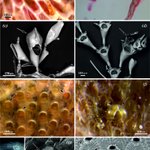
Finally out! Boring systematics on endolithic bryozoans and other ctenostomes. Big thanks to all my collaborators: @ahmedjoudahnass C. Baranyi @moostiere @Sarah_TheSea @AndySombke @faguilgen @lmanzoni @AbbyOtago @BryoEvolution @TSchwaha
doi.org/10.1002/ece3.11276

Andrea Waeschenbach retweeted

One for the weekend: the spinose cheilostome bryozoan Celleporaria building a tube with a very prickly surface for its hermit crab symbiont. New Zealand.

Andrea Waeschenbach retweeted

frontiersinzoology.biomedcen…
Finally out. Two years ago we rediscovered Monobryozoon ambulans from its type locality, Helgoland. Read more about its morphology and phylogenetic position here. with @SH_Decker @ahmedjoudahnass and Christian Baranyi

Andrea Waeschenbach retweeted
#FossilFriday The Cincinnatian Series in the US is renowned for its superb bryozoan fauna, exemplified by this trepostome Dekayella from the collections of the NHMUK. Note the borings adding further interest.

Andrea Waeschenbach retweeted

Position open for a curator of Invertebrates (non-insects), with expertise or knowledge of #Bryozoa (required) at the Natural History Museum of London. Applications close on the 20th November 👇
uk.indeed.com/m/viewjob?jk=4… #JobAlert #bryozoans #taxonomy @NHM_London
Andrea Waeschenbach retweeted

#ProcB Multiple #evolutionary transitions of reproductive strategies in a phylum of aquatic colonial #invertebrates ow.ly/rBTG50Q3Otl #Evolution @lmanzoni @BryoEvolution

Andrea Waeschenbach retweeted

Thank you @IJPara for choosing our cover for February’s issue 🤓🤩 Read more about our work on poo genome skimming to pull helminth mitogenomes in the same issue @DrCinziaCanta @stephenrdoyle @phylofacts @NHM_Science @Cambridge_Uni @CamVetSchool @sangerinstitute
This Post is from an account that no longer exists. Learn more
Andrea Waeschenbach retweeted
#FossilFriday Just a few millimetres in size, the type specimen of Fasciculipora waltoni from the Middle Jurassic of Bath now in the Sedgwick Museum, Cambridge. This beautiful cyclostome bryozoan species was described by Jules Haime as long ago as 1854 but remains poorly known.

Andrea Waeschenbach retweeted

Unbelievable @plymouthcc and totally unacceptable.
This Post is from an account that no longer exists. Learn more
Andrea Waeschenbach retweeted
The unique pseudocyphonautes of Flustrellidra hispida is approximately 1 mm in width and one of largest bryozoan larva. This peculiar larval type is only present in two relatively unknown ctenostome bryozoan families and a rather rare sighting.
@SBRoscoff #Bryozoans #Bryozoology
Andrea Waeschenbach retweeted

I’m very pleased to see the first paper of my PhD published!
Finally, morphological data of lophopodids reveal unique characters + help ground pattern reconstruction of phylactolaemate bryozoans.#bryozoan #phylax @TSchwaha @kasetsart_ku @univienna
💪🥹👉bmcecolevol.biomedcentral.co…

Andrea Waeschenbach retweeted
#FossilFriday Weathering out from a building stone of the ice-cream parlour in Aubeterre-sur-Dronne, a tasty colony of the cyclostome bryozoan Reticrisina. Upper Cretaceous. Campanian.

Andrea Waeschenbach retweeted
Just preliminary, but finally the next publication in the ctenostome morphology series is out #bryozoa #ctenostomata
onlinelibrary.wiley.com/doi/…

Andrea Waeschenbach retweeted

Short-read phylogenomics isn't dead! Check patchwork, our new tool to fully exploit the power of genome skimming. We use it especially to retrieve USCOs. Awesome work by @fethalen and Clara Köhne.
This Post is from an account that no longer exists. Learn more
Andrea Waeschenbach retweeted
#FossilFriday Much of the Cretaceous Chalk of southern England is very soft, allowing fossils to be easily prepared, like this ramose cyclostome bryozoan from the Santonian of Pegwell Bay in Kent left on a carved pedestal.

Andrea Waeschenbach retweeted

Nineteen species of bryozoans found in Pennsylvanian Texas show increasing diversity over time
Authors: Andrej Ernst, Anna Lene Claussen, Barbara Seuss, and Patrick N. Wyse Jackson
Full paper 👉 palaeo-electronica.org/conte…

Andrea Waeschenbach retweeted
#FossilFriday The white meshwork of this fine specimen of the bryozoan ‘Fenestella’ nodulosa contrasts nicely with the black shale matrix. Lower Carboniferous of Halkyn, Flintshire in Wales.

Andrea Waeschenbach retweeted

Got no funding for an Article Processing Charge, but you have an excellent paper in evolutionary biology? I explain that lack of funding is not an impediment to publishing in MBE or GBE

Listen to the SMBE news from our President @jomcinerney!
President's Update 20220510 youtu.be/y3OT-UY3Wgg via @YouTube

