

Deep Tech & Growth Investor | Exploring small caps and asymmetric setups. Sharing my deep dives & fundamental research
Joined March 2022
- Tweets2.3K
- Following843
- Followers1.9K
- Likes10.1K




Pinned Tweet
Yesterday’s hedge fund rumors are confirmed by WSJ and Bloomberg, and the details hurt.
Per Morgan Stanley, October saw the largest active reduction of positions by stock pickers in over a decade. More than 40% of them were flat or down YTD, while the indexes were still positive. And of the 46 major funds tracked by Bloomberg, more than half finished October in the red.
The damage:
- Lone Pine: +40% in H1, now -7.5% YTD. Caught on both sides, on its AI longs and on its shorts against companies threatened by AI, which went up.
- VARA: -33% in October
- Arini: -26% YTD, forced to dump over $2B of assets in a week under margin call pressure. Rivals are now shorting its biggest positions.
- Tiger Global: -8.5% in October, back to flat YTD
- Kirkoswald: worst month in its history
- Millennium: -2.3% in October, with several internal pods reportedly shutdown
- Engineers Gate: shutting most of its human-plus-quant strategy, keeping only 5 PMs. The head of the unit is leaving.
- Samlyn: dropping everything except financials. Other sector heads and senior analysts are out.
- Walleye: head of equities and a large part of the long/short teams let go, and capital going back to clients
Thursday made it worse. Per Goldman Sachs, tech funds lost more than 4% in one session, wiping out YTD gains that had reached 24% before the summer. The Nasdaq lost $2.5T, to the point that Dan Loeb (Third Point) joked on X: “Hug your hedge fund manager.”
The problem is that everyone holds the same names: funds, retail and leveraged ETFs. Hedges stop working, and every sale drags down everyone else’s positions. $SOXL lost 39% in one session, and volatility-control funds could still liquidate up to $135B of futures.
But forced selling always stops at some point, and the rebounds that follow can be violent. On Wall Street, an old rule says to wait three sessions after a shock before deciding anything.
$QQQ $SOXX


From what’s circulating, here are the hedge funds cracking this week, between losses, big redemptions and PMs let go:
- Axebrook
- Walleye
- Engineers Gate
- Lone Pine
- Millennium (internal pods)
- Verition (pods)
- Samlyn
Plus 4 more in the UK, apparently.
Bloomberg is starting to confirm:
- Walleye returning capital
- Engineers Gate cutting most of its equity team
- VARA down 33% in October on AI
- Kirkoswald (Greg Coffey) posts its worst month ever
Lone Pine had already lost 31% in Q3, with a portfolio packed with AI and semis: $NBIS, $ASML, $STX, $AMAT, $TER, $HUT, $WULF.
From the rumors I’m hearing, margin calls have already started. If tomorrow looks like current futures, they’ll keep coming.
source: teapaw.org/nishantkumar07/status/…
$QQQ $SOXX


BullRush retweeted
Bloomberg’s breakdown of Thursday’s rout: $3.7T wiped out in one session. It was the Nasdaq 100’s worst drop since March 2020.
How it unfolded:
Retail sold first. Only two days in March 2020 saw more net selling (Vanda).
Hedge funds and long-only managers followed, with no buyers on the other side.
Then the machines:
– options dealers were selling ~$7B per 1% drop;
– vol-control funds had ~$61B to sell;
– leveraged ETFs ~$47B;
– CTAs ~$13B.
Optical ($LITE $COHR $CIEN $AAOI), memory ($MU), data-center and AI-semis baskets fell 12-15% on the day, 5-6 standard-deviation moves. The S&P ex-AI fell 2.3%. For about a dozen AI baskets, it was the worst day since ChatGPT launched.
Goldman’s memory basket went from +1,202% at its June 22 peak to +540%, a 51% drawdown. April 2025’s -44% took 14 months to recover. This one is 136 days in, with no dip-buying yet.
The VIX went from 16.6 to nearly 28. Since 1990, only two spikes started calmer and went further: Feb 5, 2018 and Dec 18, 2024.
Since 1980, the S&P has fallen 2%+ the day after a 1.5% gain only 48 times, almost all in bear markets or crises.
$SOXX $QQQ

BullRush retweeted
Walleye Capital, a $17B+ hedge fund, lost 5.9% in October, its worst month since March 2020, and is down 6.8% YTD.
The fallout: the head of equities is out, along with a large part of his teams, and some capital goes back to investors. The fund keeps volatility, quant and its external managers, and drops the classic equity long/short pod model.
Sounds a lot like the "entire division of a fund" Shkreli mentioned earlier today.
From what I'm seeing, Walleye isn't alone: several other pods reportedly closed today.
teapaw.org/nishantkumar07/status/…
$QQQ

Pods closing, an entire division of a fund shut down, per Shkreli.
Makes sense after a -5% day on $QQQ with no major headline.
Quick reminder: a pod is a trading team (a PM and a few analysts) inside a multi-manager hedge fund like Millennium, Citadel or Point72. Each pod runs a slice of capital with leverage and very tight loss limits: around -5% its capital gets cut, around -7/-8% the team gets shut down.
The catch is that these pods often hold the same positions( « crowded trades ». When the market drops hard, they hit their stops at the same time, sell their longs, cover their shorts, and accelerate the selloff.
The drop blows up pods, and pods blowing up deepens the drop.
The drop blows up pods, and pods blowing up deepens the drop.
So nobody’s buying the dip anymore?
On Thursday, QQQ fell 6.5%, its worst day since March 2020. Investors still poured $2.8 billion into it that day. The buying reflex is still there; the enthusiasm is gone.
On Friday, per Vanda, retail buying in Nasdaq 100 names was modest at the open and faded from there. Nvidia, which had just wiped out its gains for the year with a 9.3% drop the day before, was the most-bought stock. Vanda’s Viraj Patel: some modest net buying, ‘not gangbusters.’
The detail that matters: per Vanda, the only two places retail has been buying aggressively for weeks are two 3x leveraged ETFs, $SOXL and $TQQQ, which topped the retail leaderboard Friday morning. Part of the dip-buying base is chasing triple exposure right as volatility explodes. Fidelity data from Thursday show some fatigue, though: SOXL drew more sell orders than buys, while the S&P 500 (VOO) drew roughly nine buys for every sell.
Interactive Brokers: "Steve Sosnick: ‘We now have a generation of investors who run into the building when the smoke alarm goes off."
$QQQ $SOXX $NVDA $MU


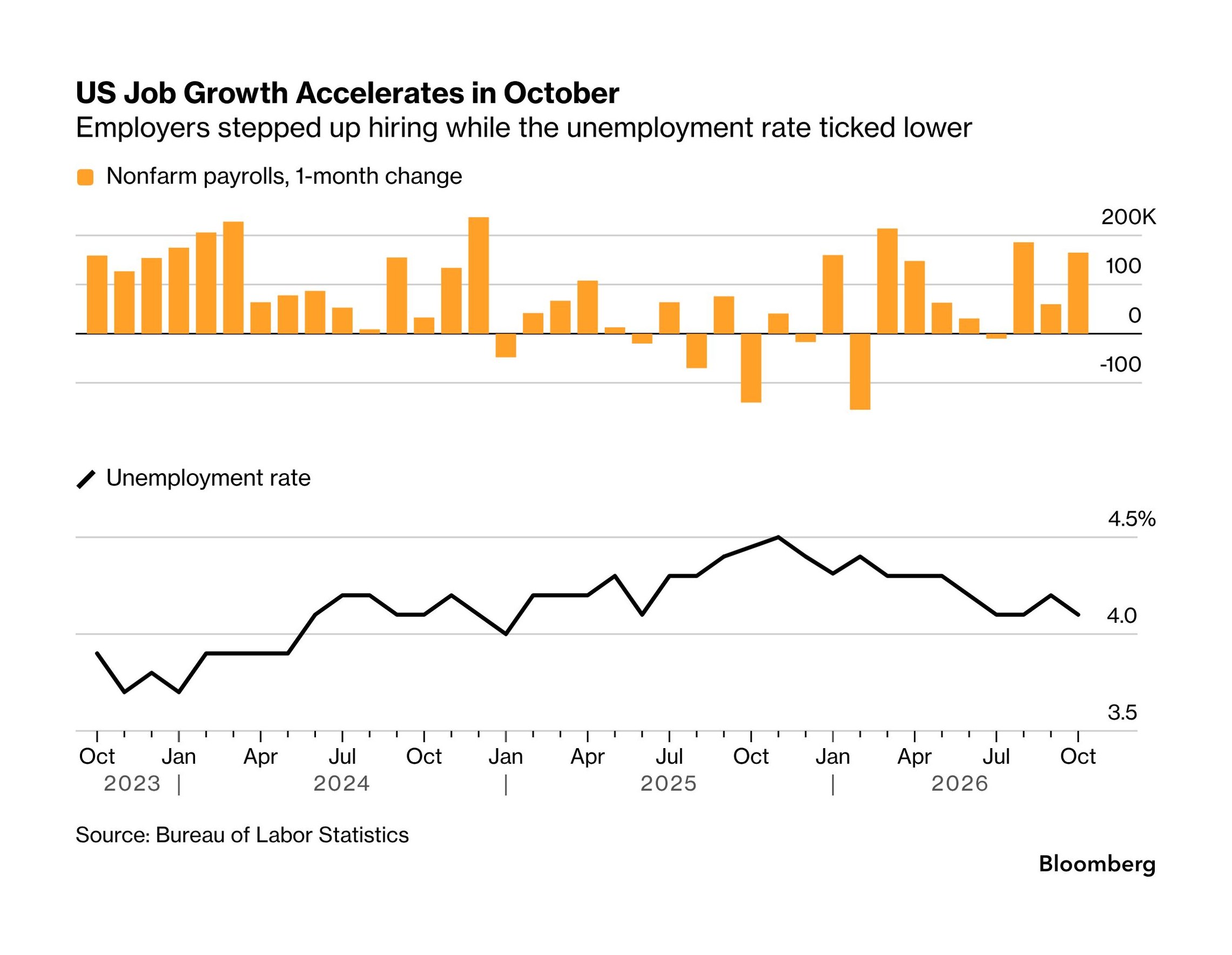
Is the US jobs report still usable data? The BLS printed 165,000 new jobs in October vs a 70,000 median in Bloomberg’s survey, and none of the 70+ economists polled was above 131,000. Unemployment fell to 4.1%. August and September were revised up by 84,000, with September going from 29,000 to 60,000, more than double its first print. A number that can double in a month and that nobody can forecast anymore raises a real reliability question.
October’s 95,000 miss wasn’t even the year’s biggest. February, March, July and August were each missed by more than 100,000. In 2026 the average consensus error is about 88,000 a month, vs roughly 50,000 in 2010-2019. The forecasters haven’t gotten worse; the measurement has. BLS funding is down more than 20% in real terms since 2010, survey response rates are collapsing and samples are shrinking. Erika McEntarfer, the BLS commissioner fired in 2025, told the FT that businesses are harder to reach, and budget cuts are hitting the field staff whose job is to reach them.
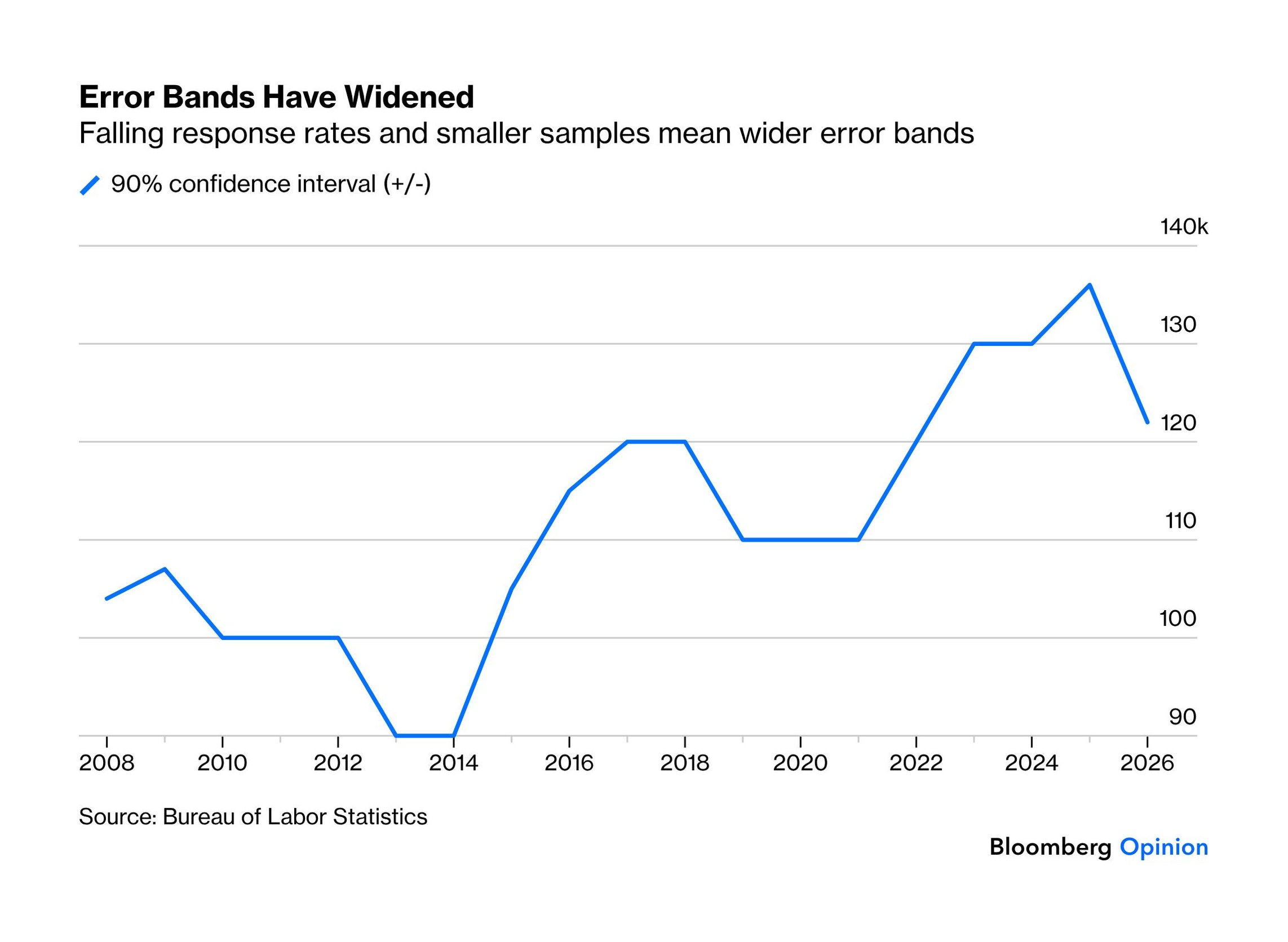
The result: the 90% confidence interval on the monthly print is about ±122,000, vs ±90,000 in 2013-2014. October’s true number sits somewhere between 43,000 and 287,000. Per Bloomberg, roughly half of 2026’s reports are statistically indistinguishable from zero. Two structural factors add to it. Since January, the BLS has used a new birth-death model that is more responsive but more volatile. And with immigration curbs, labor supply is growing so slowly that the trend blends into statistical noise.
The details are softer than the headline. Per Reuters, all net gains in household-survey employment and participation came from foreign-born workers, while native-born employment has fallen since July. The long-term unemployed are 27.6% of the jobless, the highest share since late 2021. The average job search now exceeds 27 weeks, longer than unemployment benefits last. Involuntary part-time work jumped 339,000. It’s a low-hire, low-fire market: those with jobs keep them, those without stay out.
The engine is easy to spot. Data-center spending is supporting nonresidential construction, and computer and electronics manufacturing added the most jobs in four years. Part of Friday’s strength rests on the very buildout voters just pushed back on. Meanwhile, information and finance, the heaviest AI adopters, keep shedding jobs on trend.
Goldman: ‘AI’s labor market impact has become increasingly visible.’
None of this matters to the Fed. Markets price roughly 75% odds of a hike on Dec. 9, and the 2-year yield is moving higher. A data-dependent central bank is tightening on a number whose error band is three-quarters of its size.
$SPY $QQQ $TLT

BullRush retweeted
Bloomberg confirms what was brewing: the hedge fund purge isn't stopping at equities, "at least two more credit trading pods" have just been shut down.
The multi-strat giant ($95B AUM) continues to double down on cuts across its debt teams, with the portfolio managers out:
- Abacove Capital: Dominick Maggio & Amit Agrawal ("who ran Abacove Capital within Millennium") are leaving.
- Twin Lights: Mark Meenan & David Ulrich ("another internal trading pod of Millennium") are gone as well.
These closures build on recent cuts: Millennium pulling capital from Axebrook Capital ("credit-focused hedge fund") and the departure of senior credit trader Manav Gupta ("Credit Trader Who Had Moved His Hedge Fund to Millennium Leaves") just 6 months after moving his fund. Over at Brevan Howard, "at least five portfolio managers focused on credit trading" have also departed.
The catalyst? European junk debt spreads spiking to 2009 highs , caught in a vise between "concerns about the financing of the AI buildout", sticky high rates, and geopolitical shocks.
First it was the brutal de-grossing on tech L/S equities, and now credit is taking the hit.

Yesterday’s hedge fund rumors are confirmed by WSJ and Bloomberg, and the details hurt.
Per Morgan Stanley, October saw the largest active reduction of positions by stock pickers in over a decade. More than 40% of them were flat or down YTD, while the indexes were still positive. And of the 46 major funds tracked by Bloomberg, more than half finished October in the red.
The damage:
- Lone Pine: +40% in H1, now -7.5% YTD. Caught on both sides, on its AI longs and on its shorts against companies threatened by AI, which went up.
- VARA: -33% in October
- Arini: -26% YTD, forced to dump over $2B of assets in a week under margin call pressure. Rivals are now shorting its biggest positions.
- Tiger Global: -8.5% in October, back to flat YTD
- Kirkoswald: worst month in its history
- Millennium: -2.3% in October, with several internal pods reportedly shutdown
- Engineers Gate: shutting most of its human-plus-quant strategy, keeping only 5 PMs. The head of the unit is leaving.
- Samlyn: dropping everything except financials. Other sector heads and senior analysts are out.
- Walleye: head of equities and a large part of the long/short teams let go, and capital going back to clients
Thursday made it worse. Per Goldman Sachs, tech funds lost more than 4% in one session, wiping out YTD gains that had reached 24% before the summer. The Nasdaq lost $2.5T, to the point that Dan Loeb (Third Point) joked on X: “Hug your hedge fund manager.”
The problem is that everyone holds the same names: funds, retail and leveraged ETFs. Hedges stop working, and every sale drags down everyone else’s positions. $SOXL lost 39% in one session, and volatility-control funds could still liquidate up to $135B of futures.
But forced selling always stops at some point, and the rebounds that follow can be violent. On Wall Street, an old rule says to wait three sessions after a shock before deciding anything.
$QQQ $SOXX
Bloomberg puts the damage at $5.7T of US market value erased since the Oct. 6 peak, $2.3T of it from the Nasdaq 100 on Thursday alone. 57% of the index’s members now sit more than 20% below their highs. That’s a larger share than in March 2022, when the index itself entered a bear market.
The catalyst is political. The Democratic sweep of Congress puts regulatory risk on the data-center buildout that underpins the AI capex cycle.
The mechanics are technical. Retail sold at a pace not seen since the pandemic, then hedge funds, leverage and systematic strategies took over. SocGen traces it to crowded AI and oil positioning unwinding together. Funds had to sell the tech they owned and cover the defensives they were short, a margin-call-style deleveraging. The rotation predates the vote: growth trailed value by 10 points in October, the widest monthly gap since 2001.
Morgan Stanley data show hedge funds have cut gross leverage from the June peak by the most in over a decade. Its quants think the liquidation is nearing exhaustion, but expect another low after a relief bounce.
Some saw it coming. Jeff Muhlenkamp exited almost all his AI holdings before the rout. His $275M fund is flat for November and ahead of the S&P 500 this year. “We sold what was expensive and popular, and bought what was cheap and forgotten. When momentum changes, we benefit.”
The usual backstops are missing too. The market is pricing a December Fed hike, and the White House comes out of the midterms weakened. BlackRock’s Rick Rieder: “The aggressive speed of the AI spend, you have to assume that will be at a more deliberate pace. That changed this week and you have to factor that into your calculus.
$SOXX $QQQ

Wow, my post got featured on @amitisinvesting live 🙌
Really appreciate it Amit, big fan of your content

Bloomberg’s breakdown of Thursday’s rout: $3.7T wiped out in one session. It was the Nasdaq 100’s worst drop since March 2020.
How it unfolded:
Retail sold first. Only two days in March 2020 saw more net selling (Vanda).
Hedge funds and long-only managers followed, with no buyers on the other side.
Then the machines:
– options dealers were selling ~$7B per 1% drop;
– vol-control funds had ~$61B to sell;
– leveraged ETFs ~$47B;
– CTAs ~$13B.
Optical ($LITE $COHR $CIEN $AAOI), memory ($MU), data-center and AI-semis baskets fell 12-15% on the day, 5-6 standard-deviation moves. The S&P ex-AI fell 2.3%. For about a dozen AI baskets, it was the worst day since ChatGPT launched.
Goldman’s memory basket went from +1,202% at its June 22 peak to +540%, a 51% drawdown. April 2025’s -44% took 14 months to recover. This one is 136 days in, with no dip-buying yet.
The VIX went from 16.6 to nearly 28. Since 1990, only two spikes started calmer and went further: Feb 5, 2018 and Dec 18, 2024.
Since 1980, the S&P has fallen 2%+ the day after a 1.5% gain only 48 times, almost all in bear markets or crises.
$SOXX $QQQ
Understanding the $CRWV debt chain
1️⃣ GPUs sit in SPVs, which borrow against the chips and their customer contracts (DDTLs).
2️⃣ Senior unsecured notes are issued at the parent, behind the SPV lenders’ claim on the GPUs.
3️⃣ Some of those SUNs end up in European CLOs, themselves levered ~10x.
In those CLOs, CoreWeave debt is marked at ~71 cents on the dollar.
Top holders:
• PGIM: €25.7M
• RBC BlueBay: €19.1M
• Sona: €18.4M
• UBS: €9.5M
• BlackRock: €9.4M
Over €100M across these lines alone.
Overall: ~$35.6B of debt, about half secured. GPUs depreciated over 6 years. Notes yielding ~15%.
The further down the chain, the further from the GPUs.


CLOs: You have 10x levered CLOs, buying the $CRWV SUNs which fund the equity into SPVs which borrow at 80% LTV to buy Nvidia chips. Insane. CDO Squared of 2026

$MSFT is winding down its deal to rent AI computing capacity from $ORCL.
What we know:
• In recent months, Microsoft has been turning off the capacity it rented from Oracle, after declining to renew the contract.
• Why: according to people familiar with the matter, the servers no longer fit Microsoft’s specs. They ran on older-generation Nvidia chips.
• The deal, signed in 2023, was meant to power the new AI-assisted Bing. At the time, Microsoft renting from a rival was seen as a sign of how short AI compute was.
• The move is part of a wider review. Microsoft has committed more than $80B to rent capacity from other clouds, including CoreWeave, Nebius and Nscale. Its leaders are frustrated with these neoclouds over high costs and delays.
• Oracle says demand for its AI infrastructure remains strong, including for older GPUs. In September it said it was renewing contracts on 4-year-old GPUs at a 20% premium.
Context: Oracle’s cloud business made $18B in revenue in the fiscal year ended May 2026. Heavy capex has pushed its free cash flow negative.
$ORCL −2.9% today, new 52-week low at $109.21. The stock has lost more than half its value since its June 1 peak.
$MSFT $NBIS $CRWV $IREN $CIFR
