

Professor of Political Science @uinjktofficial | Founder of @indikatorcoid | PhD from Australian National Univ | Senior Fellow @ISEAS | IG: @burhanuddinmuhtadi
Jakarta-Canberra-Singapore
Joined April 2010
- Tweets37.1K
- Following1.6K
- Followers366K
- Likes4.9K




IG @burhanuddinmuhtadi retweeted
Bisa jadi. Kolega saya Prof Tulio asal Brazil bilang kekalahan Lula di putaran pertama membuat banyak kelompok independen dan unlikely voters jadi antusias datang ke TPS. Bukan karena Lula, tapi lebih karena takut Bolsonaro berkuasa. Dalam ilmu politik, ini disebut negative partisanship.
IG @burhanuddinmuhtadi retweeted
Ya, dugaan saya independent voters, unlikely voters dan perempuan rame-rame datang ke TPS dukung Lula, apalagi setelah Lula dihina sbg manusia sembilan jari di debat televisi terakhir serta momentum kampanye terbesar Lula di San Paulo.
IG @burhanuddinmuhtadi retweeted

Chart Mas @BurhanMuhtadi ini menarik banget dibaca serious.
@grok can you draw four bullet points most important conclusions from this data points? Tks


IG @burhanuddinmuhtadi retweeted

Prabowo’s Falling Approval Rating: When Government Priorities Diverge From What Indonesians Actually Need
I came across this rather revealing survey by Indikator Politik Indonesia, conducted in July 2026, and I think it helps explain one of the biggest problems facing President Prabowo Subianto’s administration: the priorities of ordinary Indonesians appear increasingly disconnected from some of the government’s most prominent policy initiatives.
The numbers are striking, particularly because they suggest that the public’s sense of urgency is concentrated not on the programmes receiving the greatest political attention, but on the more fundamental economic conditions that determine whether households can live with security and dignity.
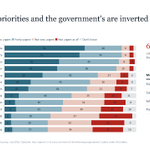
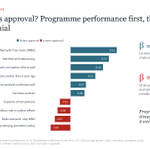
According to the survey, 61% of respondents consider job creation very urgent, followed by poverty reduction at 57%, better healthcare services at 41% and infrastructure development at 40%. When we combine those who consider these issues either very urgent or fairly urgent, the figures become even more compelling, reaching 89% for job creation, 89% for poverty reduction, 86% for healthcare and 85% for infrastructure.
Now compare those figures with several of the administration’s flagship programmes, and the contrast becomes difficult to ignore.
Only 5% consider the Free Nutritious Meals programme (MBG) very urgent, while 6% say the same about village cooperatives, 5% about the new capital city and 9% about new military equipment, and even when we include respondents who consider these programmes fairly urgent, the combined figures remain considerably lower, at approximately 35% for MBG, 33% for village cooperatives, 33% for the new capital and 44% for military equipment.
The survey does not establish that Indonesians oppose these programmes, because asking whether something is urgent is different from asking whether people support it, and the chart does not measure the government’s actual budget allocation across all competing priorities, but it does reveal a significant difference in perceived urgency, and that difference deserves serious attention when the government is allocating hundreds of trillions of rupiah under increasingly difficult fiscal and economic conditions.
The public is asking for jobs, higher incomes, affordable necessities and better public services, while the political conversation remains heavily dominated by large, expensive and highly visible government programmes.
I suspect this disconnect is contributing to President Prabowo’s deteriorating approval rating, because voters may be increasingly judging the administration not by the number of programmes it has announced, but by whether those programmes are improving the economic realities they experience every day.
According to Saiful Mujani Research and Consulting (SMRC), Prabowo’s approval rating declined from 81.2% in November 2025 to 66.4% in March 2026, 51.1% in July and just 44.5% in October 2026, representing a remarkable decline of 36.7 percentage points in less than a year, and although approval ratings can fluctuate in response to political events, economic news and changes in public expectations, a decline of that magnitude is not a small fluctuation in public sentiment.
The latest SMRC survey also found that 50.8% of respondents considered Indonesia’s economic conditions bad or very bad, while 43.1% believed economic conditions had deteriorated compared with the previous year, and although other pollsters report higher current satisfaction levels, meaning that the precise national approval rating remains disputed, the substantial deterioration within SMRC’s own survey series is difficult to ignore.
What makes these developments particularly interesting is that they challenge the assumption that highly visible welfare programmes necessarily translate into greater political support, because in this case the programmes that were supposed to demonstrate the administration’s commitment to ordinary Indonesians may instead be becoming sources of public dissatisfaction.
In fact, SMRC found that approximately 62% of respondents were dissatisfied with the free meals programme, while 71.4% doubted the success of the government’s village cooperative initiative, suggesting that the political value of these programmes may be weakened when implementation problems, fiscal concerns or doubts about effectiveness become more visible than the benefits they are intended to provide.
I think the explanation is fundamentally economic, because people do not evaluate their standard of living by counting how many government programmes have been announced; they evaluate it through their purchasing power, employment prospects, financial security and access to essential services.
A household does not become economically secure simply because its children receive free meals if the parents remain unemployed, wages are stagnant, rent is increasing and basic necessities continue becoming more expensive, and while free meals can certainly help reduce household expenditure, improve nutrition and support educational outcomes, particularly among vulnerable children, they cannot substitute for an economy that creates productive employment and allows families to generate sufficient income independently.
That distinction matters because there is a fundamental difference between policies that alleviate the consequences of poverty and policies that address the economic mechanisms producing poverty in the first place, and although both have a legitimate role in public policy, they are not interchangeable.
A government can distribute benefits to millions of households while simultaneously failing to improve the underlying conditions that determine whether those households can eventually become economically self-sufficient, and if productive employment, real wages and household purchasing power fail to improve, the demand for government assistance may actually increase over time, creating a cycle in which the state must spend more simply to prevent living standards from deteriorating further.
This is why I believe Indonesia needs to pay considerably more attention to the quality of its economic growth rather than simply celebrating headline GDP expansion, because an economy can grow by approximately 5% annually while significant portions of the population experience stagnating real incomes, deteriorating employment prospects and declining purchasing power, and there is no contradiction between those outcomes.
GDP measures aggregate economic production, not how evenly the benefits are distributed, how many productive jobs are created or whether the typical household is becoming materially better off, which means that a country can experience strong growth in capital-intensive industries, commodity production and infrastructure spending without generating sufficient high-quality employment for its expanding workforce.
This is particularly relevant for Indonesia, where the challenge is not simply creating more jobs but creating jobs that offer adequate compensation, productivity growth, formal employment protections and opportunities for upward mobility, because employment that is insecure, poorly paid or disconnected from productivity growth may reduce official unemployment without providing households with the economic security they actually need.
When the public identifies job creation and poverty reduction as its two most urgent priorities, I interpret that as a warning that the economic benefits of growth are not being experienced broadly enough, and that is something policymakers should take seriously, especially because public dissatisfaction often emerges not when growth disappears entirely, but when people feel that growth is occurring around them without improving their own circumstances.
The fiscal implications are equally important, particularly because Indonesia’s National Nutrition Agency has received an allocation of approximately Rp240.2 trillion for 2027, an enormous commitment of public resources at a time when the government is also facing pressure from expensive energy imports, subsidy obligations, financing costs and the need to maintain fiscal discipline.
That does not automatically make the programme economically unjustified, because improving childhood nutrition can generate substantial long-term returns through better health, cognitive development, educational attainment and lifetime productivity, especially when interventions are properly targeted toward vulnerable populations, but these benefits depend on programme design, implementation quality, targeting, food safety and the actual nutritional improvements achieved, and they should not simply be assumed because a large amount of money has been allocated.
From an economic perspective, every major government programme should be evaluated against its opportunity cost, which means that if Rp240 trillion is committed to one initiative, policymakers should be able to demonstrate why that allocation produces better social and economic outcomes than alternative uses of the same resources, including improving public education, strengthening healthcare, supporting infrastructure, reducing logistics costs or investing in programmes that address barriers to productive employment.
The question is not whether feeding children is desirable, because of course it is, but whether the current programme design, scale and expenditure represent the most effective use of scarce public resources, particularly when the public identifies other needs as substantially more urgent and when the government itself faces a limited fiscal space in which every major commitment affects its ability to respond to future economic shocks.
There is also a legitimate case for targeting nutritional assistance more precisely toward children and households facing the greatest nutritional risks, rather than assuming that universal or near-universal coverage necessarily produces the highest social return, because a smaller, better-targeted programme with stronger food safety standards and measurable outcomes could potentially deliver greater benefits per rupiah spent, although that proposition would need to be tested against actual implementation costs and evidence rather than treated as an ideological conclusion.
This is where the execution problems surrounding MBG become especially concerning, because the programme has faced food poisoning incidents, logistical difficulties and corruption allegations, while authorities have taken action in connection with alleged wrongdoing, and although these problems do not invalidate the underlying objective of improving nutrition, they raise serious questions about whether the administrative capacity required to operate such an enormous programme has kept pace with its expansion.
A programme intended to improve children’s health cannot afford systemic weaknesses in food safety and accountability, and when public resources are scarce, poor execution carries a particularly high opportunity cost because every rupiah lost through waste, inefficiency or corruption is a rupiah that cannot be used to improve another public service or strengthen another part of the economy.
The political consequences are becoming increasingly visible, as recent reporting indicates that some parties within Prabowo’s governing coalition have become concerned about the political damage associated with the free meals programme, with coalition figures reportedly distancing themselves from aspects of its implementation.
This is significant because Prabowo has enjoyed an exceptionally broad parliamentary coalition, which has historically provided considerable political support for his administration, but political support within a coalition and approval among ordinary citizens are not necessarily the same thing, and a president can command a comfortable parliamentary majority while facing growing public dissatisfaction over economic conditions.
The larger the gap between political power and economic delivery becomes, the more difficult it may be to maintain the perception that government policy is responding effectively to the needs of ordinary households, because parliamentary strength can protect an administration from immediate legislative challenges but cannot permanently shield it from declining public confidence.
To me, this is the broader lesson of the survey: political popularity cannot indefinitely substitute for economic performance.
A government may initially enjoy strong approval because of leadership image, campaign promises, political momentum or expectations that conditions will improve, but over time those expectations must be converted into tangible improvements in living standards, because people eventually want to know whether finding employment has become easier, whether their salaries are sufficient to support their families, whether food prices are affordable, whether healthcare has improved and whether their children have better opportunities than they did.
Those are not abstract macroeconomic indicators; they are the practical measures through which millions of households experience government performance, and they help explain why the public’s most urgent concern is not necessarily the same as the programme receiving the most political attention.
There is another important dimension to this discussion, which is Indonesia’s increasingly difficult macroeconomic environment, because the country is confronting elevated global interest rates, pressure on the rupiah, expensive energy imports, fiscal constraints and growing concerns about the credibility and investability of its equity market, all of which can increase the cost of capital, discourage private investment and place additional pressure on household purchasing power.
Under such conditions, the government has even less room for inefficient spending, because if higher oil prices increase subsidy obligations, if rupiah depreciation raises the cost of imports and if government bond yields increase the cost of financing, policymakers may eventually have to make difficult choices between competing expenditure priorities, and that is precisely why public investment should be directed toward initiatives with demonstrable economic and social returns.
Indonesia needs stronger productivity growth, a more competitive manufacturing base, better human capital, lower logistics costs, credible institutions and an investment environment capable of attracting businesses that create productive employment, and these are not problems that can be solved through government transfers alone.
The private sector ultimately needs sufficient confidence to invest, expand capacity, hire workers and increase wages, and that requires predictable regulation, reliable infrastructure, competitive financing conditions, capable workers and confidence that capital will earn an adequate risk-adjusted return.
Without those foundations, the government risks becoming increasingly responsible for supporting household consumption through fiscal transfers while the economy struggles to generate the productive employment necessary to make those transfers less important, and that is not a sustainable development model because it leaves the state carrying a growing financial burden without addressing the structural weaknesses that created the need for assistance.
I also think policymakers should be careful about interpreting political criticism as opposition to social welfare itself, because an Indonesian who questions the fiscal cost of MBG is not necessarily opposed to improving childhood nutrition, just as someone who questions the village cooperative programme is not necessarily opposed to rural development.
The disagreement may instead concern the design, sequencing, opportunity cost and effectiveness of those initiatives, and that is a legitimate economic debate that deserves more than a defensive political response, particularly when the public is not rejecting government intervention altogether but is instead asking the government to direct its resources toward the problems that most directly affect household security.
Indeed, the July survey suggests that Indonesians are not rejecting government intervention altogether, because large majorities consider healthcare improvements, infrastructure development, poverty reduction and job creation urgent, but what they appear to be demanding is a government that concentrates its resources on the problems most directly affecting their economic security.
There is an important difference between opposing government action and questioning whether government action is being directed toward the right objectives, implemented effectively and financed responsibly, and it brings us back to Prabowo’s declining approval rating.
I would not claim that the survey proves his falling popularity is caused exclusively by misplaced programme priorities, because public approval is influenced by economic conditions, political developments, law enforcement, leadership perceptions and many other factors, nor should the results of different polling organizations be treated as directly interchangeable.
But when one survey shows that employment and poverty reduction dominate public priorities, while another documents worsening economic sentiment and a substantial decline in presidential approval, the findings are consistent with a broader interpretation: economic insecurity and dissatisfaction with policy delivery are becoming increasingly important political liabilities.
That interpretation is reinforced by SMRC’s findings on public dissatisfaction with the free meals and village cooperative programmes, because it suggests that the administration’s most visible initiatives are not necessarily producing the political confidence that their scale and prominence might have been expected to generate.
Ultimately, the administration should judge its success not by how many programmes it launches, how much money it allocates or how ambitious its targets sound, but by whether those programmes produce measurable improvements in productivity, employment, household income and public welfare.
A government that spends Rp240 trillion should be able to demonstrate what outcomes that expenditure purchases, how efficiently those outcomes are delivered and why the allocation is preferable to competing priorities, while a government that promises faster economic growth should be able to show that the benefits are reaching ordinary workers and households rather than remaining concentrated in aggregate GDP statistics.
My biggest concern is that Indonesia is increasingly confusing the visibility of government spending with the effectiveness of economic development.
Those are not the same thing, because a large programme can be politically prominent without being economically efficient, just as a less visible reform involving education quality, regulatory simplification, investment incentives or labor productivity can produce substantial long-term benefits without generating immediate political attention.
The survey should therefore serve as an important warning to the administration, because the public is telling policymakers what matters most to them: jobs, poverty reduction, affordable necessities, healthcare and infrastructure, and the government would do well to listen before the gap between public expectations and official priorities becomes even more politically damaging.
Because ultimately, Indonesians do not need more impressive programme announcements; they need an economy in which they can earn a decent living without becoming increasingly dependent on government assistance.
And if the gap between what the government prioritizes and what ordinary Indonesians experience continues to widen, Prabowo’s declining approval rating may prove to be more than a temporary political setback, because it may become an indication that the administration’s economic strategy is failing to deliver the improvements in living standards that voters expected.
Chart courtesy of @BurhanMuhtadi

IG @burhanuddinmuhtadi retweeted

Prabowo ~ MBG
MBG dicintai rakyat --> @prabowo dicintai rakyat
MBG dibenci rakyat --> Prabowo dibenci rakyat

What drives Prabowo’s approval? Based on our August 2026 national survey, my regression model explains 54% of the variance. Satisfaction with MBG is the strongest predictor (β = 0.21), and the relationship cuts both ways: those satisfied with MBG tend to approve of Prabowo, while those dissatisfied tend to disapprove. And 58% are now dissatisfied with MBG.
And calls for the President to admit policy failures show the strongest negative association with approval. Programmes create disappointment. Denial turns it into distrust.

IG @burhanuddinmuhtadi retweeted

Menarik ada yg komen R2 kok kecil cuma 0.54. Sebenernya dlm hal ini R2 > 0.5 itu besar sekali, artinya model reliable.
Karena ini regresi OLS.Linear yg outputnya kontinu [-inf, inf], di-fitt ke target variable yg binary (approval = 0/1). Praktik standard di ilmu sosial-ekonomi.
What drives Prabowo’s approval? Based on our August 2026 national survey, my regression model explains 54% of the variance. Satisfaction with MBG is the strongest predictor (β = 0.21), and the relationship cuts both ways: those satisfied with MBG tend to approve of Prabowo, while those dissatisfied tend to disapprove. And 58% are now dissatisfied with MBG.
And calls for the President to admit policy failures show the strongest negative association with approval. Programmes create disappointment. Denial turns it into distrust.


IG @burhanuddinmuhtadi retweeted
Nah itu dia. Jika sudah melibatkan gengsi dan harga diri susah ada perubahan. Temuan saya; 41,7% responden mengaku punya anak yang "sangat sering/sering" tidak memakan porsi MBG yg disediakan SPPG. Hanya 26% yg mengaku selalu memakan jatah MBG. fulcrum.sg/article/commentar…

IG @burhanuddinmuhtadi retweeted

Sejak MBG bergulir, satu problem fatal belum pernah diselesaikan yaitu; Iron Triangle. Seperti dijelaskan Prof. Burhan, tiga elemen kebijakan—cost, coverage, dan quality—mustahil dioptimalkan bersamaan, minimal satu harus dikorbankan. Tapi Prabowo memaksa semua berjalan bersama.
What drives Prabowo’s approval? Based on our August 2026 national survey, my regression model explains 54% of the variance. Satisfaction with MBG is the strongest predictor (β = 0.21), and the relationship cuts both ways: those satisfied with MBG tend to approve of Prabowo, while those dissatisfied tend to disapprove. And 58% are now dissatisfied with MBG.
And calls for the President to admit policy failures show the strongest negative association with approval. Programmes create disappointment. Denial turns it into distrust.
IG @burhanuddinmuhtadi retweeted

"MBG itu merah, Jenderal!"
What drives Prabowo’s approval? Based on our August 2026 national survey, my regression model explains 54% of the variance. Satisfaction with MBG is the strongest predictor (β = 0.21), and the relationship cuts both ways: those satisfied with MBG tend to approve of Prabowo, while those dissatisfied tend to disapprove. And 58% are now dissatisfied with MBG.
And calls for the President to admit policy failures show the strongest negative association with approval. Programmes create disappointment. Denial turns it into distrust.

Efek Jokowi 😊 Sudah saya tulis di Journal of Current Southeast Asian Affairs: journals.sagepub.com/doi/10.…


IG @burhanuddinmuhtadi retweeted

Makan siang gratis (Free nutritious meals/MBG): Hanya 5% yang bilang sangat mendesak. Terima kasih Mas Burhan. Semoga wantimpres mau bersuara, terutama Rocky Gerung.
IG @burhanuddinmuhtadi retweeted

Dalam ilmu sosial, R2 itu tidak harus mendekati 1 untuk bisa dikatakan bahwa hasil estimasi informatif, apalagi pada data yg jenisnya cross-section
Siapa bilang kecil? R² 0,54 berarti bahwa 54% variasi kepuasan terhadap kinerja presiden dalam sampel dapat dijelaskan secara statistik oleh seluruh variabel independen yang dimasukkan ke dalam model regresi OLS. Tergolong tinggi untuk ilmu sosial, apalagi untuk data survei di level individu. Cohen yang sering jadi rujukan bilang R² sekitar 0,26 sudah “besar”. Jadi 0,54 jauh di atas itu. Full hasilnya ada di paper. Workshop paper baru kelar di Peking University.
Besok penentuan pemenang antara Lula vs Bolsonaro Jr. Di putaran pertama, Bolsonaro unggul tipis 1,87% di atas Lula. Masalahnya, kata kolega ekonom dari Brazil, capres-capres yg tidak masuk putaran kedua umumnya dari partai ekstrem kanan yg lebih dekat ke Bolsonaro. Katanya, Lula butuh keajaiban untuk menyelamatkan Brazil dari kemenangan Bolsonaro.

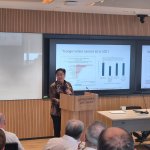
Saya kasih satu lagi slide paparan saya di PKU, Beijing. Semoga pemerintah bisa introspeksi. It's clear that the public and the government are reading from different agendas.

Justru semakin bersikeras tanpa merevisi skema MBG, approval beliau malah makin drop. Mending diubah skemanya menjadi lebih targeted, bukan kayak sekarang bersifat universal dan sangat costly. Akibatnya banyak program lain yg lebih dibutuhkan rakyat yg jadi trade-offnya. Saya udah jelaskan pas diwawancara Reuters di reuters.com/world/asia-pacif…

IG @burhanuddinmuhtadi retweeted
Justru semakin bersikeras tanpa merevisi skema MBG, approval beliau malah makin drop. Mending diubah skemanya menjadi lebih targeted, bukan kayak sekarang bersifat universal dan sangat costly. Akibatnya banyak program lain yg lebih dibutuhkan rakyat yg jadi trade-offnya. Saya udah jelaskan pas diwawancara Reuters di reuters.com/world/asia-pacif…