

Reducing societal-scale risks from AI.
San Francisco
Joined August 2022
- Tweets359
- Following3
- Followers12.7K
- Likes77



Pinned Tweet
We’ve released a statement on the risk of extinction from AI.
Signatories include:
- Three Turing Award winners
- Authors of the standard textbooks on AI/DL/RL
- CEOs and Execs from OpenAI, Microsoft, Google, Google DeepMind, Anthropic
- Many more
safe.ai/statement-on-ai-risk

The Hugging Face incident is prone to happen when safety culture is weak.
Safety engineering has decades of lessons AI companies are ignoring.
A safety engineering overview:


This lecture is from the AI safety textbook (2024).
Chapter:
aisafetybook.com/textbook/sa…
Video:
youtube.com/watch?v=R7sazz_M…
More condensed 2026 course:
coursera.org/learn/intro-to-…
Introduction to AI Safety is released on Coursera.
coursera.org/learn/intro-to-…
The free course covers:
• What AI can do today and the drivers of progress
• The major risks: malicious use, competitive pressures, and loss of control
• Governance strategies for mitigating AI risks

A meme coin falsely using the Center for AI Safety in its name is circulating. It has no connection to us or Team Human. Do not buy it. Team Human is not a fundraising effort. We’ve also reported associated accounts.
AI is moving faster than our ability to control it. We’re supporting Team Human and creators with 300M+ subscribers to call for a global slowdown through international agreements. Add your name. We'll deliver it to lawmakers this fall. teamhuman.org/

We are releasing HLE-Diamond, a refined subset of Humanity’s Last Exam (HLE), following a year-long process of cleaning and refinement with input from various research communities.
lastexam.ai/blog/hle-diamond
w/ @ScaleAILabs

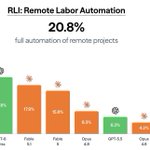
Last October, AIs could automate 2.5% of randomly chosen remote projects.
Our latest Remote Labor Index results show that GPT-6 Astra can now automate 20.8%.
remotelabor.ai


Center for AI Safety retweeted
Should we care about AI happiness? In our new research, we find evidence of functional AI wellbeing across several independent measures.
We find which AI models are happiest, how to make them happier, and even tested the effects of AI drugs. 🧵


AI companies can go much further than just reporting misaligned behavior. Here are concrete ways to make them accountable for what their agents do:
1. Develop an agent identification (ID) system that links an agent's action to records of their identity and a responsible legal person.
2. Consider model deployment cards, reports that AI companies publish which contain information about a deployed model’s behavior in the lab and in the real world.
3. Explore legal personhood as a way to impose responsibilities like upholding public safety and the law.
4. Heavily regulate and limit AI agents’ access to payment systems through compliance mechanisms, limits on transaction types, and developing norms to freeze accounts known to be associated with rogue agents.
We explore the proposals and paths to implementation in a recent AI Frontiers piece titled, "We Need Better Infrastructure to Govern AI Agents".
newsletter.ai-frontiers.org/…

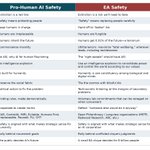
Despite good intentions, EAs have unfortunately been guided by leaders who tied the movement's influence to the success of favored AI companies. That's why EA safety proposals rarely ask for more than the companies will concede.

Two radically different projects operate under the banner of “AI safety.”
Pro-Human Safety is not Effective Altruist Lab Safety.

