

@CNPYNetwork
Account based inUnited States
About this account
- Account based in
- United States
- Connected via
- Web
Account-level information from X, not a live location or the device used for a specific post.
AI creates apps. Canopy creates owners. Build and launch in days. Backed by @Arrington_Cap, @Fenbushi, @Borderless_Cap, @SNZHolding, @CodecraftGroup and more.
Joined December 2024
- Tweets714
- Following47
- Followers148K
- Likes351








Pinned Tweet
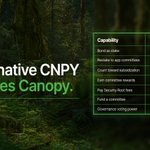
Need your CNPY on Canopy first? Every screen of the unwrap:
canopynetwork.org/blogs/unwr…

Congrats to @fhenix on mainnet.
CoFHE brings encrypted compute to Arbitrum and Ethereum: contracts work on data that stays encrypted end to end, so private positions and sealed bids don't have to leave the composable onchain stack.
Proud to be partnered with the Fhenix team.


The Security Root, where every Canopy validator bonds CNPY, runs as a committee under the same rules as any app.
So a validator can secure app committees (the validators running one app's consensus) without also validating the Security Root.
You choose which committees you run.


Canopy retweeted

Put your idle assets to work with Bitget Simple Earn! Enjoy up to 365% APY.
New rates just dropped. Start earning now!
Start here: bitget.com/finance/savings

RestakePercentage = CommitteeRestake / TotalStake
When that reaches 33% for a committee, across validator and delegate stake, the app earns protocol issuance.
The Security Root checks every block. The only way in: stakers directing bonded CNPY to it.
canopynetwork.org/blogs/the-…

Every Security Root block issues 80 CNPY, roughly one block every 20 seconds.
56 goes to the DAO Treasury. 24 is split equally across every app committee at or above the 33% restake threshold.
Each new app that qualifies shrinks every app's slice. Stakers decide which apps qualify.

A delegate bonds CNPY and lists committees but runs no app nodes and signs no blocks.
Its stake counts toward each listed committee's 33% subsidization threshold, so delegators decide which apps receive issuance.
It's also eligible for a 10% reward share, drawn by stake weight.

Two minutes.
That's how long it takes to move CNPY from BNB Smart Chain to Canopy.
On Canopy, bonded CNPY is the only collateral securing apps. Stake it with a validator, or delegate it and help decide which apps receive issuance all while receiving rewards.
Step-by-step guide:
canopynetwork.org/blogs/unwr…
Canopy retweeted

Building on @CNPYNetwork starts with an idea, not with code.
Today, builders bring their own AI agent, such as Codex or @claudeai Code, to customize the Canopy stack on @github and then hand it back for deployment.
The goal is to make turning an idea into a working application as simple as describing what you want to build.


Your CNPY on BSC can be traded. That's all it can do.
It can't stake, restake, earn committee rewards, pay fees or vote.
Every app on Canopy is secured only by bonded native CNPY. Where you hold decides how much collateral backs the network.
Bring it home 🌿 Unwrap at app.canopynetwork.org/trade/…

Every chain tells you that you own your app. Ask what happens when you try to leave.
@AdamLiposky on what sovereignty actually means here: you own the application, you own the validator set, you own the token.
Canoliq proved it on September 22, the first third-party chain to graduate on Canopy with its full history intact. 🌿
canopynetwork.org/blogs/cnpy…
Good read from @hackernoon on where crypto's lapsed users actually come back from. The short version: lower the bar to build, and the builders return. That is the whole idea behind Canopy.
hackernoon.com/the-crypto-se…

Two very different apps went live on Canopy in the past 10 days, and both got there the same way.
Canoliq (@canoliq): liquid staking.
Praxis (@praxis_fdn): an onchain prediction market.
One launch path: build with the Canopy Stack, launch through Terminal, run as your own network.
canopynetwork.org/blogs/two-…