

Popular science blog about the flora and natural history of South Africa's Cape Floristic Region and beyond
Cape Town, South Africa
Joined April 2016
- Tweets190
- Following590
- Followers823
- Likes1.1K




Cape Town Botanist retweeted

163 taxa of #Aloe #Asphodelaceae occur in #Madagascar, all are endemics, which makes #Madagascar the richest country in the world for Aloes @KewGardens @TeamKMCC

Cape Town Botanist retweeted

Microhabitats in #OverbergRenosterveld: The #Renosterveld of South Africa’s #Overberg region is one of the most species diverse Mediterranean type shrublands: overbergrenosterveld.org.za/… @CTBotanist @BotSocSA @BotsocSOverb


#Serruria aemula (Proteaceae): Endemic to the #CapeFlats and thought to have only around 1000 plants remaining in the wild. #CriticallyEndangered on the Red List. Photo: Tony Rebelo ispotnature.org/node/557907 #PlantProfiles #ThreatenedSpecies

Cape Town Botanist retweeted
We tell all about the extraordinary mass flowering of Brunsvigia bosmaniae that took place this April in the small #Namaqualand town of #Nieuwoudtville. Read on to find out more https://teapaw.org/t.co/SggbK61ZTn #BotSocSA #BotSocBlog


#Babiana villosula (#Iridaceae): Distributed from #Malmesbury to #GordonsBay growing in lowland seasonally moist areas. It is known from just seven localities and is #Vulnerable on the Red List. #CapeFlora #Geophytes #ThreatenedSpecies

Jordaniella anemonifolia (Aizoaceae): Originally discovered in coastal dunes around #Hermanaus in 1924. No further populations were identified until it was found in the Macassar and since lost to development. #Extinct in the wild. Photo: Alice Notten #PlantProfiles #CapeFlora

#Hessea mathewsii (#Amaryllidaceae) Grows in damp depressions adjacent to granite outcrops between Vredenburg and Langebaan on the #WestCoast. It is known from only three fragmented subpopulations and is threatened by urban development. Red Listed as #CriticallyEndangered.

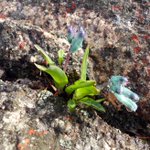
Water droplets on one of our favourite geophytes #Lachenalia viridflora (Hyacynthaceae). It grows in damp cracks in granite boulders and has just two fragmented subpopulations at its #WestCoast home. #CriticallyEndangered on the Red List. #CapeFlora #Geophytes #Strandveld

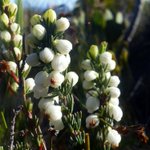
#Erica grisbrookii (Ericaceae): Distributed from #Stanford to #Bredasdorp in the #Overberg on rocky outcrops. It was named by Guthrie and Bolus after Charles Grisbrook (1843-1902) who discovered this species. #PlantProfiles #CapeFlora #SouthAfrica

#Microloma tenuifolium is also known as the Wax Creeper. It is found from Gifberg to the #CapePeninsula and east to Grahamstown. where it grows on sandy or loamy soils derived from granite or shale. This species is pollinated by sunbirds. #CapeFlora #Fynbos #Renosterveld

Hessea cinnamomea (Amaryllidaceae) is distributed from the #CapePeninsula to the #Swartland in seasonally waterlogged lowland fynbos. Endangered on the Red List due to urbanisation and habitat loss for agriculture. Photo by Clifford Dorse #CapeFlora #Geophytes

#Protea neriifolia: Distributed from #CapeTown eastwards to #PortElizabeth, growing on sandstone derived soils. This species was first discovered in 1597 and illustrated in 1605, making it the first Protea to be mentioned in the botanical literature. #Proteas #CapeFlora

#Haemanthus pubescens subsp pubescens: This species was first collected from the #Cape by Francis Masson who introduced it to @kewgardens in the 1770s. It was later described by Linnaeus in 1781. Distribution from #Graafwater to the #CapePeninsula #Geophytes #CapeFlora

#Erica retorta: Also known as the Bottle Heath. Common on dry mountain slopes at #BettysBay and #Kleinmond in the #Overberg. The species epithet retorta means twisted or bent back in Latin, referring to the leaf shape. #CapeFlora #Fynbos

#Gladiolus brevifolius (#Iridaceae): Common on shale derived soils from #Clanwilliam to #Bredasdorp. Pollinated by anthophorid bees but populations on the #CapePeninsula have also been visited by the fly Psilodena valida #PlantProfiles #Geophytes
