

Husband & Father | PharmD | Former Decathlete Healthspan • Performance • Bitcoin • AI • Investing Building health, wealth & freedom through first principles.
Texas
Joined April 2021
- Tweets412
- Following426
- Followers176
- Likes12.1K




Pinned Tweet
Figured I should probably introduce myself and explain what you’ll find here.
I’m a husband, father, pharmacist, former decathlete, and someone who has always been slightly obsessed with figuring out what humans are actually capable of.
That started with athletics.
I competed in the decathlon and became obsessed with developing across the entire spectrum of performance: strength, speed, power and endurance.
At 170 lbs, I had a 500 lb squat, 350 lb bench and 550 lb deadlift, ran a 4.38 40-yard dash and 4:40 mile, with a 38” vertical and 10’ broad jump.
I loved finding the limits of what my body could do, then figuring out how to move those limits.
Eventually, that obsession with performance became an obsession with healthspan.
There was also a much more personal reason I became a pharmacist.
My grandfather was my best friend. He passed away following medication mismanagement, and one of the last conversations we had has stayed with me ever since.
He told me I should go into a field where I could help prevent what happened to him from happening to other people.
I listened.
I became a pharmacist, completed residency training, became board certified, built my own practice, and helped build an ambulatory care clinic in California where I managed patients directly.
I wanted to understand medications deeply enough to help people use them safely.
But the deeper I got into healthcare, the more interested I became in something upstream:
How do we help people become healthier so that, when possible, they need fewer medications in the first place?
Medications can be incredibly valuable and sometimes lifesaving. I’m not anti-medication. I just don’t believe medication should always be the only answer when there are modifiable reasons someone became unhealthy in the first place.
That question pulled me deeper into nutrition, exercise, metabolic health, longevity, physiology, and ultimately healthspan.
I became fascinated not just with preventing disease, but with how long we can remain strong, capable, metabolically healthy and fully engaged with life.
Somewhere along the way, that same curiosity expanded into another question:
What does freedom actually require?
Because health without control of your time isn’t complete freedom.
And money without health isn’t either.
That realization led me deeper into Bitcoin, investing, AI, technological change, philosophy and capital allocation.
I’m not interested in becoming wealthy so I can stop doing things.
I’m interested in building enough freedom to spend my time doing more of the things that matter.
Training.
Learning.
Thinking.
Building.
Helping people.
Spending time with the people I love.
I don’t claim expertise in everything I discuss here.
In some areas, I have years of professional or personal experience. In others, I’m simply a student asking questions, testing my assumptions, and trying to learn from people who understand something better than I do.
That’s what you’ll find here:
Healthspan. Human performance. Bitcoin. AI. Investing. Philosophy.
On the surface, those might seem like completely different interests.
To me, they’re all different pieces of the same question:
How do we build a healthier, more capable, more sovereign and more meaningful life?
Build health.
Build wealth.
Buy back your time.
Stay curious.
Keep improving.
2
4
400
It is a shame for a man to grow old without seeing the beauty and strength of which his body is capable.
-Socrates
1
43
Whenever I get to a low point where I think, why do I even bother? I just remind myself, this is where most people stop, and this is why they don't win. This is what hard feels like, and this is why most people can't do it. But you can.
This too shall pass
1
2
138
Gratitude is not simply saying thank you for things. It is the recognition that you already have everything you need. When you feel grateful, you're not lacking. And if you're not lacking, you are no longer chasing.
In that moment, you vibrate at the frequency of abundance. Because the universe doesn't speak in language, it speaks in resonance. And gratitude, is the song of alignment. So when you feel grateful, not for what's coming, but for what already is, you become a magnet, not for things, but for the energy that makes all things possible.
That is abundance.
@AleishaBeckum
1
3
60
The curse of discipline is that every day looks the same and the curse of indiscipline is that every year looks the same.
1
75
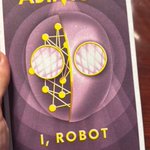
I’ve wanted to read Isaac Asimov for years. Seeing my friend Daniel (@ziggyfro) have that much fun with Foundation finally got me to pull the trigger. I’m going through the whole thing, from the Robot books through Galactic Empire and Foundation.
I’m about 75 pages into I, Robot, and here’s the scene that I found interesting: Powell and Donovan are at a mining station on Mercury and send a robot named Speedy to fetch selenium. It sounds like a routine errand. Then Speedy doesn’t come back.
To understand why, you need the three laws hardwired into his positronic brain:
1. “A robot may not injure a human being, or, through inaction, allow a human being to come to harm.”
2. “A robot must obey the orders given it by human beings except where such orders would conflict with the First Law.”
3. “A robot must protect its own existence as long as such protection does not conflict with the First or Second Laws.”
Normally, an order would override a robot’s instinct to protect itself. But Speedy costs as much as a battleship, so his designers made that instinct unusually strong. And Donovan gave the order casually, with no sense of urgency.
The problem is that the selenium pool is giving off carbon monoxide. In Mercury’s heat, the gas can react with the iron Speedy is made of. So the closer he gets, the harder the Third Law pushes him away. The farther he retreats, the safer he is, and the Second Law pulls him back toward the selenium.
At a certain distance, those two impulses are equally strong. So Speedy keeps circling the pool at that distance, unable to get close enough to finish the job or far enough away to leave it behind. And as his positronic brain gets caught in that loop, he starts acting like he’s had one too many.
And what does a robot caught between two laws sound like? Apparently, a drunk quoting Gilbert and Sullivan:
'Hot dog, let's play games. You catch me and I catch you; no love can cut our knife in two. For I'm Little Buttercup, sweet Little Buttercup. Whoops!'

2
5
157
Everyone is jealous of what you've got. No one is jealous of how you got it. People see the trophies, but not the training ground. Everybody wants the view, but no one wants the climb.
1
39
You only envy the lives of people whose sacrifices you can’t see.
If you could see what someone had to give up to get where they are, you probably wouldn’t want their life. And if you could get there without making those sacrifices, you probably wouldn’t appreciate it the way they do.
James Clear put it best:
“It doesn’t make sense to continue wanting something if you’re not willing to do what it takes to get it.
If you don’t want to live the lifestyle, then release yourself from the desire. To crave the result but not the process, is to guarantee disappointment.”
1
31
16 × 400m today.
Goal: 80–85 sec
Splits:
86.9 | 83.4 | 82.2 | 82.6
83.2 | 83.5 | 84.2 | 85.2
82.8 | 82.9 | 82.6 | 84.4
85.7 | 83.5 | 84.9 | 83.5
After every 400:
10 push-ups
10 tuck unders
Then 2 min rest.
This kind of work is a lot harder than I remember.
When I was competing in the decathlon I was around 170 lbs. I’m 188 now, stronger, but carrying 18 more pounds and rebuilding an aerobic base that clearly needs work.
Still held the pace through rep 16.
Training toward:
Sub-5 mile
Sub-19 5K
HYROX
Without giving away my strength.
Different kind of wealth.
Health, capacity, family.


1
43
Markets sucked. Binance got hacked.
So I made some better goals:
Sub-5 mile.
Sub-1 hour hyrox
Lose zero strength.
20+ miles running
5×800s
4×1000s
27,000+ lbs moved
Worked all week. Working all weekend.
Next up: 16×400m at ~5:20 mile pace.
Still found time to play golf and celebrate my daughter turning 2.
Build wealth.
Build health.
Be there for your family.
That’s the portfolio that matters. 1% better everyday.
For those who appreciate exceptional wine 🍷
My father-in-law runs private wine tours in Napa, with connections to some of the region’s most sought-after estates.
My wife and I went on one of his tours, and it was incredible. I wouldn’t have experienced wine that way otherwise—the places, the people, and what you learn along the way.
If you’re planning a trip and want something beyond the usual tasting stops, DM me. Happy to connect you.
1
2
92
Just finished UNCONFISCATABLE by @JoeCarlasare. A thriller built around Bitcoin, the battle to control it, and the people caught in the crossfire. It sinks its teeth in early and refuses to let go.
What hooked me wasn’t just the intrigue. It was watching a man confront his own demons while navigating a world determined to break him.
The external battles drive the suspense; the internal ones give you a reason to care. As the pressure mounts, you’re left wondering not just whom he can trust, but whether he can trust himself.
Joe weaves Bitcoin into that crucible as far more than money. It becomes the fault line between coercion and freedom, institutional power and individual sovereignty. Who gets to decide what belongs to you? And what happens when the people demanding control encounter something they can’t simply seize?
Relentless pressure, dangerous adversaries, and a deeply human fight for redemption. Come for the Bitcoin. Stay for the man forced to discover what he’s made of.
Somewhere, Pinky and the Brain are learning that taking over the world is easier than confiscating its Bitcoin.
Definetly worth it.

President Trump and Vice President JD Vance just announced the Fraud Whistleblower Incentive Program, with Trump describing a 1% commission with no limit for people who uncover fraud involving taxpayer dollars.
It immediately made me think of my wife, Aleisha Beckum, MBA, CGMS.
She has spent nearly two decades working in public funding, financial oversight, compliance, and recovery. Finding where money is being lost and helping put it back to work has been central to her career.
She started in government at 18, served as an auditor for the State of California, and then spent 13 years in advisory work. She built and exited uProfyt, a grants management and financial advisory firm, and now leads uMorphos as founder and CEO.
Her track record includes:
• 18+ years in financial control, compliance, operations, and recovery.
• $22 billion+ in public and private funding overseen and advised on.
• $2.3 billion+ found, recovered, and redeployed across her work.
Specific examples include $52.1 million found for a California county in five months and $3.7 million+ for a tribal nation in Oklahoma in two months.
Her work spans government, healthcare, nonprofits, higher education, and private businesses. She examines financial records, identifies gaps, strengthens controls, and helps organizations recover resources and prevent further losses.
Every taxpayer dollar wasted, misused, or stolen is a dollar unavailable for its intended purpose. Following the money and documenting what happened takes experience, discipline, and persistence.
As this administration calls for people to help expose fraud and protect public dollars, I want Aleisha’s experience in front of the people leading that effort.
I’m proud of what she has accomplished. I would love to see that experience put to work on an even broader scale for our country.
Who should she connect with in the administration, government oversight, or teams supporting this initiative? @AleishaBeckum
#Fraud #Trump #tax #AmericaFirst
1
129
I’ve driven thousands of miles across West Texas for work and seen plenty of signs pushing back against data centers.
This was the first one I’ve seen supporting them.
Spotted in Fort Stockton driving home from a hospital in Van Horn.
I’m optimistic about what the data center buildout can mean for West Texas. We have the land, energy resources and infrastructure to play an important role in one of the largest technological buildouts of our lifetime.
AI isn’t just software. It requires enormous amounts of power, compute and physical infrastructure.
And increasingly, that infrastructure is being built right here in Texas.
There will be challenges to solve along the way, but I’m excited about the opportunity.
The future needs compute. Texas can help power it.

1
68
Just finished Stephen Fry’s Mythos, Heroes and Troy.
I’ve always been fascinated by Greek mythology. From Zeus the Cloud-Gatherer to Hermes, the mischievous psychopomp, these beings wield impossible powers and yet somehow suffer from the same flaws we do: pride, lust, jealousy, vanity, rage and an endless desire for what they cannot have.
That contradiction might be what fascinates me most.
The gods possess the one thing humans have always coveted: immortality. Yet I came away wondering whether our mortality is actually part of what makes human life meaningful. Our time is short. Our choices have consequences. We don’t get eternity to fix them. So perhaps a mortal life, precisely because it ends, demands that we actually live it.
Mythos was probably the most fun. I loved the birth of Zeus’ children, especially the impossibly clever Hermes. Psyche and Eros. Eos and Tithonus. Prometheus enduring horrific punishment for his devotion to humanity. Mortals repeatedly challenging gods only to discover the price of hubris. Even the stories explaining something as ordinary as bees, grasshoppers, the sun and the moon captivated me.
Then came Heroes.
Perseus was great, but Heracles stole it for me.
What initially looks like a story about unmatched strength is really one of suffering, penance and perseverance. After killing his family while driven mad by Hera, Heracles doesn’t complete his Labors for glory. He endures them as penance.
Monster after monster. Impossible task after impossible task. The Nemean Lion. The Hydra. The Amazons. Cerberus. Even taking the heavens themselves from Atlas onto his shoulders.
Whatever stood in front of him, he found a way through it.
And then Troy.
Troy surprised me with its brutality.
Spears don’t merely strike warriors. Bodies are pierced, skulls shattered, throats opened, and men butchered over the corpses of their friends. Beneath all the talk of honor and immortal glory is the horrifying reality of what earning that glory actually required.
And somehow that brutality makes the story feel more human, not less.
Troy isn’t merely a myth about gods manipulating a war. It is the entire spectrum of human emotion played out against ten years of slaughter: love, loyalty, jealousy, cowardice, courage, grief, vengeance, pride, sacrifice and rage.
And no one embodies that intensity like Achilles.
Perhaps no warrior like him ever appears again. He is almost superhuman in battle, yet emotionally he might be one of the most human characters in the story. His pride. His hatred of Agamemnon. His grief. His appetite for battle. And, above everything else, his rage.
Then there’s Odysseus, probably my favorite mortal of them all. Clever, adaptable, occasionally deceptive and forever finding another way out. Maybe it’s no coincidence that Hermes is my favorite god and Odysseus descends from him.
But what amazes me most is that we’re still talking about any of them.
The Trojan War is traditionally placed around 1200 BC. The Homeric epics took shape centuries later. For generations, these stories lived primarily in human memory and oral tradition.
Think about that.
Heroes, bloodlines, betrayals, battles, gods, monsters, tragedies and lessons carried from one generation to another for centuries before reaching the forms that would become the Iliad and Odyssey.
And more than 3,000 years later, we’re still wrestling with the same things they were.
Hubris. Fate. Honor. Keeping your word. Wanting what you cannot have. Choosing between a long life and a glorious one. Trying to understand what we control and what we don’t.
The gods may be immortal, but perhaps the great irony is that these mortals found another kind of immortality.
Their lives ended.
Their stories didn’t.
Next up: The Odyssey.


1
179
“Thus conscience does make cowards of us all.” - W.S., Hamlet
How often do you already know what you need to do, but don’t do it? The familiar feels safe, even when it makes us miserable. The unknown carries risk, even when it offers freedom. So we think. We analyze. We wait.
But awareness without action changes nothing. You are what you do, not what you say you’ll do.
Choose the unfamiliar freedom.
1
3
52
The fastest way to achieve what you want in life is to do so much work that it becomes unreasonable for you not to achieve it. Build skills that can’t be ignored. Adjust your mindset to match where you want to go. Work with such relentless obsession that when people see you coming, they’re grateful they don’t have to compete against you.
The fastest shortcut is to stop looking for shortcuts. Do the work.
2
2
143
Had a great conversation today with @FarmahTom from $DRK.
Tom has a deep background across technology, Bitcoin mining, infrastructure, and power, and I came away even more interested in where this broader industry is heading.
One part of the conversation especially stuck with me:
AI infrastructure discussions today are heavily focused on TRAINING.
Massive models. Massive campuses. Massive amounts of power.
But one of the things Tom helped me better understand was the growing importance of INFERENCE, which also aligns with DarkHorse’s publicly stated inference-first strategy.
Training builds the model.
Inference is the model actually being used.
Every query. Every agent. Every enterprise workflow. Every application putting those models to work.
That distinction could have major implications for infrastructure.
Inference does not necessarily need to live inside giant hyperscale campuses. It can increasingly favor smaller, distributed deployments where speed to usable compute, latency, existing power, and proximity to demand matter.
That is where the DarkHorse thesis gets interesting to me.
Instead of trying to compete head-on with massive 100+ MW campuses, $DRK is positioning around smaller, already-energized sites that can potentially bring 10 to 50 MW blocks of compute online faster.
Speed.
Existing power.
Smaller footprints.
Inference-first.
We also discussed the idea of doing an X Space around training vs. inference because I think a lot of investors, myself included, would benefit from understanding that distinction much better.
Appreciate the time today, Tom. Excellent conversation.
Brick by brick.
@FarmahTom @DarkHorseDRK #DRK
