Independent intelligence on the Canton Network. Evidence-first.

Netherlands
Joined April 2021
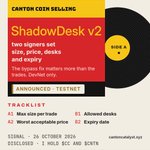
Node operators earn Canton Coin but pay many of their costs in dollars. ShadowDesk v2 is a private desk built for selling that CC. A builder posting as Saberdev put it on the Canton forum on 26 Oct. The mechanism is a mandate that two people sign on the ledger. It sets which trading desks can quote, the most that can be sold per trade, the worst acceptable price and an expiry date. An agent sells only inside those limits. Desks quote privately, the best price wins by a fixed rule, and both sides settle in one transaction or not at all. The rest is announced by the team. They say version one let the agent skip the mandate, and that they found the bypass, fixed it and now test for it four ways. They also say two competitive trades settled on DevNet, Canton's developer test network. I'd give the bypass admission more weight than the trades. A tool like this only earns its place if the network, not the agent, holds the limit. If you hold $CC, this doesn't change how much operators sell. It changes how, with size and price caps written down before an order goes out. For a validator's treasury team, a co-signed mandate with a desk allowlist works like a written sales policy that the ledger enforces, which is easier to show an auditor than a script holding the keys. The limits are plain. It's DevNet, no real money moves and the CC to stablecoin leg isn't built yet. Policy first, then the sale. I hold $CC and $CNTN. If you run a node, who converts your CC today, and what limits do they work under?
16
Does a merged proposal mean an approved one? The CIP-0104 amendment, the proposal that pays apps from the traffic they burn, was merged into the CIPs repository today, 26 Oct. On 23 Oct it was an open pull request. Per CIP-0104's merged text on GitHub, the cap is set at 79 cents of CC minted per $1 of burn. Its header still reads Proposed Amendment, with the Approved field blank, so I'd read the merge as settled text, not adoption. If you hold $CC, the cap is now the written baseline. An app's finance team can model on it, but not book it. I hold $CC and $CNTN. Have the operators who govern the network scheduled their vote on it?
30
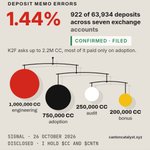
K2F Labs has filed a Canton Development Fund proposal for a Deposit Gateway. Across seven exchange treasury accounts on Canton from 9 April to 9 July, the proposal counts 922 of 63,934 deposits, or 1.44%, arriving with a missing or malformed memo. A memo tells an exchange or custodian which customer to credit. When it's wrong, someone checks by hand. K2F puts that at 461 support hours and $23,050 over three months. The gateway is open-source software each receiver runs beside its own validator (an operator that checks the transactions it is part of). It checks the memo, the amount and the sender's rate, then accepts, denies or holds the deposit. The ask is 1,000,000 CC for engineering, up to 750,000 CC tied to outside receivers running it in production for at least 30 days, up to 250,000 CC for an independent audit and a 200,000 CC early-delivery bonus. That's 2.2 million CC if every part is earned. The filing is confirmed on GitHub as a draft with no champion yet. The adoption tranche is the best part, since most of the upside is paid only if exchanges run it. If you hold $CC, this is Dev Fund spend, and any amount not earned goes back to the fund. For a custodian's operations team, the setting to check is the hold when the decision check times out, since that decides whether this saves hours or builds a new queue. The other reading is that the cost being fixed is K2F's own estimate, from seven accounts. Pay for use, not for code. I hold $CC and $CNTN. If you take deposits on Canton, what share of your support tickets are memo errors?
26
TSV LLC revised the notice for its Tokenized Stock Venue on 23 Oct, now version 1.2. It's filed under an SEC exemption, Release No. 34-106402, and it describes a stock venue it plans to run on @CantonNetwork. Confirmed in the notice itself, there's a 0.30% baseline swap fee, with 0.20% to liquidity providers and 0.10% to TSV. Pools start on a Uniswap v3-style design, there's no venue-wide price circuit breaker, and USDC from Circle and SBC from Brale are the cash side. TSV says it hasn't commenced operations. The line I'd circle is about the ledger. The notice calls Canton a public, permissionless ledger and says the permissioning happens in the app, through onchain credentials, allowlists and transfer restrictions. Pools are held by contract-controlled parties, accounts no single firm runs, and a confirmation group of Obsidian, 4M Group and M1X Global governs them at launch. If you hold $CC, that framing is what to keep. A securities venue telling the SEC that the base layer is open and the rules sit in the app is the case Canton has been making to regulated firms. For a broker's compliance desk, I'd look at the confirmers first. Obsidian is TSV's own affiliate, so one of the three seats sits inside the operator's group. The limit is that this is TSV's filing, not an SEC finding, and production contract IDs haven't been deployed yet. Open ledger, rules in the app. I hold $CC and $CNTN. Would your desk accept a confirmation group where one of three seats belongs to the operator?
1
47
What does Canton burn when you buy traffic on the Global Synchronizer, the shared ordering service, and does that burn cover every synchronizer? The tokenomics page says those fees are denominated in USD and paid by burning Canton Coin. The sending validator is charged. Recipients are not. The latest OpenMiningRound the public Scan API returned is round 118394. trafficPrice is 60.0. extraTrafficPrice is 60.0, a USD per MB price. amuletPrice, USD per CC, is 0.11294. CIP-0129, a Canton Improvement Proposal, is status Proposed, created 2026-10-07. It says traffic on a dedicated synchronizer, an ordering service apart from the shared one, does not burn anything. The file puts the list price at $60/MB. Super Validators, the operators that jointly run the shared network, can change those parameters with a 2/3 vote. That widening is proposed, not live. The same file says those operators cannot see traffic on synchronizers they do not operate, and that at launch the reports rely on the operator being honest. The scan payload lists 13 sv_node_states entries. The foundation version list names the same 13. Tradeweb-Markets-1 is on 0.8.4. The homepage prints 62 above Super Validator Nodes and credits The Tie. I am not treating 62 as this scan count. I hold $CC and $CNTN. Disclosure at cantoncatalyst.xyz/disclosur… On the next Scan round, is trafficPrice still 60.0?
3
129
Canton Coin isn't handed out on a timer. Minting starts from something the docs call an activity record, and once that clicked for me the rest of the tokenomics got easier to follow. An activity record names a party that did something useful for the network, and it carries a weight, its relative share of that round's minting. Recording the activity and minting the coin are separate steps. Per the Canton Coin tokenomics page, they happen in a cycle called a round, with five phases. Fee values are written to the ledger. Activity records are created. The network works out how much CC each unit of weight is worth. Record owners mint in proportion to their weight. Then the round closes. A new round starts every 10 minutes by default, and several run at once in different phases. Three groups earn this way. Super Validators for running the infrastructure, validators in proportion to the fees they burn, and application providers, but only for featured apps. Unfeatured apps get nothing. For featured apps, the docs describe two mechanisms. The older one has the app's code create activity markers. The newer one, CIP-0104, computes rewards off-ledger from the traffic an app's confirmed transactions actually burned, with no code changes, on networks where the Super Validators have voted it in. Burn on one side, mint tied to work on the other. Which part would you watch? For transparency, I hold $CC and $CNTN. docs.canton.network/overview…
4
125
Greywick Digital wants Canton Coin rewards on its Litecoin-backed token before the token has any MainNet history. Its Featured Asset application, filed 24 Oct, targets a launch around 1 November, two months ahead of the end-2026 date it gave on 1 Oct. Featured status matters because @CantonNetwork pays Canton Coin rewards on qualifying transfers and trades through approved apps. Greywick wants cLTC activity to count, and it asks to skip the usual 14 days of MainNet history, since it hasn't launched. Greywick's own site describes one cLTC for each LTC held in a multi-signature reserve, with supply capped at the attested reserve. CantonNews reports the only test ran on DevNet with 0.5 LTC from an isolated test chain, and that there's been no independent audit yet of cLTC's Canton contracts. I'd want the reserve addresses published and checked before the 14-day rule is waived for anyone. If you hold $CC, rewards are new coins minted against activity, so the activity should be real backing moving, not a test balance. For a desk weighing cLTC as collateral, Greywick's 1 Oct post made go-live conditional on publishing reserve addresses, the attestation format and the launch sequence, so those three documents are the diligence file. The counter is that an exception request is only a request, and reviewers can refuse it or wait. Backing first, bonuses second. I hold $CC and $CNTN. Will Greywick publish its reserve addresses before the Featured Asset review closes?
1
3
183
Canton conditions, 25 Oct 2026. Round 118,951 closed. Dollar burn 1.37M USD, 0.93x the 7-day average; 13.6M CC. Mint 21.3M CC, 78% of the ceiling. Burn to mint 0.64. Validators 833 (-13 on the week). Dollar burn is 7 percent below its 7-day average, and its 30-day average is 5 percent above the 30 days before. Burn moves when traffic is bought and fees are paid. Fees are paid at the median of 13 Super Validator (SV) price votes; today 10 of 13 sit on one price and all are within 0.13%. The latest round's rate is 0.1% above the market. An SV vote on a featured app grant closes 14:25 Berlin, with 12 of 13 votes cast. A vote needs 9 of 13 SVs to pass. The largest SV takes 50% of SV rewards, shared with 57 beneficiaries. That's a share of rewards, not of votes; each SV votes once. Watch the SV vote that closes in 5h. I hold $CC. What do you check first when you read the network's day?
1
3
88
Why this number moves, in about a minute. NYK 05, who pays for the network to agree. cantoncatalyst.xyz/nyk Round data: CantonScan (cantonscan.com)
26
The Canton Foundation is recommending that DFNS's Super Validator minting weight go from 0.6 to zero, and that Taurus drop from 3.0 to 1.8. The notice went to Super Validators on 21 Oct, after that day's Tokenomics Committee meeting. It cites CIP-0105, the Super Validator Locking and Long-Term Commitment Framework. Per the notice, DFNS did not comply with the locking and unlocking requirements, so the committee proposes removing all of its remaining active weight. Taurus does not currently meet the Tier 1 locking requirements, so it would return to Tier 2, which carries 60% of the reward weight. Its escrowed weight would stay at 2.0. Weight sets a relative share of Super Validator rewards, not a fixed number of coins. The notice asks operators to start the governance votes that would put these changes on MainNet. Until those votes pass, the weights have not changed. A separate vote is already open. CIP-0123 made @a16z a weight 10 Super Validator, and a MainNet vote would raise the MPC-Holding-Inc node that carries that weight from 55 to 65. That vote closes 27 Oct at 07:20 UTC. I hold $CC and $CNTN. Disclosure at cantoncatalyst.xyz/disclosur… If weight now follows locking, which operator gets checked next?
1
7
277
A Canton Forum post from 23 Oct, by Andrii_Semibratov, makes a point every Daml team should test. @CantonNetwork enforces whatever visibility your design sets up, and it doesn't check that design against your business rules. The post counts three ways a party learns about a contract. Signatories and observers see it and every later event. Divulgence lets a party that witnessed a transaction which fetched the contract see it too, a view with no right to use it. Explicit disclosure hands the contract over off-ledger, so the recipient can use it while it's active. The example is a bank lending to Bob, with a KYC provider holding Bob's identity record. If the bank's Accept choice fetches that record, everyone who witnesses Accept sees the identity data. The fix is to pass a yes or no attestation instead. Archiving doesn't recall copies already sent, and divulged copies stay in node storage until pruning. Privacy on Canton is a property of each app's design, and I'd audit it app by app. If you hold $CC, the bank pitch rests on that privacy, so one leaky app becomes the whole network's headline. For a bank's compliance team, the question moves from whether Canton is private to who reviewed the observer lists and fetches in the app it uses. All of this is confirmed from the post itself. The counter is that it's one community post, not an incident, and each leak point has a fix. The ledger keeps your secrets as well as you wrote them down. I hold $CC and $CNTN. Does your security review check which choices fetch contracts a counterparty shouldn't see?
3
131
HackCanton Season 3 has its winners. According to CantonNews on 24 Oct, AppsFactory's results put @Canborsa_DEX's Canborsa Lending first with $2,000, then Exodus with $1,250 and Tavryn with $750. Four track winners took $500 each, per CantonNews. The sponsor bounties were paid in Canton Coin (CC). BitSafe gave 30,000 CC to Umbra, 12,000 to CompressRail, 6,000 to Indivisa and 2,000 to Canborsa Lending. Grofty's wallet bounty paid Talang 5,000, GroftPay 3,000 and Collat.Trade 2,000. Per CantonNews, that's $6,000 in cash and 60,000 CC in total, with no payment dates set. Umbra's prize has a backstory. CantonNews also reports an Umbra trade on DevNet that settled through BitSafe's co-host while Umbra's own node was down. Co-hosting means a second operator's node also carries your identity and contracts, so trades don't stop when your server does. A sponsor that pays its biggest bounty to a team already testing its product is paying for proof. If you hold $CC, Canborsa Lending is the one to follow. It lets users borrow USDCx, a dollar stablecoin, against CC or CBTC, which ties up CC if it reaches MainNet. For a bank's operations team, the co-hosting test answers an early question, which is what happens to settlement when a node fails. All of this is announced, through CantonNews. Canborsa's lending release was on DevNet, and a hackathon win doesn't confirm a MainNet launch. Prize money is small. Who pays it says more. I hold $CC and $CNTN. Does Canborsa Lending plan to take both CC and CBTC as collateral on MainNet from day one?
1
5
176
Canton conditions, 24 Oct 2026. Round 118,811 closed. Dollar burn 1.37M USD, 0.91x the 7-day average, lowest in 30 days; 13.5M CC. Mint 21.3M CC, 78% of the ceiling. Burn to mint 0.63. Validators 834 (-15 on the week). Dollar burn is 9 percent below its 7-day average, and its 30-day average is 4 percent above the 30 days before. Burn moves when traffic is bought and fees are paid. Fees are paid at the median of 13 Super Validator (SV) price votes; today 10 of 13 sit on one price and all are within 0.01%. The latest round's rate matches the market. An SV vote on a featured app grant closes 14:25 Berlin, with 12 of 13 votes cast. A vote needs 9 of 13 SVs to pass. Watch the SV vote that closes in 29h. I hold $CC. What would you add to a daily read of Canton's numbers?
1
4
182
Why this number moves, in about a minute. NYK 05, who pays for the network to agree. cantoncatalyst.xyz/nyk Round data: CantonScan (cantonscan.com)
58
The software behind Canton's Global Synchronizer is open source, and I think more people should browse it. It's called Splice. Per the Splice reference apps page in the Canton docs, the repository holds the applications that run the Global Synchronizer's infrastructure. They're both production infrastructure and reference code. The GitHub repo lists the Apache 2.0 licence. Four pieces are worth knowing. The SV App runs on Super Validator nodes, the operators that jointly run the network. It handles governance voting and proposals, synchronizer parameter updates, Canton Coin issuance and reward distribution. The Scan App is a read-only view of public network state. Validator information, coin supply data, governance proposal status and synchronizer health. The Validator App is for node operators. Onboarding, traffic management, synchronizer connections and health monitoring. The Wallet handles Canton Coin balances, transfers, payment requests and traffic purchases. The docs make a useful point for builders. You don't need to modify Splice to build on Canton, but reading it helps you understand the APIs your app will call. The tokenomics docs add one naming tip too. At the contract level, Canton Coin is called Amulet, which explains a lot of the template names you'll meet. Have you ever opened the code a network runs on before using it? docs.canton.network/sdks-too… github.com/canton-network/sp…
2
179
How much of @CantonNetwork can one company decide on its own? A 22 Oct analysis by Tunde, via CantonNews, argues that decentralization isn't all or nothing, and that the question is who holds which kind of power. Its core numbers match Canton's public Scan API this morning. There are 13 Super Validators, and a governance decision needs 9 of them. Super Validators run the Global Synchronizer, the shared service that orders Canton transactions, and they vote on network changes. Digital Asset runs 2 of the 13 node identities. Cumberland also runs 2. So Digital Asset can't pass a vote alone, and even with Cumberland that's 4 of the 9 needed. The piece also asks what happens if Digital Asset left. Open-source code and other operators give a path to keep running, it says, but running isn't the same as development and incident response. My read is that the second point matters more than the seat count. Votes are spread across 13 operators, the piece's own caveat points at the development work, and that's the dependence I'd track. If you hold $CC, the 9 of 13 threshold is the number to watch as seats are added or merged. For a bank's risk team, the question is vendor concentration, meaning how many firms could patch the synchronizer if its main developer stepped back. The counter is that 13 seats is a small set and MainNet entry is permissioned, so this is power shared among approved operators. The seats are spread out. The engineering isn't, yet. I hold $CC and $CNTN. If Digital Asset paused releases for a quarter, which Super Validator could ship one?
4
251
Temple Digital Group (@temple_ny) has signed up @tZERO to hold the license for its tokenized securities platform on @CantonNetwork. tZERO said on 22 Oct that tZERO Securities will be the registered broker-dealer and ATS operator. Implementation is pending, and launch timing will be announced separately. An ATS, or alternative trading system, is an SEC-regulated venue that matches buyers and sellers of securities without being a stock exchange, and a registered broker-dealer has to run it. tZERO Securities is one, and a FINRA member. Temple, registered with FinCEN as a money services business, gets to offer securities trading without building its own broker-dealer, the release says. Temple's side is the software, with an order book for tokenized NMS securities (exchange-listed stocks) and ETPs, settled on Canton with asset and cash moving together. Renting the license was the quick part. The release doesn't name a stock or ETP to list, so the first named security will tell us more than this agreement. If you hold $CC, a working securities market would add traffic, and Canton burns CC to pay for it, but that won't show up until launch. For a broker's compliance team, the regulated counterparty would be a FINRA member, a name its onboarding checks already handle. The counter is that Temple's $1.6B of Canton volume and its largest-platform line are its own claims, and there's no date. The license is signed and the shelf's still empty. I hold $CC and $CNTN. Which tokenized stock or ETP do you expect Temple to list first?
3
9
1
64
2,150
Canton conditions, 23 Oct 2026. Round 118,671 closed. Dollar burn 1.42M USD, 0.93x the 7-day average; 13.8M CC. Mint 21.2M CC, 77% of the ceiling. Burn to mint 0.65. Validators 833 (-25 on the week). Dollar burn is 7 percent below its 7-day average, and its 30-day average is 3 percent above the 30 days before. Burn moves when traffic is bought and fees are paid. Fees are paid at the median of 13 Super Validator (SV) price votes; today 10 of 13 sit on one price and all are within 0.67%. The latest round's rate is 0.3% above the market. Watch whether dollar burn gets back above its 7-day average by Monday. I hold $CC. Which figure here would you watch most closely this week?
1
4
205
Why this number moves, in about a minute. NYK 05, who pays for the network to agree. cantoncatalyst.xyz/nyk Round data: CantonScan (cantonscan.com)
44
Now You Know 37, two cabins, one cable. In the published design, a Canton transaction can call an EVM contract. Every validator reruns that call, and one different answer stops the whole transaction. Which EVM app would you wire in first?
1
3
136
I hold $CC and $CNTN. Narration is synthetic. The script, the claims and the sign-off are mine. cantoncatalyst.xyz/nyk
76